

Updated:
Reinstate ‘The Hate U Give’ in Budmouth Academy Classrooms
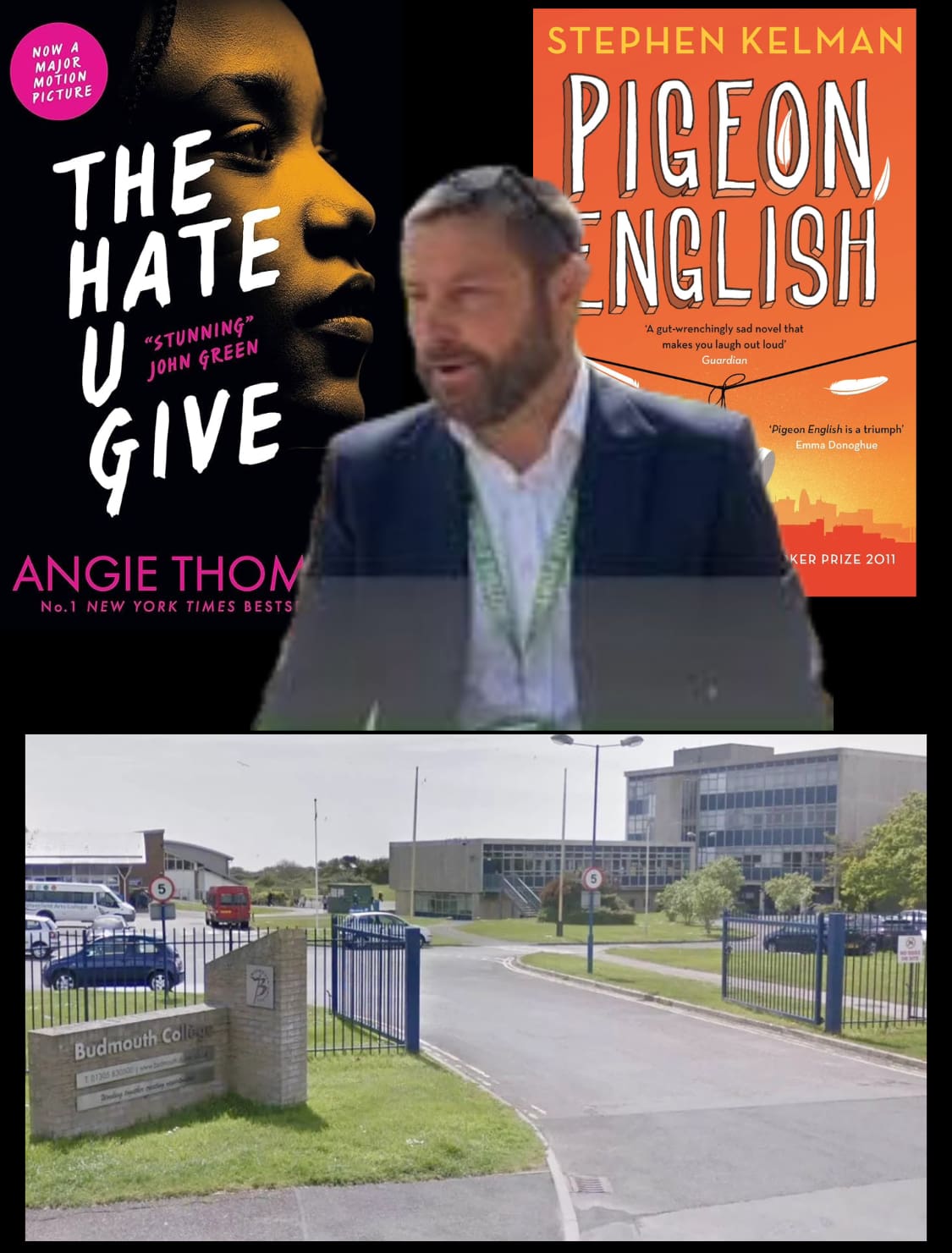
The social media post from ex Tory councillor and Chairman of Nothe Fort, James Farquharson (see below) is a potent example of the contemporary debate surrounding literature, education, and parental rights. While it raises legitimate questions about age-appropriateness and school communication, its core arguments are fundamentally flawed, misrepresent both the educational purpose of the texts and the law, and demonstrate a concerning approach to resolving sensitive issues.
Let us begin by summarising ‘The Hate U Give’ and its public reception.
Angie Thomas’s debut novel, ‘The Hate U Give’, follows sixteen-year-old Starr Carter, who navigates a double life between the poor, predominantly Black neighbourhood where she lives and the wealthy, mostly white prep school she attends. This fragile balance is shattered when she witnesses the fatal shooting of her unarmed childhood best friend, Khalil, by a white police officer. Thrust into the centre of a national controversy, Starr must overcome her fear and find her voice to speak out against the systemic racism and injustice that the tragedy exposes, all while grappling with the immense personal toll it takes on her family and community.
The novel was met with widespread critical acclaim upon its release in 2017. It was praised for its authentic, powerful, and unflinching portrayal of contemporary race relations and police brutality, told through the compelling and relatable voice of its teenage protagonist. It quickly became a major bestseller, won numerous awards including the Waterstones Children’s Book Prize, and its cultural impact was solidified when it was adapted into a successful and equally lauded film in 2018.
Public reception cemented the book’s status as a defining work of the young adult genre and a touchstone for social discussion. It was frequently championed for sparking vital conversations about race and activism, particularly among younger readers. However, its explicit themes and use of strong language also made it one of the most frequently challenged and banned books in some countries, especially the United States, highlighting the very issues of censorship and inequality that the story itself confronts.
And the second text Mr Farquharson has an issue with – ‘Pigeon English’.
Stephen Kelman’s 2011 debut novel, Pigeon English follows the story of eleven-year-old Harrison “Harri” Opoku, a Ghanaian boy who has recently immigrated to a London housing estate with his mother and sister. Told through Harri’s captivating and naïve voice, the narrative is a poignant blend of childhood innocence and brutal reality. Harri and his friend Dean become amateur detectives, embarking on a mission to find the murderer of a boy stabbed outside their apartment building, a crime Harri witnessed. This central plot is interwoven with the everyday challenges of adapting to a new culture, navigating the dangers of gang violence, and the simple, often humorous, observations of a child trying to make sense of a frighteningly complex world.
The public and critical reception of Pigeon English was overwhelmingly positive, marked by its shortlisting for the prestigious Man Booker Prize. Critics widely praised Kelman’s remarkable achievement in crafting Harri’s authentic and compelling narrative voice, which manages to be both charmingly humorous and deeply heart-wrenching. The novel was lauded for its unflinching yet sensitive portrayal of contemporary urban life, tackling weighty themes like poverty, immigration, and youth violence through the uniquely perceptive yet limited lens of its young protagonist. This approach allowed the novel to address social issues with a powerful emotional impact, avoiding didacticism and instead fostering a profound sense of empathy in the reader.
However, the reception was not without its nuanced criticisms. Some commentators questioned whether an author from outside the community could authentically represent the inner-city experience he depicted, sparking conversations about voice and representation in literature. Despite these debates, Pigeon English was celebrated as a significant and urgent novel that gave a voice to the often-unheard. It successfully bridged the gap between social commentary and literary fiction, resonating with a broad audience and establishing Kelman as a notable new talent. The novel remains a powerful and accessible exploration of lost innocence and the resilience of the human spirit in the face of adversity.
Now let us assess the response by James Farquharson to them both being taught in schools.
1. Examination of the Political in GCSE Literature
Mr Farquharson’s assertion that schools must avoid “partisan political views” misunderstands the very nature of a robust literary education. The GCSE English Literature syllabus is explicitly designed to include texts that examine social, moral, and political contexts. This is not about promoting a partisan stance but about developing critical thinking by engaging with challenging ideas.
Multiple core texts on the GCSE syllabus serve as examinations of the political: For example:
- ‘An Inspector Calls’ by J.B. Priestley (AQA, Edexcel, OCR): This is arguably the most direct examination of political ideology in the GCSE canon. Priestley, a committed socialist, uses the play as a blatant critique of capitalist greed and the irresponsible upper classes. The Inspector is a mouthpiece for collectivist responsibility (“We are members of one body. We are responsible for each other”), directly opposing the individualist, capitalist views of Birling. It is a deeply political and moralistic play taught to foster debate about social responsibility.
- ‘Macbeth’ by William Shakespeare (All Boards): This examines the politics of power, ambition, and tyranny. It explores the divine right of kings (a deeply political and religious doctrine), the consequences of regicide, and the Machiavellian pursuit of power. It is a study of the political structure of its time and the psychological corruption it engenders.
- ‘A Christmas Carol’ by Charles Dickens (AQA, Edexcel, OCR): Like Priestley, Dickens offers a searing critique of the political and economic philosophy of his day. Scrooge embodies the worst excesses of laissez-faire capitalism (“Are there no prisons? Are there no workhouses?”). The novella is a political argument for compassion, charity, and social reform, directly challenging the prevailing orthodoxies of the Victorian ruling class.
A longer list of the ‘political’ in the English GCSE syllabus going back decades:
- Plays
- Blood Brothers by Willy Russell
- The Crucible by Arthur Miller
- A Taste of Honey by Shelagh Delaney
- Chips with Everything by Arnold Wesker
- My Mother Said I Never Should by Charlotte Keatley
- Novels (Modern)
- Animal Farm by George Orwell
- Lord of the Flies by William Golding
- Of Mice and Men by John Steinbeck
- To Kill a Mockingbird by Harper Lee
- The Lord of the Flies by William Golding
- The Curious Incident of the Dog in the Night-Time by Mark Haddon
- Pigeon English by Stephen Kelman
- Never Let Me Go by Kazuo Ishiguro
- The Power and the Glory by Graham Greene
- Novels (19th Century)
- Hard Times by Charles Dickens
- Oliver Twist by Charles Dickens
- Pride and Prejudice by Jane Austen
- Jane Eyre by Charlotte Brontë
- The Strange Case of Dr Jekyll and Mr Hyde by Robert Louis Stevenson
- Poetry (From Exam Board Anthologies)
- Power & Conflict (AQA Cluster):
- ‘Ozymandias’ by Percy Bysshe Shelley
- ‘London’ by William Blake
- ‘The Prelude: Stealing the Boat’ by William Wordsworth
- ‘My Last Duchess’ by Robert Browning
- ‘The Charge of the Light Brigade’ by Alfred Lord Tennyson
- ‘Exposure’ by Wilfred Owen
- ‘Storm on the Island’ by Seamus Heaney
- ‘Bayonet Charge’ by Ted Hughes
- ‘Remains’ by Simon Armitage
- ‘War Photographer’ by Carol Ann Duffy
- ‘Tissue’ by Imtiaz Dharker
- ‘The Émigrée’ by Carol Rumens
- ‘Checking Out Me History’ by John Agard
- ‘Kamikaze’ by Beatrice Garland
- And on and on….
The inclusion of ‘The Hate U Give’ and ‘Pigeon English’ fits squarely within this tradition. They both examine the political reality of race, ethnicity and policing in a modern context, just as Dickens examined the political reality of poverty. The goal is not to indoctrinate but to illuminate a perspective and allow students to analyse, critique, and understand it.
2. Refuting the “Cultural Marxism” Claim
Mr Farquharson’s accusation that the book is “surreptitiously teaching this new form of Marxism” is a misapplication of a nebulous and politically loaded term. “Cultural Marxism” is a conspiracy theory, not a recognised critical or educational framework. Its use typically serves to dismiss any critical analysis of power structures related to race, gender, or identity by falsely linking it to a Marxist plot.
- Critical Race Theory (CRT) vs. Marxism: Farquharson conflates CRT with classical Marxism, stating both divide the world into “oppressed and oppressor.” This is a fundamental error. Classical Marxism is an economic theory focused on class conflict between the proletariat and the bourgeoisie. CRT is a legal and academic framework developed decades later that examines how laws and institutions perpetuate racial inequality. They are distinct fields of study.
- The Purpose of the Novel: ‘The Hate U Give’ is not a Marxist tract. It is a work of Young Adult fiction that gives a voice to a lived experience. Its aim is empathy, not economics. It explores the personal and social trauma of racism from the perspective of a black teenager. To claim it teaches white children they are “baddies” is a profound misreading. It invites all readers to understand systemic bias, not to feel personal guilt. A competent teacher would facilitate a discussion on these complex issues, including various perspectives on policing and justice, not force a single conclusion.
- The Law on “Balanced Presentation”: Farquharson cites a “statutory requirement” for balance. This primarily applies to the teaching of factual subjects like Politics or History, not to the study of literature. The purpose of studying a text is to understand its worldview, its context, and its artistic merits. One does not teach ‘Macbeth’ and then give “equal prominence” to a text arguing that regicide is a good idea to provide “balance.” The balance comes from the critical skills taught to analyse the text, not from teaching an “opposing” novel.
3. Throwing His Children Under the Bus: The Failure of Discretion
Mr Farquaharson could have handled this situation very differently.
Might I suggest that a responsible parent would have considered the following:
- Undermining Authority: The email’s aggressive tone (“brainwash,” “slop,” “bad writing”) guarantees defensiveness from the school. It frames the teachers not as professionals but as ideologues, making productive dialogue almost impossible. A discreet meeting, as was initially offered, would have been the appropriate forum to express concerns about language and maturity, and to understand the educational rationale behind the book’s selection.
- Handling it Discreetly: A discreet approach would have involved:
- Requesting a private meeting with the Head of English and the class teacher.
- Asking to see the scheme of work for the unit to understand how the book was being taught.
- Calmly expressing concerns about specific language or scenes and asking about the school’s policy on teaching texts with mature content.
- Discussing alternative arrangements for his children if he remained unsatisfied, such as providing an alternative text for them to study independently.
This process would have protected his children from public exposure and maintained a constructive relationship with the school.
In summary, the email demonstrates a failure to distinguish between the promotion of a political view and the examination of it, a key tenet of literary study. It weaponises misleading terminology (“Cultural Marxism”) to shut down discussion rather than engage in it. While concerns about profanity and age-appropriateness are valid and worth raising discreetly, Farquharson’s confrontational method and choice to publicise the issue suggest a performance of outrage that ultimately sacrifices his children’s privacy for the sake of a political point. He has chosen the role of a campaigner over that of a parent seeking a pragmatic solution.
James Farquharson’s Very Public Social Media Post Criticising Budmouth Academy
My initial email to Budmouth Academy Weymouth. I accepted a meeting to discuss this issue but then another very serious matter with legal implications was flagged to me that I needed to add to the meeting. I asked to make a voice recording of the meeting. They refused, so the meeting did not go ahead.
Budmouth Academy, Principal and Chair of Governors,
I’m writing to you about the novels being used to educate my daughters (currently 14 and 12 years old), who are pupils in Budmouth Academy’s Year 10 and Year 8. I’ll focus on the novel my Year 10 daughter is being taught, ‘The Hate U Give’ (THUG), but I have similar concerns about the ‘King of Nothing’, which is being taught to my other daughter in Year 8. I bought a personal copy of THUG so my comments below are based on direct knowledge of its text.
All British schools, regardless of type, have a statutory requirement not to promote partisan political views and should take steps to ensure a balanced presentation of opposing views on political issues that are brought to the attention of pupils.
THUG is centred on issues of blackness and whiteness. It is argued that the novel’s intellectual core is critical race theory. It is certainly inspired by the BLM movement. These are expressions of a highly contested political ideology. Classical Marxism’s ‘worker’ and ‘boss’ classes (oppressed and oppressor) divide the world into goodies and baddies. You are teaching my daughters that their inherited skin colour makes then baddies. That is racism. By extension, you are also casting their country as a baddie. That is damaging to their self-esteem and the functioning of society. You should not be surreptitiously teaching this new form of Marxism to my children, hidden as it is within a work of fiction. If you want to expose them to that ideology, by law, you should be clear what it is and give fair treatment and equal prominence to its counterarguments.
I understand it is your school’s policy that pupils must not swear on your estate. Why then did you think it acceptable to teach a book to children that features the word “fuck” 89 times? You are banning bad language at the same time as normalising it. That is incoherent. In addition to “fuck”, there is a range of other obscenities and words of dubious merit, which a simple flick-and-scan of the book reveal appear once on every three to four pages, e.g. “shit”, “bitch” and “nigga.” Sexualisation of characters, as well as drug use, occur regularly within the book and are implicitly normalised. You’re teaching this to a school year in which only a handful can have reached their fifteenth birthday.
Beyond words you evidently know a child ought not to use, and themes that are not age appropriate, the book’s grammar is a point-in-time colloquial construction of English found in a US city. You have very limited class time with pupils, within which your duty is to pass to them their cultural inheritance so that you send them out into the world having mastered core skills, such as the English language. With THUG, you are teaching them to replace careful expression of their thoughts in a language that billions of people understand, with a stream of bad language and a limited-use pidgin version of it.
With good teaching, children can accommodate themselves to and access the ideas contained within far better works of literature than THUG. It’s the bigotry of low expectations to impose poor ‘street’ literature on them because you assume they’ll think it’s cool. If kids want to read such slop in their own time, that’s up to their parents. Bad writing should not be taught in school.
Here is what I want you to do:
1. Stop attempting to brainwash my daughters with highly contested political ideology by hiding it within fiction – if you want them to know about it, be transparent and balance it with the counterarguments – it’s the law
2. Despite what the literary and educational establishment aver, this is a poor book – stop teaching it to my daughter, stop teaching it to the rest of the kids
3. Select books that will teach them their cultural inheritance and equip them for a successful life after school – it’s your duty
This letter will remain between you and I, as well as the mother and stepmother of my daughters (on cc), who are both in agreement with the points I have made, as long as I receive a response from you that satisfies my concerns.
I look forward to hearing from you.
Regards,
James
I do hope that the more intelligent readers will be aware that far from enlightening us about the texts and the GCSE syllabus, Mr Farquharson has sought to alienate the school and those who have literary and intellectual prowess. While those who have fallen for the cancel culture conspiracy theory may embrace his words unthinkingly, the rest of us are much more discerning.







