

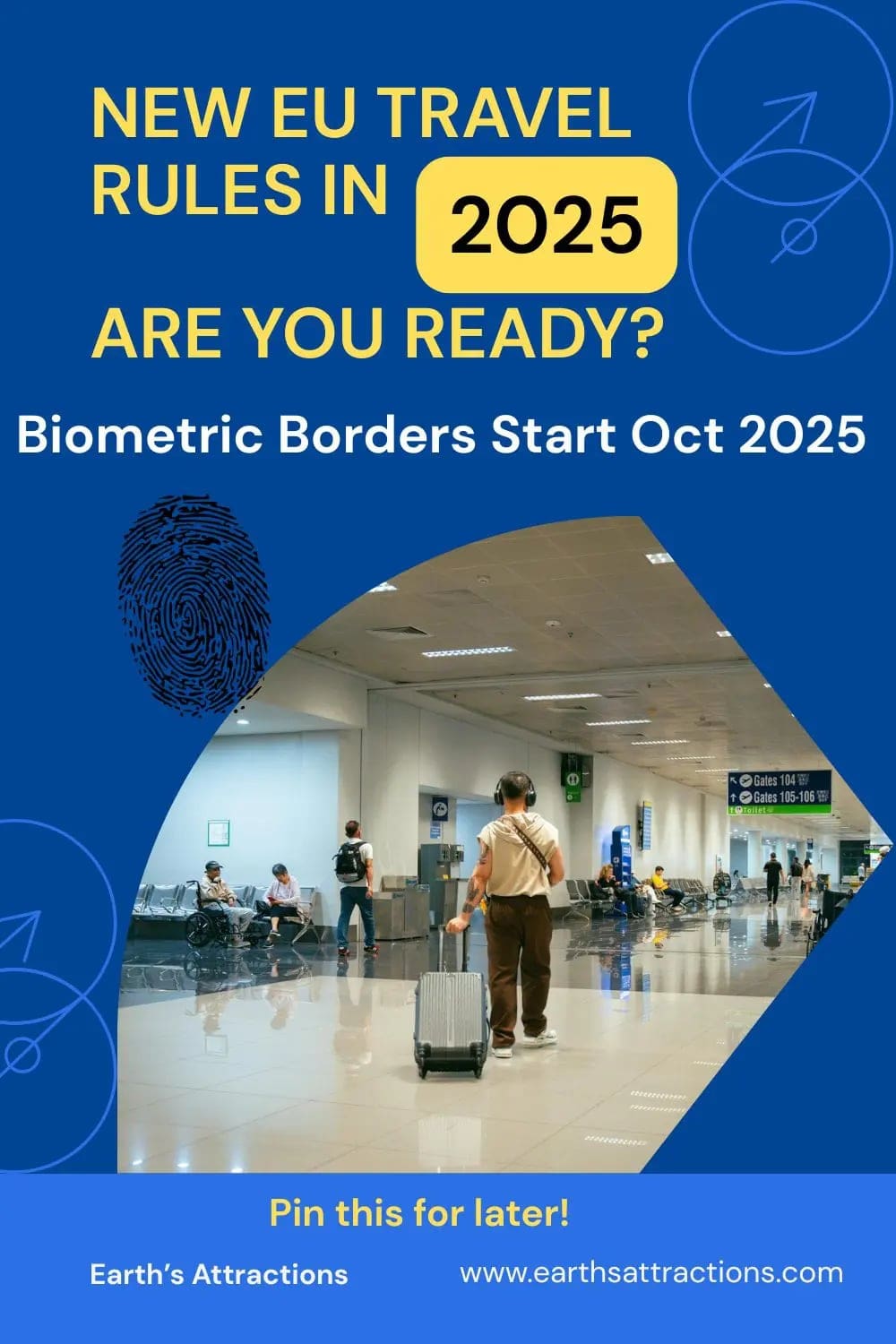
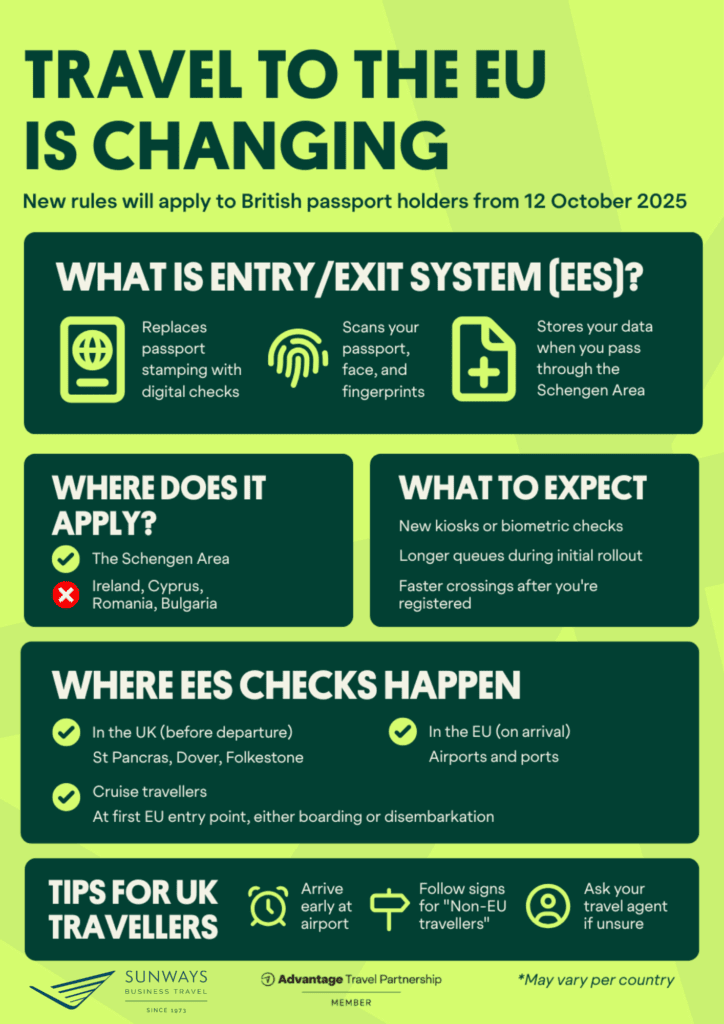
The Entry Exit System (EES) requires non-EU citizens to register at the EU border by scanning their passport and having their fingerprints and photograph taken.
From 12 October, British passport-holders will need to register on their first visit to a country where EES checks are operating. Registration is valid for a rolling three-year period or until the passport expires.
The new system will be phased in over six months, meaning different ports may have varying requirements until April 2026. This should allow for a gradual implementation that minimises disruption, particularly at peak periods.
On exit, and for subsequent visits to a participating country, travellers will only need to scan their passport and provide either fingerprints or a photograph at the border.
EES will be a requirement when entering Schengen area countries including Iceland, Liechtenstein, Norway and Switzerland. EES will not be required when travelling to Ireland and Cyprus.
For travellers using the Port of Dover, Eurotunnel at Folkestone or Eurostar at St Pancras International, the process will take place at the border before they leave the UK.
The government has supported these juxtaposed ports (Eurostar, St Pancras; Eurotunnel, Folkestone; and the Port of Dover) with £10.5m of funding for border infrastructure to make the change as smooth as possible for travellers. While EES is an EU system, the government has been working closely with the travel industry, ports and transport operators to help raise public awareness and understanding of the border changes.
Minister for Border Security and Asylum, Alex Norris, said:
We recognise that EES checks will be a significant change for British travellers, which is why we have worked closely with our European partners to ensure the rollout goes as smoothly as possible.
The UK and EU have a shared objective of securing our borders and these modernisation measures will help us protect our citizens and prevent illegal migration.
Minister for Aviation, Maritime and Decarbonisation, Keir Mather, said:
We’ve backed our ports and operators with £10.5 million to help them get ready for the EU’s new Entry/Exit System, ensuring they have the infrastructure and systems in place to manage the changes.
Our priority is to minimise disruption for travellers and hauliers, particularly at our busiest border crossings. We’ll continue working closely with European partners and local resilience forums to keep traffic flowing and journeys smooth.
Travellers do not need to take any action before travelling and the process is free. Registration will take place upon arrival at the EU border and may take slightly longer than previous border checks.
Whilst the checks should only take 1-2 minutes for each person, they may lead to longer wait times at border control upon arrival in the Schengen area. At the juxtaposed ports, where registration will be completed in the UK prior to departure, there may be longer waits at busy times. Eurotunnel, Eurostar and the Port of Dover have plans in place to minimise disruption as much as possible.
Last month, the government launched an awareness campaign to help prepare British travellers for the new system.
Messages advising the public about the changes have been shared across government social media channels, by transport operators and on travel websites. Up to date information can also be found on GOV.UK and FCDO’s Travel Aware pages.
The EU has introduced EES to replace passport stamping for all non-EU citizens, helping them to track compliance with the 90-day visa-free travel rule and strengthen their border control.
British citizens covered by Withdrawal Agreement residence documents and UK-EU dual citizens using their EU passports will be exempt from the new requirements.
Children under 12 will not be fingerprinted but under the new EU rules, all travellers, including babies, will be photographed and have digital records created.
The UK Government has rolled out its own Electronic Travel Authorisation (ETA) scheme, which is a digital permission to travel for visitors who do not need a visa for short stays, or do not have another valid UK immigration status prior to travelling to the UK.
How It Will Impact Those With Criminal Offences:
The new EU travel rules, specifically the upcoming ETIAS (European Travel Information and Authorisation System), will make it harder for those with criminal records to travel to the EU because applicants must disclose past convictions, and a criminal history can lead to a denial of travel authorization. While a criminal record doesn’t automatically prevent travel, the seriousness of the offence, the date of conviction, and the assessed risk are key factors in the decision.
How the new rules will affect travel with a criminal record:
- Disclosure is mandatory: The ETIAS application will require you to disclose criminal convictions. Lying or failing to disclose a conviction can lead to greater difficulties, as the EU has access to certain shared databases.
- Risk assessment: Your application will be assessed based on the seriousness of the conviction and the time elapsed since it occurred. The more serious the offence (e.g., murder, rape, terrorism, serious fraud), the higher the risk and the more likely your application is to be denied.
- Background checks: ETIAS will conduct background checks against international policing databases, including the ECRIS database, which contains information on criminal records.
- Potential for manual processing: Any discrepancies in your application, such as a failure to report a conviction that is found in the databases, may lead to manual processing, further delaying or complicating your application.
- Impact on travel authorisation: The decision to grant or deny the ETIAS authorization depends on the individual case and the outcome of the risk assessment. A conviction doesn’t mean you will be automatically banned, but it does mean your application will be subject to closer scrutiny.
How many voted for this in 2016?







