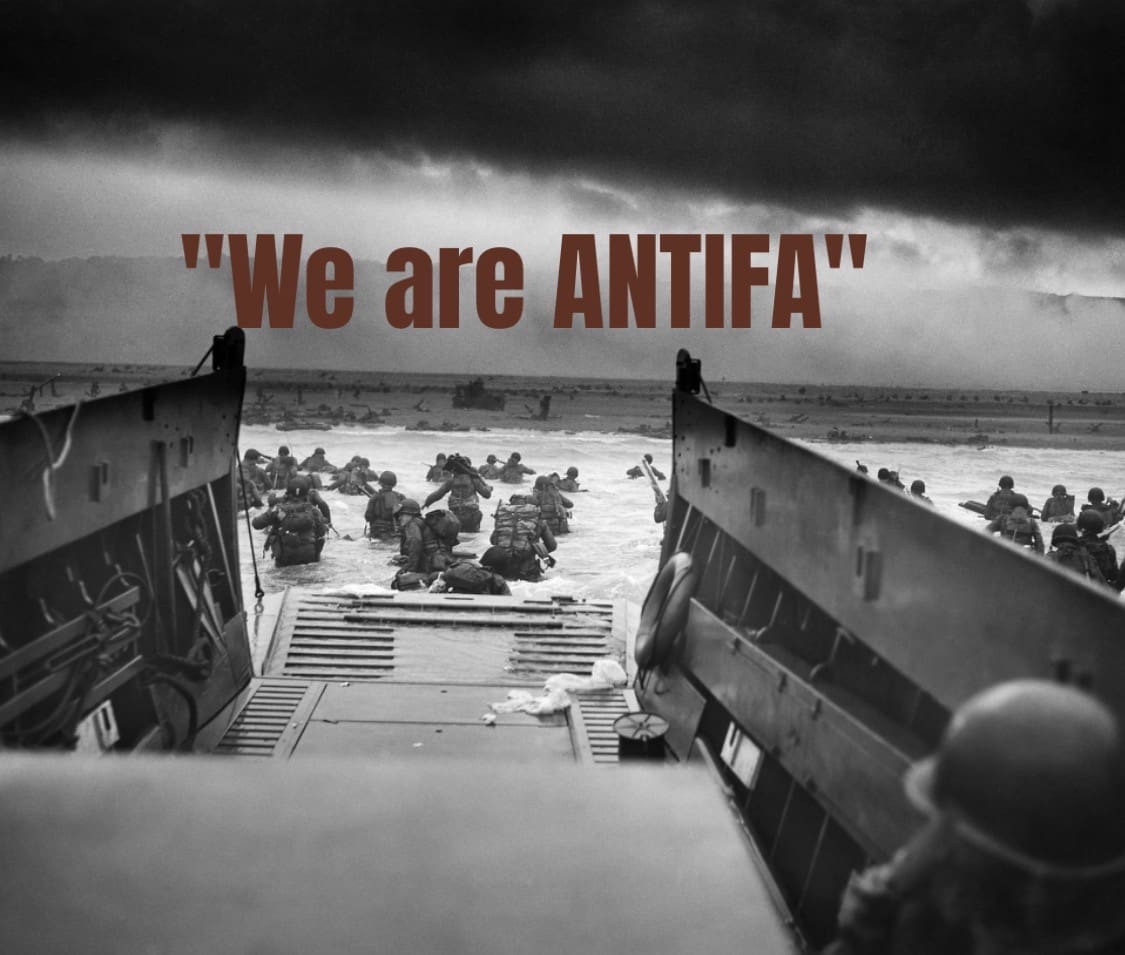
ANTIFA is a contraction of two simple words: anti-fascist. Stripped of distortion and hysteria, that is all it means. To be anti-fascist is to oppose fascism, the authoritarian, ultra-nationalist political ideology that defined regimes such as that of Adolf Hitler and his Nazi Party.
From that basic definition flows an unavoidable historical truth: everyone who fought the Nazis was, by definition, anti-fascist. In other words, they were antifa.
This is not a slogan. It is not a partisan trick. It is a matter of plain language and historical record.
The meaning of anti-fascism
Fascism, as practised in Nazi Germany and Fascist Italy, fused dictatorship, violent repression, racial hierarchy and the crushing of democratic institutions. It abolished opposition parties, censored the press, persecuted minorities and glorified political violence. To resist such a system was to oppose fascism.
When Britain declared war on Nazi Germany in 1939, it did so in response to aggression by a fascist regime. When British soldiers landed in Normandy, when the RAF fought in the Battle of Britain, and when merchant seamen braved U-boat-infested waters, they were engaged in a struggle against fascism. That is anti-fascism in its most literal and profound sense.
Winston Churchill was no socialist radical. He was a Conservative imperialist with deeply traditional views. Yet his wartime leadership is celebrated precisely because he refused to bow to fascist tyranny. Churchill defined the conflict as a defence of parliamentary democracy against a totalitarian menace. By any honest use of language, he was anti-fascist.
So too were the millions of ordinary Britons who enlisted or supported the war effort. So too were American, Canadian, Australian and Soviet forces. Political differences among the Allies were vast, but they were united by opposition to fascist expansion. To say they were anti-fascist is not to appropriate their sacrifice for modern causes; it is simply to describe what they did.
Anti-fascism before and after the war
Anti-fascism did not begin in 1939. In Britain during the 1930s, opposition to home-grown fascism was visible in the resistance to the British Union of Fascists, led by Oswald Mosley. When communities mobilised to prevent blackshirt marches, they were acting in defence of pluralism and against authoritarian nationalism. They were anti-fascists.
After 1945, the exposure of the Holocaust and the devastation of Europe left fascism morally and politically discredited. Mainstream conservatism, liberalism and social democracy alike defined themselves against it. In post-war Britain, to be a democrat was to reject fascism outright. That rejection was embedded in institutions, education and law.
Yet fascism did not vanish. Fringe movements such as the National Front sought to revive aspects of ultra-nationalist and racialist politics in the 1960s and 70s. Opposition to them was again described as anti-fascist. Trade unionists, church groups, community organisations and mainstream politicians stood against them. None of this was controversial at the level of principle: fascism was understood as a threat to democratic society. Now we have Britain First, Restore and Reform UK…, who are attempting to bring back elements of fascist ideology into the UK. Across the pond, Trump, ICE and MAGA are ignoring the checks and balances of representative democracy. There are others also in the West, including Israel and Hungary.
How “antifa” became a slur
In recent years, however, the word “antifa” has been deliberately reframed by sections of the right and far right. Instead of being treated as a descriptive term, i.e., anti-fascist, it has been portrayed as a shadowy, extremist network synonymous with disorder.
This rhetorical manoeuvre serves several purposes.
First, it detaches the term from its plain meaning. By presenting “antifa” as inherently violent or subversive, critics imply that opposition to fascism is itself suspect. The focus shifts from the ideology being opposed to the tactics of some who claim to resist it.
Secondly, it creates a moral inversion. If “antifa” can be cast as dangerous, then those who align themselves against it can present themselves as defenders of order and stability, even when elements within their own political tradition flirt with authoritarian or exclusionary ideas.
Thirdly, it blurs historical continuity. The same political traditions that proudly celebrate the defeat of Nazi Germany now sometimes recoil from the label anti-fascist. This produces an odd contradiction: reverence for those who fought fascism abroad, coupled with hostility to those who use the same descriptive term today.
In Britain, mainstream right-wing parties generally stop short of embracing fascism outright. However, rhetoric about “antifa mobs” or claims that anti-fascism is inherently extremist have circulated in parts of the commentariat and among some politicians, including figures associated with parties such as Reform UK. The implication is that “antifa” is less about opposing fascism and more about advancing left-wing radicalism.
Yet this framing depends on ignoring the literal definition. Anti-fascism does not require adherence to any particular economic programme. It does not necessitate support for any specific party. It is a stance against a clearly defined authoritarian ideology.
The distinction between tactics and principles
It is important to be clear: not everyone who calls themselves anti-fascist agrees on methods. Some adopt confrontational or disruptive tactics that others reject. Democratic societies rightly debate the limits of protest and the rule of law.
But disagreement over tactics does not invalidate the underlying principle. One may criticise certain forms of protest while still affirming that fascism, with its record of repression, racial persecution and dictatorship, is morally and politically indefensible.
To conflate the two is intellectually dishonest. It is akin to suggesting that because some environmental activists break the law, the principle of environmental protection is discredited. The label describes the objective, not a single strategy.
A matter of historical honesty
When veterans marched through London after 1945, they did not carry banners reading “antifa”. They did not need to. Their actions had already defined the term. They had opposed fascism in its most lethal form.
The attempt to turn “antifa” into a slur depends on historical amnesia. It requires forgetting that the defining struggle of the twentieth century in Europe was against fascist regimes. It requires ignoring that Britain’s political mainstream—left, centre and right—united in that cause.
To state that everyone who fought the Nazis was anti-fascist is not a provocative claim. It is a tautology. If you fought fascism, you were anti-fascist. If you defended democratic institutions against a fascist state, you were anti-fascist.
The real question, then, is why the term has become contentious. The answer lies less in history than in contemporary politics. In an era of polarisation, words become weapons. “Antifa” has been recast not to clarify but to inflame.
Reclaiming its literal meaning is not an act of partisanship. It is an act of linguistic and historical accuracy. Anti-fascism is the principled rejection of dictatorship, racial supremacy and the destruction of democratic norms. That principle underpinned the Allied war effort, shaped post-war Europe and remains embedded in Britain’s constitutional culture.
Those who fought the Nazis did not fight for a slogan. They fought against fascism. And in doing so, they were, in the clearest sense imaginable, anti-fascist.