

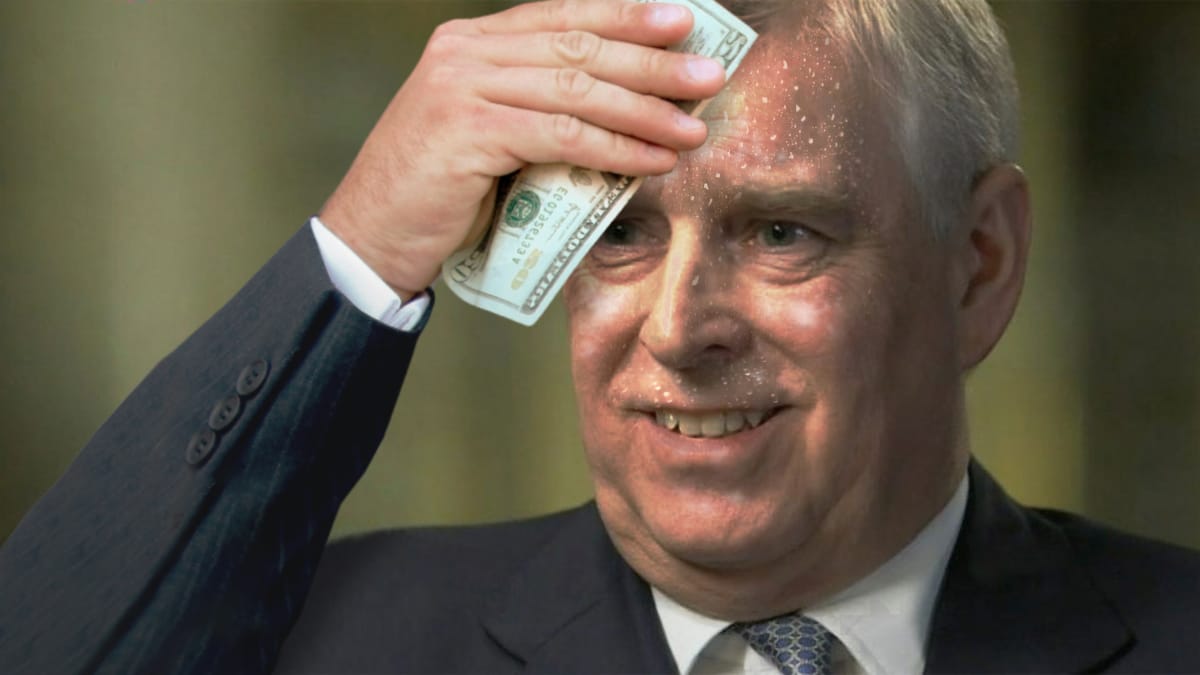
Ever since the ‘death’ of Jeffrey Epstein in a Manhattan jail cell, a stubborn belief has persisted in certain quarters: that one day Andrew Mountbatten might decide or be compelled to “spill the Epstein beans” and expose a web of powerful figures allegedly entangled in the financier’s orbit. It is a wonderful idea for the masses. A disgraced insider, cornered and resentful, finally revealing all. A dramatic reckoning. A cascade of indictments. The powerful humbled.
But the belief that such a moment would ever be allowed to happen misunderstands how elite systems function. If Epstein’s network truly extended into the highest tiers of politics, finance, intelligence and royalty, as court documents, flight logs and testimony have long suggested, then the stakes are not personal. They are systemic. And systemic interests do not volunteer their own destruction.
Andrew’s association with Epstein is well documented. He maintained contact with him after Epstein’s 2008 conviction in Florida. He stayed at Epstein’s properties. A now-notorious photograph showed him with Virginia Giuffre in London. His 2019 interview was widely regarded as catastrophic, a public relations disaster that compounded the damage. Ultimately, he stepped back from royal duties and later reached an out-of-court settlement in a US civil case, paid for by his mother, the Queen, while denying wrongdoing.
What followed was instructive. The scandal has been narrowed. Contained. Personalised. Andrew was repositioned as the problem. His titles were removed. His public role shrank. The wider institution, the British Royal Family, remained intact. The Crown did not wobble. The constitutional settlement did not collapse. The state did not convulse.
That outcome was not accidental. It reflected a basic principle of institutional survival: isolate a liability. Large, entrenched structures do not permit crises to metastasise beyond control if they can help it. They identify the pressure point, remove or sideline it and move forward.
To imagine Andrew freely revealing damaging information about others is to imagine a rupture that would threaten far more than his own reputation. If powerful politicians, financiers, business leaders or intelligence-linked figures were implicated in criminal wrongdoing, the consequences would be seismic. Markets would react. Governments could fall. Diplomatic relationships would strain. Trust in institutions — already fragile, would fracture further.
History shows that when such stakes are involved, investigations tend to migrate towards areas that are serious but survivable. Financial irregularities. Security concerns. Conflicts of interest. Procedural misconduct. These are manageable forms of scandal. They can be litigated without dismantling the broader architecture.
Allegations of trafficking, exploitation and systemic abuse at elite levels are different. They cut to the core of moral legitimacy. They imply complicity not just by individuals but by gatekeepers who knew, ignored or enabled. And here lies the crux of the public suspicion: the belief that “they all knew”. That if Epstein was moving in rarefied circles for years, hosting gatherings attended by the influential and well-connected, then it strains credulity to assume ignorance was universal.
Whether that suspicion is justified in specific cases is a matter for evidence and courts, not conjecture. But the structural incentive to avoid wide-ranging exposure is undeniable. Power protects itself. Not through cartoonish villainy, but through bureaucracy, legal strategy, narrative management and distraction.
Consider the asymmetry. Andrew is not an independent political actor with nothing to lose. He is a member of a hereditary institution intertwined with the British state. The monarchy’s legitimacy rests on public confidence and constitutional continuity. Any revelation that seriously implicated other senior figures, particularly within allied governments or major corporations, would not simply embarrass individuals. It would destabilise relationships that underpin trade, security and diplomacy.
Even outside the royal sphere, elite networks are dense and interlinked. Business leaders sit on boards with politicians. Donors fund campaigns. Former officials move into corporate roles. Media organisations depend on access. Law firms represent multiple high-profile clients. In such an ecosystem, a full and uncontrolled disclosure from a central figure could have cascading effects. The incentive, therefore, is to limit exposure to the smallest possible circle.
This is not unique to one scandal. It is how modern institutions have historically weathered crises. Corporate cover-ups, intelligence failures, financial collapses—again and again, the pattern repeats. Identify the most visible offender. Remove them. Express contrition. Reform procedures. Move on.
It is also important to recognise the role of legal settlements. Civil cases, particularly in the United States, often end without admission of liability. They provide closure for claimants while avoiding prolonged public trials. For institutions and individuals with resources, settlement can be preferable to disclosure. The cost is financial; the benefit is containment.
Those who insist that Andrew could simply “tell everything” overlook the constraints that surround him. Legal agreements may include confidentiality provisions. Advisers, lawyers and institutional figures would strongly resist any course of action that magnified liability. Even if he wished to speak freely, he would face formidable legal and political barriers.
There is also the question of credibility. A belated confession that implicated others would be scrutinised intensely. Motive would be questioned. Evidence demanded. Without documentary proof, claims could be dismissed as self-serving or retaliatory. The idea of a single, explosive revelation that brings down an entire network presumes both intent and capacity that may not exist.
Meanwhile, public appetite for a grand unmasking speaks to a deeper malaise: a profound distrust of elites. After financial crises, parliamentary expenses scandals and years of perceived double standards, many citizens assume that the powerful operate by different rules. The Epstein saga, with its air of privilege and impunity, fits neatly into that narrative.
But distrust alone does not guarantee disclosure. In fact, it may encourage tighter control. When confidence in institutions is low, those institutions have even stronger incentives to avoid destabilising shocks.
The more uncomfortable possibility is not that a dramatic confession is being suppressed at every turn, but that the truth is messier and less theatrical. Networks of influence often rely less on explicit conspiracies than on shared interests, mutual discretion and the quiet understanding that exposure would damage everyone involved.
Andrew’s fall from grace has already served a purpose. It demonstrated that association with Epstein carried consequences. It allowed the institution to draw a line. Whether that line represents full accountability is hotly debated. But it reflects a strategy: absorb the impact, prevent contagion.
In the end, the belief that Andrew would be allowed, politically, legally or institutionally, to detonate a revelation implicating numerous powerful figures requires one to assume that those figures lack both foresight and influence. History suggests otherwise.
Power rarely dismantles itself voluntarily. It fragments, adapts, and survives. The fantasy of a single insider pulling back the curtain appeals to a public hungry for justice. Yet systems built over decades, supported by wealth, law and global relationships, are not easily undone by confession.
If there are truths still concealed within the Epstein saga, they are far more likely to emerge slowly, through documents, litigation, investigative journalism and incremental disclosures, than through a dramatic moment of televised catharsis.
Anyone waiting for Andrew Mountbatten-Windsor to bring the whole edifice crashing down will almost certainly be extremely disappointed. Any likelihood that he or anyone else would do that would mean a terminal and abrupt conclusion. You know what I mean.







