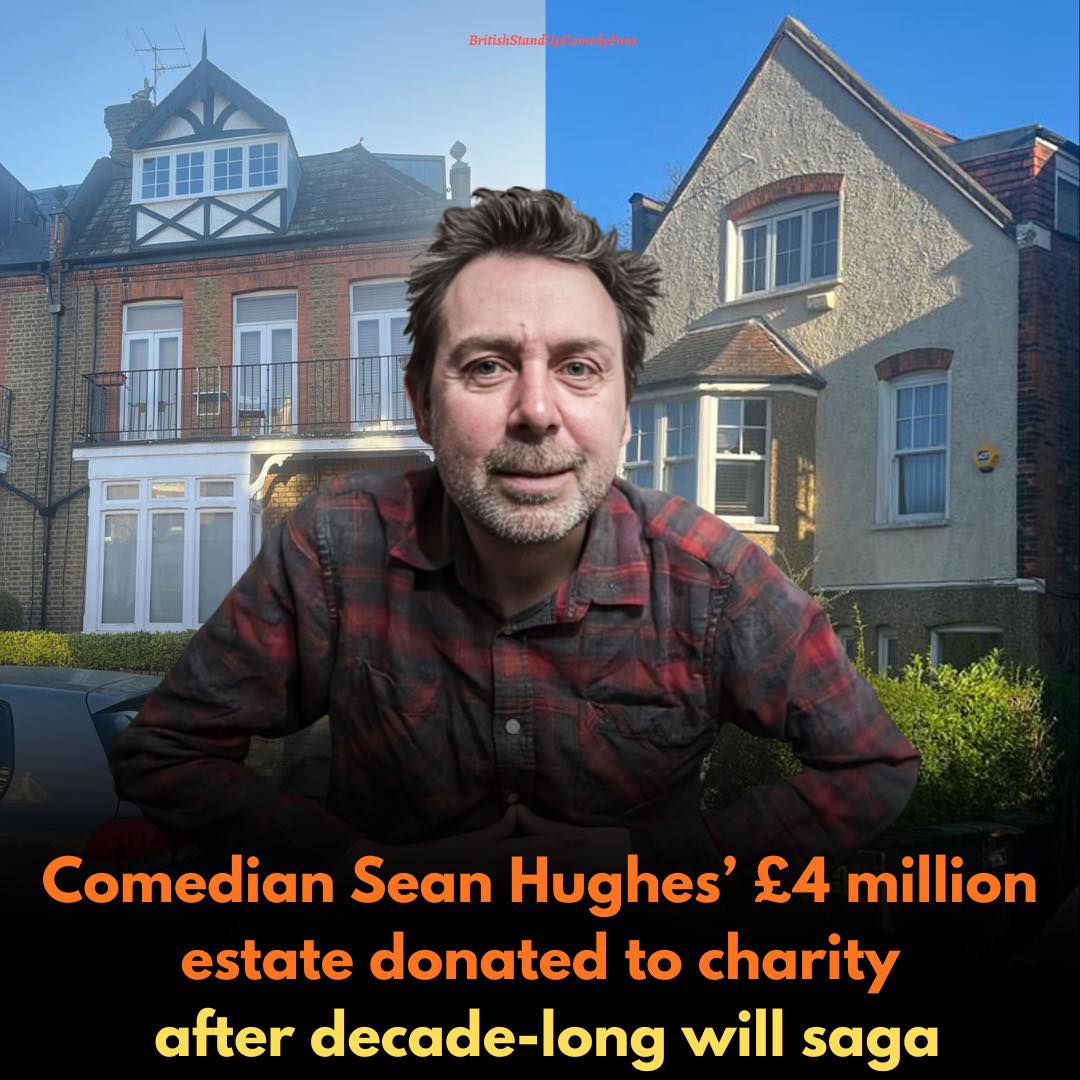
Nearly a decade after his death, the final act of Sean Hughes’ life has taken on a significance that reaches far beyond the stage he once commanded. The comedian, who died in 2017 at the age of 51, has posthumously become the centre of a protracted legal battle over his will, one that has now ended with a £4 million estate being awarded to the homelessness charity Shelter.
At the heart of the dispute lay a deceptively simple phrase, scribbled in Hughes’ own hand: “my three houses to Shelter.” It was a line that seemed clear in intent, if not in execution. Hughes had long been a supporter of the charity’s work and, by all accounts, wished for his assets to help address the growing crisis of homelessness in Britain. Yet the legal reality proved more complicated. Of the three properties he referenced, only one was owned outright in his name. The other two were held through a company structure, introducing ambiguity that would take years to untangle.
That ambiguity ultimately propelled the case into the High Court, where judges were tasked not merely with interpreting legal ownership but with reconstructing the likely intentions of a man no longer able to clarify his wishes. It is a familiar problem in inheritance law: the tension between the literal wording of a will and the broader context in which it was written. In Hughes’ case, the court found that the spirit of the instruction outweighed the technical inconsistencies. The properties, including his home in Crouch End, would indeed pass to Shelter.
The ruling closes a long and, at times, uncertain chapter. For nearly a decade, Hughes’ estate had remained in limbo, its intended purpose stalled by legal technicalities. That delay is not insignificant. In the years since his death, the issue of homelessness in the UK has only grown more acute, shaped by rising rents, insecure tenancies, and the long tail of austerity. Against that backdrop, the eventual transfer of Hughes’ estate feels less like the resolution of a private matter and more like the delayed arrival of a public good.
Shelter itself was quick to acknowledge both the generosity and the intention behind the bequest. In a statement following the ruling, the charity described Hughes as “a passionate supporter” of its work and expressed gratitude for what it called a transformative gift. The funds, it said, would enable the organisation to continue providing expert advice, support services, and advocacy for those facing housing insecurity. In practical terms, that means legal assistance for tenants, emergency help for those at risk of eviction, and continued campaigning for systemic reform.
Yet the story also serves as a cautionary tale. Handwritten wills, sometimes romanticised as expressions of personal sincerity, can carry significant risks when they lack precision. Hughes’ phrasing, though heartfelt, left enough room for doubt to trigger years of litigation. For legal professionals, the case underscores the importance of clarity, particularly when dealing with complex assets such as property held through corporate entities. For the wider public, it is a reminder that good intentions alone are not always enough to ensure that one’s wishes are carried out.
Beyond the legal intricacies, however, lies the enduring legacy of Hughes himself. Rising to prominence in the 1980s, he quickly distinguished himself as one of the most original voices of his generation. At just 24, he became the youngest-ever winner of the prestigious Perrier Comedy Award, a milestone that marked him out as a major talent. His comedy, often introspective, occasionally melancholic, and always sharply observed, offered a contrast to the more bombastic styles of his contemporaries.
Hughes’ influence extended beyond stand-up. He became a familiar face on British television, appearing on programmes such as Never Mind the Buzzcocks, where his quick wit and distinctive presence earned him a loyal following. Yet despite his success, there remained an undercurrent of restlessness in his work, a sense of someone never entirely at ease with the trappings of fame.
It is perhaps fitting, then, that his final legacy is not a punchline but an act of generosity. The decision to leave his estate to Shelter reflects a concern with the realities of life offstage, the struggles that rarely make it into the spotlight but define the lives of millions. In that sense, Hughes’ last contribution may prove to be his most impactful.
The resolution of the case also highlights the broader role that charitable bequests can play in addressing social challenges. At a time when public services are under strain and demand for support is rising, such donations can provide vital resources. They are, in effect, a form of private intervention in public problems, imperfect, perhaps, but often essential.
For Shelter, the outcome is both a windfall and a responsibility. The funds will help sustain its work at a critical moment, but they also carry the weight of Hughes’ intention: to make a tangible difference in the fight against homelessness. For those who admired him, it offers a final glimpse of the values that underpinned his life and career.
And for everyone else, it leaves a simple, if sobering, reflection. Long after the applause has faded and the lights have dimmed, what remains is not just what we said or did, but also what we chose to leave behind and who, ultimately, benefits from it.