

Listen to the lying hypocrite if you can bear it.
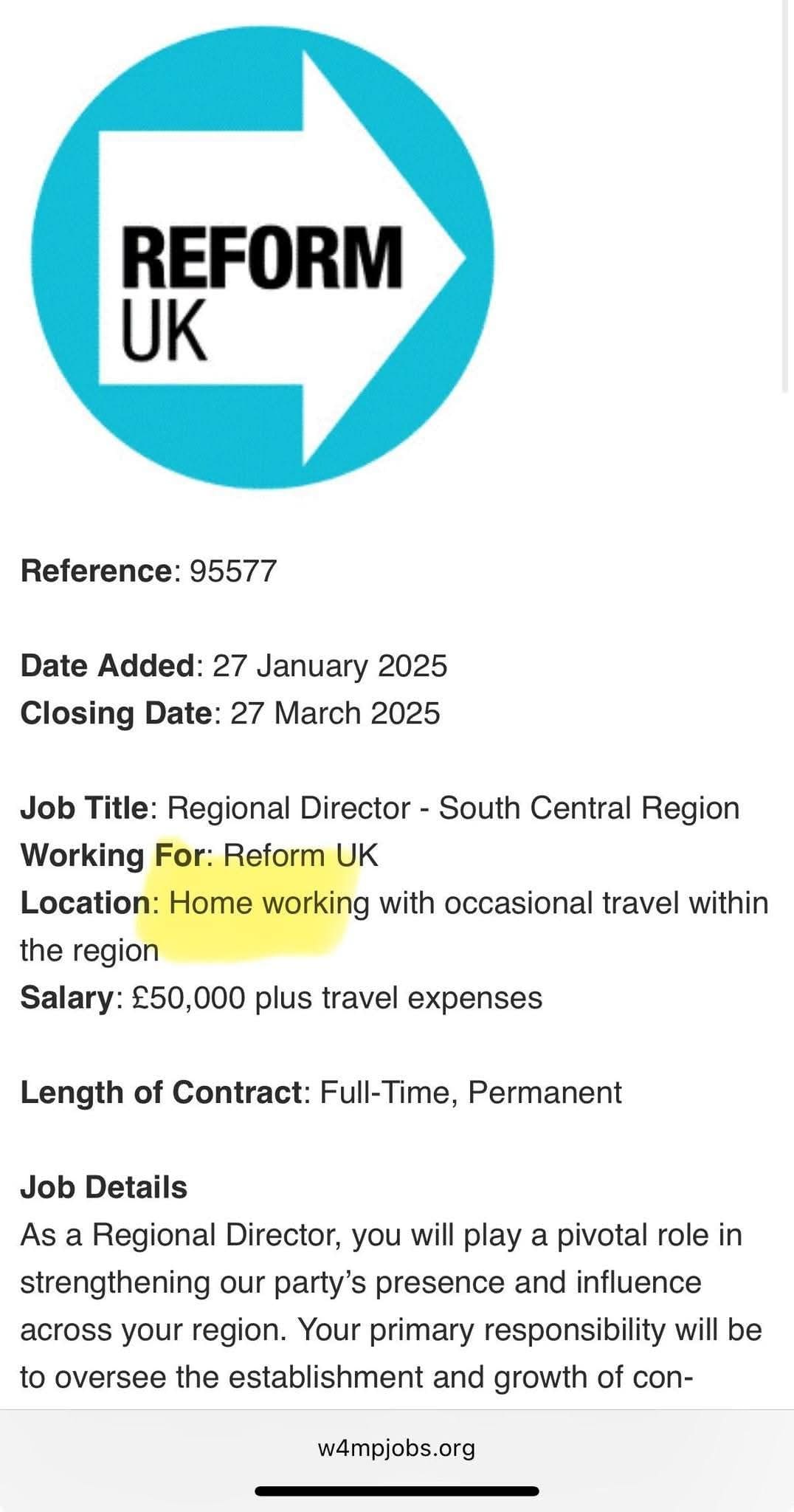
The inset image says more than any speech ever could.
There it is in black and white: Reform UK – Regional Director – £50,000 a year – Location: Home working with occasional travel within the region.
Home working. For a senior political organiser. On a generous salary. With travel expenses covered.
And yet Nigel Farage has repeatedly railed against remote working culture, painting it as a symptom of national decline, laziness, urban decay and economic stagnation. He has spoken about empty offices, faltering city centres and the supposed moral weakness of a workforce no longer chained to a desk from nine to five. The message is clear: Britain needs to get back to the office.
Except, apparently, if you work for him.
This is not merely inconsistency. It is political theatre wrapped in selective outrage. When ordinary workers choose flexibility to balance childcare, caring responsibilities, long commutes, or the simple desire for a better quality of life, they are accused of undermining productivity. When Reform UK recruits a senior regional director, however, home working becomes entirely acceptable, even desirable.
Why? Because it makes sense.
It reduces overheads. It widens the talent pool. It allows political organisers to operate across wide regions efficiently. It is modern. It is practical. It is cost-effective.
In other words, it is exactly the same reasoning millions of businesses and employees use every day.
The hypocrisy is not subtle. A £50,000 salaried political director working from home is framed as strategic flexibility. A call centre worker, civil servant or marketing executive doing the same is framed as part of Britain’s alleged decline.
This is a familiar pattern in populist politics: one rule for “the elite” when it suits them, another rule for everyone else when it suits the narrative. Remote working is condemned rhetorically because it plays well with certain voters who see boarded-up high streets and assume causation. But when organisational efficiency is at stake, ideology melts away.
There is also something revealing about the tone. Calls to “ban” or heavily restrict home working are rarely about productivity data, much of which shows mixed but often neutral-to-positive outcomes depending on sector. They are about control, symbolism and cultural grievance. The office becomes a stage on which toughness and discipline are performed.
Yet here is the reality: Reform UK itself recognises that regional political organising across the South Central region does not require a daily commute to a central HQ. It requires connectivity, coordination and flexibility, precisely what remote structures enable.
So which is it?
Is home working a national failing?
Or is it a sensible modern practice when it benefits your own operation?
If the answer shifts depending on who is doing it, then this is not a principle. It is opportunism.
A party cannot credibly campaign against remote work culture while simultaneously advertising remote executive roles. Either home working is a legitimate model in a digital economy, or it is not.
The job listing suggests that when efficiency, money and practicality are involved, Reform UK knows exactly which side of that argument it falls on.
And that, more than any speech, exposes the contradiction.







