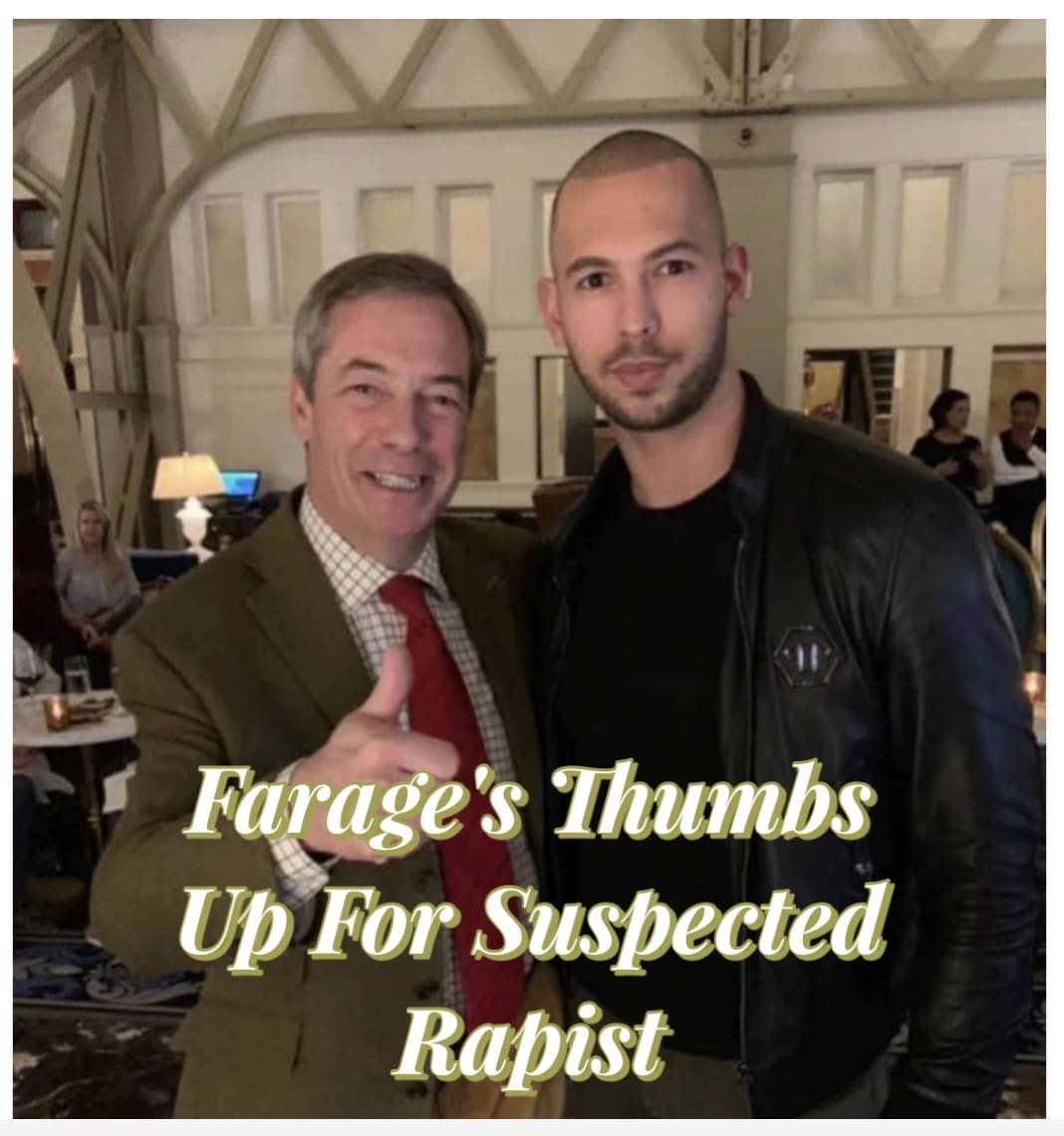
Does anyone really want paedophiles, misogynists, racists, Nazis, homophobes, terrorists, rapists, abusers… filling the Commons chamber all the while purposefully destroying the lives of our children? No one who perceives themselves or calls themselves decent people would answer ‘yes’ to this question. Yet, we face just that threat unless the truly decent people unite to stop them.
The image of Nigel Farage posing alongside Andrew Tate, reinforced by comments reported in The Independent where the same Farage described Tate as an “important voice” for men, only adds to the alarm bells ringing for anyone considering a vote for Reform UK or scared stiff that they will gain power. This is not a trivial controversy or a media storm that will pass. It is a moment that speaks volumes about judgement, values, and the kind of society political leaders are willing to normalise.
Andrew Tate is not simply a provocative commentator with strong opinions. He is a deeply polarising figure whose influence is tied to a worldview that many educators, parents, and safeguarding professionals consider harmful. Crucially, he is also the subject of serious criminal investigations, including allegations of rape and sexual abuse. While legal processes must take their course, and the principle of due process remains essential, it is extraordinary that any British politician would choose to publicly elevate a figure under such grave scrutiny. At the very least, it demonstrates a profound lack of judgement; at worst, it signals indifference to the seriousness of those allegations.
Defenders of Farage often claim he is merely acknowledging Tate’s reach among young men. But this defence is dangerously inadequate. There is a fundamental difference between recognising influence and legitimising it. Political leaders have a responsibility not just to reflect public sentiment but also to shape it, to challenge harmful narratives, and to promote values that strengthen society. By describing Tate as an “important voice”, Farage crosses that line. He moves from observation into endorsement.
This matters enormously when we consider the impact on young people. Boys today are navigating a complex and often confusing world, with pressures around identity, success, and belonging. They need role models who emphasise respect, responsibility, empathy, and decency. They need to see examples of masculinity that are grounded in kindness and integrity, not dominance, aggression, or contempt for others. Elevating figures like Tate sends precisely the wrong message. It suggests that notoriety, wealth, and shock value are more important than character.
But the consequences do not stop with boys. Girls and young women are already facing a mental health crisis, with rising levels of anxiety, depression, and low self-esteem reported across the UK. A significant part of that pressure comes from how they are perceived and treated by their peers. When boys absorb and replicate the attitudes promoted by figures like Tate, attitudes that often reduce women to objects or adversaries, the impact on girls can be devastating. It shapes how they are spoken to, how they are valued, and how safe they feel in their own environments.
Teachers and youth workers have increasingly reported the real-world consequences of this dynamic: misogynistic language becoming normalised in classrooms, girls feeling intimidated or belittled, and a growing divide between young men and women. This is not an abstract cultural debate; it is playing out in schools, online spaces, and communities across the country. When influential politicians appear to validate the source of these attitudes, it only deepens the problem.
For a party like Reform UK, which seeks to present itself as a serious political alternative, this episode raises fundamental questions. Leadership is not just about identifying grievances; it is about responding to them responsibly. There are legitimate issues affecting men and boys, from mental health challenges to educational disparities. But those issues require thoughtful, evidence-based solutions, not the amplification of voices that thrive on division and controversy. By aligning, even rhetorically, with Tate, Farage undermines the credibility of any claim to be addressing these challenges constructively.
There is also a broader cultural implication. Britain has long prided itself on a political tradition that, while robust and often adversarial, maintains a degree of respect and restraint. The importation of more extreme, personality-driven forms of discourse, where outrage is currency and attention is the ultimate goal, threatens to erode those standards. Tate represents a particularly stark version of that trend, and the willingness of mainstream political figures to engage with or endorse him accelerates its spread.
Supporters may argue that critics are overreacting, that this is simply another example of political correctness run amok. But this misses the point entirely. The concern is not about silencing debate or policing opinions. It is about recognising the responsibility that comes with influence. When a prominent political figure chooses to praise someone under investigation for serious sexual offences, and whose public persona is built on demeaning others, it sends a message, whether intended or not, about what is acceptable.
Ultimately, voters must decide what kind of leadership they are willing to support. Do they want leaders who elevate constructive, responsible voices, or those who flirt with controversy and legitimise figures who divide and demean? The image of Nigel Farage with Andrew Tate, and the rhetoric that surrounds it, is not just a fleeting headline. It is a clear indication of priorities and values.
For anyone considering Reform UK, that should not be ignored. It is a red flag, not only for what it says about political judgement but also for the real-world impact it risks having on the next generation. Boys deserve better role models. Girls deserve to feel safe, respected, and valued. And the country deserves leadership that understands the difference.