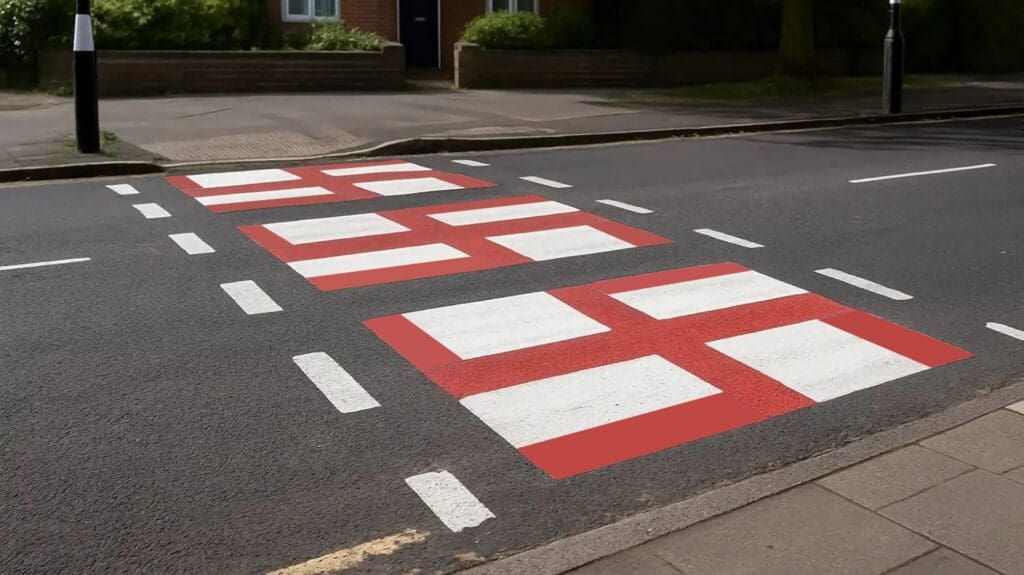
This is what it means to be a good citizen. Confronting ignorance. Confronting those whose only meaningful expression is a bit of rag with a red cross on it that does not even originate in this country.
For the record:
The flag of St George, so often paraded today as if it were an ancient and purely English emblem, in fact originates far from England and reveals how national myths are constructed by stripping away inconvenient layers of history. The red cross on a white background was not born in England at all but emerged from the wider Mediterranean world, circulating among crusaders in the twelfth century as one of several simple identifying crosses. It was the Republic of Genoa, not England, that first flew the banner in earnest, using it as a naval symbol under the protection of their patron saint. England only came into possession of the flag through a kind of political and financial arrangement, paying Genoa for the right to fly the cross over its ships in Mediterranean waters. Centuries later, Edward III deliberately elevated St George as the patron saint of England, using the imagery of crusading and sanctity to bind his realm to a narrative of Christian heroism and martial legitimacy. The so-called “English” flag, then, was imported, borrowed, and opportunistically rebranded rather than emerging organically from the soil of the nation.
This longer, more complex history is often erased by nationalist discourse, which insists on treating the St George’s flag as though it were the timeless emblem of an unchanging English identity. That reading is not only historically inaccurate but intellectually dishonest, because it ignores how symbols are constantly borrowed, traded, and repurposed to serve shifting political needs. To march under the St George’s cross while claiming it as an ancient birthright is to engage in a wilful act of forgetting, one that erases its Mediterranean origins, its entanglement with crusading violence, and its function as a cultural import. Nationalists who cling to it as a marker of pure “Englishness” demonstrate precisely the kind of ignorance that fuels myth-making: a refusal to see that the very emblem they revere is itself evidence of how nations are constructed out of borrowed parts, stitched together through power and appropriation rather than born from any essential or timeless identity.
The flags are getting the country nowhere apart from inviting reaction and counterreaction. We are in a dangerous place, and this symbolism is becoming more accurate of where we currently are.