

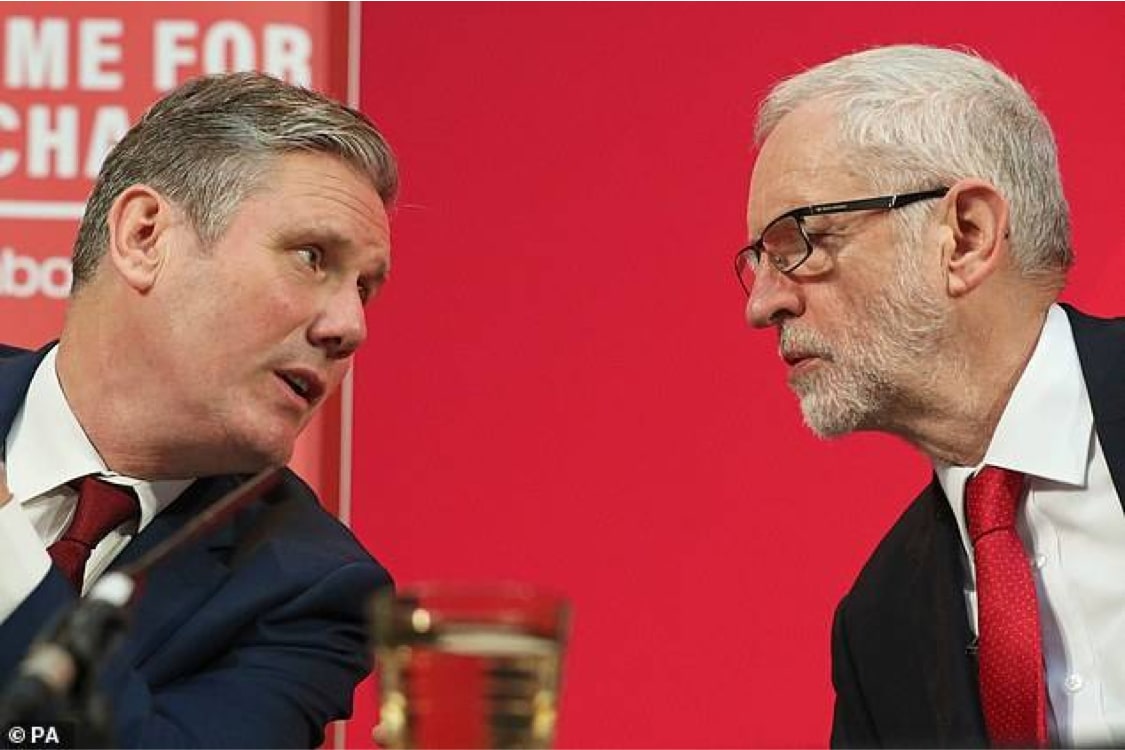
The news from Caerphilly should have shaken the Labour Party to its core. A constituency that had voted Labour for over a hundred years — through wars, recessions, and the rise and fall of entire governments — has just turned its back on the party. Under Keir Starmer’s leadership, Labour crashed to a humiliating defeat, taking only 3,713 votes — a miserable 11% of the total vote share.
To put that into perspective, when Jeremy Corbyn was leader in 2019, Labour won 22,491 votes, with a commanding 54.5% share. The same people, in the same town, in just a few years. That’s not a minor slip — that’s an absolute collapse.
Something has gone very, very wrong.
A Movement That Spoke to People
When Jeremy Corbyn led the Labour Party, he didn’t just lead it — he transformed it into a mass movement. People who had given up on politics began turning up to meetings again. Young people who had never voted before campaigned on the streets. Local branches were full of energy and hope. Labour, for a brief moment, felt like a genuine people’s party again.
Corbyn offered something clear, compassionate, and profoundly necessary: public ownership of essential services, proper funding for the NHS and schools, decent homes for all, a living wage, and a foreign policy based on peace rather than war. These weren’t radical ideas — they were common sense, rooted in fairness and solidarity.
In places like Caerphilly, that message resonated deeply. Working people there understood what Corbyn was talking about because it spoke directly to their lives. They knew the value of a publicly run railway because they rely on the trains. They knew the importance of a well-funded NHS because they use it every week. They understood that inequality isn’t inevitable — it’s a political choice.
From Movement to Management
But since Corbyn was replaced, the soul has been drained from the party. Keir Starmer promised unity, competence, and electability. Instead, we’ve seen a leader more interested in purges than participation, more focused on reassuring the establishment than representing ordinary people.
Under Starmer, Labour has become cautious, corporate, and colourless. The party that once inspired rallies, songs, and street stalls now struggles to inspire anyone at all. The leadership has spent years distancing itself from everything Corbyn stood for — scrapping his policies, silencing grassroots voices, and even suspending or expelling many of the activists who built Labour’s revival in the first place.
The result? People no longer feel Labour speaks for them. And in Caerphilly, that disconnection has turned into a disaster.
The Heartlands Are Sending a Message
The fall of Caerphilly is not an isolated fluke. Across the country, traditional Labour voters are switching off — or switching sides. They see a party that talks more about “fiscal responsibility” than social justice, more about “national security” than housing or hunger. They hear Starmer’s carefully focus-grouped soundbites and know instinctively that it’s not for them.
The voters of Caerphilly haven’t changed. The Labour Party has.
When Corbyn led Labour, he built bridges — between generations, between cities and towns, and between hope and hardship. Starmer has burnt those bridges, replacing conviction with calculation. The idea that Labour can win back trust while offering nothing but managerial politics is a fantasy.
The truth is, people want something worth believing in. They want fairness, not austerity. They want a future, not slogans. They want a leader who stands with them, not above them.
Corbyn’s Vision Still Matters
Jeremy Corbyn was not perfect; nobody is, but he was real. He said what he meant, and he meant what he said. He inspired hundreds of thousands of ordinary people to get involved — not because of slick PR, but because they saw in him a rare thing in politics: honesty.
Imagine if that same energy and moral clarity had been carried into government. A Corbyn premiership could have brought public investment to struggling communities, raised living standards, and begun to reverse the decades of inequality that have scarred this country. Instead, Labour under Starmer has chosen to look and sound almost indistinguishable from the Conservatives — and people have noticed.
The lesson from Caerphilly couldn’t be clearer: when Labour abandons its principles, it loses not just elections but also its soul.
The Future of the Left
Labour’s crisis is a crisis of identity. A party built by trade unionists and working-class communities cannot survive if it turns its back on them. The people of Caerphilly have sent a message that should echo across Britain: Labour must stand for something again.
Jeremy Corbyn’s leadership showed what was possible — a politics rooted in hope, equality, and justice. That spirit hasn’t gone away. It’s still out there, in every food bank volunteer, every striking worker, and every young person demanding climate action.
If Labour truly wants to win again, it must return to that spirit. Not technocracy, not triangulation — but courage. The courage to challenge power, to speak truth to the powerful, and to stand unwaveringly with the powerless.
Until then, more Caerphillys will fall — and no Labour seat, no matter how historic, will be safe.







