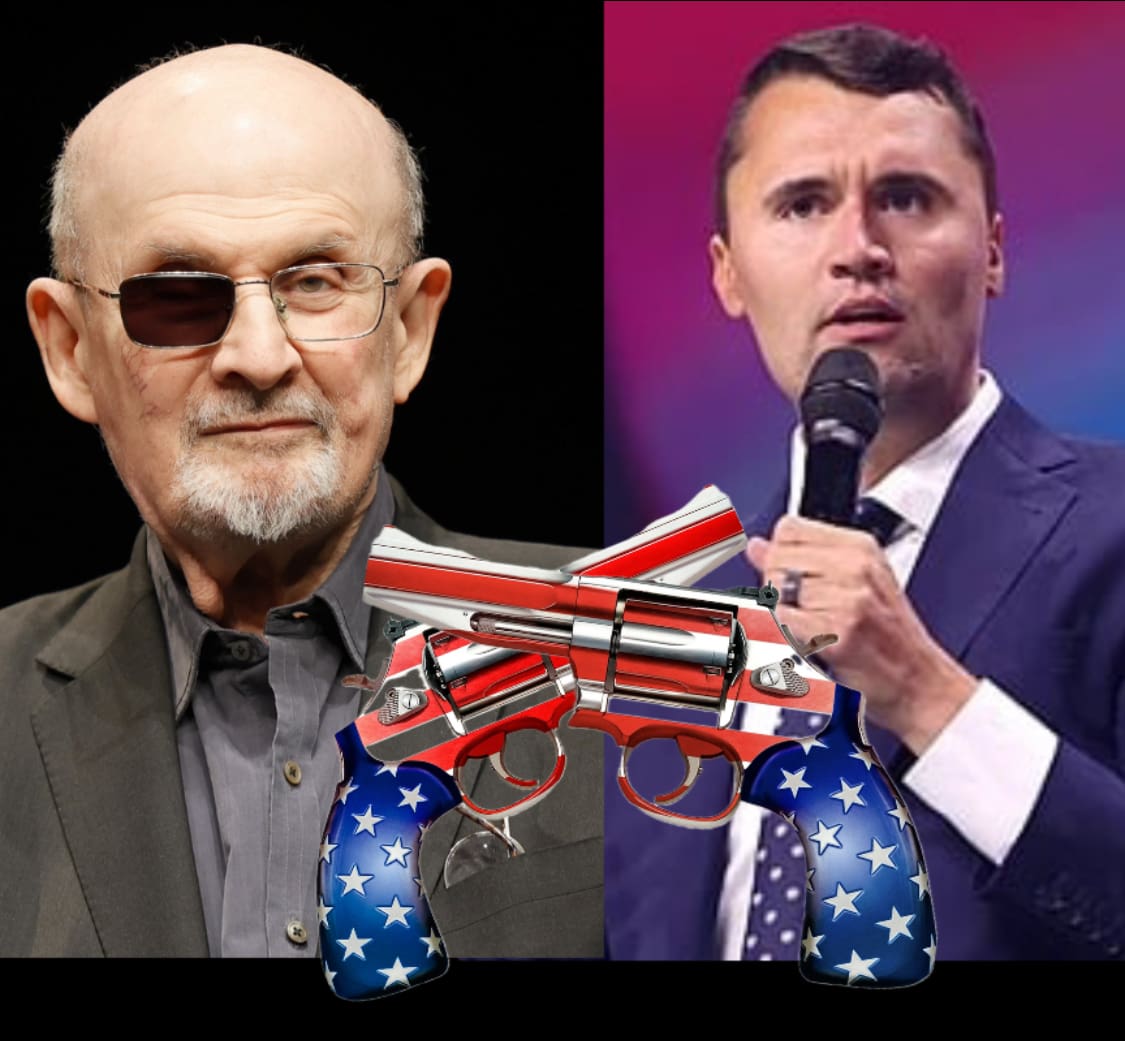
How Salman Rushdie’s Warning Exposes America’s Self-Inflicted Wound
When Sir Salman Rushdie spoke to Sky News about the assassination of Charlie Kirk, his comment was unflinching: the killing, he said, was “a consequence of America’s terrifying gun culture.” It was a stark verdict from a man who has not only written about violence and fanaticism, but survived a savage attempt on his own life.
Kirk — the founder of Turning Point USA and a prominent voice in the modern American right — was shot dead while delivering a speech at a university campus in Utah. The image is chilling: a public figure, standing at a lectern, struck by a single round fired from a rooftop with a high-powered rifle. It is the kind of scene that in many democracies would be almost unthinkable. In the United States, however, it has an awful familiarity.
Rushdie’s observation, then, is not so much radical as inevitable. In a nation where guns outnumber people, where the tools of mass killing are readily available to almost anyone, the line between political disagreement and political assassination narrows drastically. He described a society in which children are taught to use firearms, in which weapons sit unsecured in household cabinets, and in which gun violence has become “almost everyday”. Kirk’s death, he suggested, is simply one of the most brutal illustrations of a cultural disorder.
But there is an additional layer of irony — one that Rushdie himself did not explicitly articulate, yet which hangs heavily over the tragedy. Charlie Kirk spent years vigorously defending the very gun culture that ultimately facilitated his killing. He styled himself as a champion of the Second Amendment, railing against gun-control advocates and casting firearm ownership as the bedrock of American liberty. In that sense, his assassination is not just a devastating loss to his far-right supporters but a grim demonstration of the contradictions within the worldview he helped popularise.
To say this is not to revel in the cruelty of fate, nor to diminish the horror of his death. It is instead to underline Rushdie’s deeper point: that America’s relationship with guns is not merely a policy debate but a structural vulnerability that claims lives irrespective of ideology. For Kirk, the belief that a heavily armed society is a freer one proved catastrophically wrong.
The Paradox of Freedom
For decades, a significant faction of the American right has argued that gun ownership is the ultimate safeguard against tyranny — that an armed population is a bulwark against government overreach and a guarantor of personal liberty. Yet Kirk’s assassination exposes the paradox at the heart of that argument.
Guns may, in theory, protect citizens from hypothetical threats, but in practice they create a society in which the simple act of participating in public life — speaking, organising, dissenting — becomes fraught with lethal risk. What is the value of free speech if a single individual with a rifle can extinguish it before the sentence is finished?
In Rushdie’s framing, the danger does not come from the state but from a dispersed, unpredictable landscape of armed individuals. When the means of instantaneous violence are ubiquitous, the fragility of public discourse becomes impossible to ignore. The gun is no longer a symbol of empowerment; it is a suppressor of expression.
Kirk believed firearms protected liberty. In the end, the presence of a firearm destroyed his own.
A System Built for Tragedy
To interpret Kirk’s death as the result of a lone madman or a political extremist is to miss the structural truth. The United States has normalised a level of gun availability unmatched in the developed world. Policies vary by state, but in many places access to powerful long-range rifles is scarcely restricted. In such a society, assassinations are not aberrations — they are logical outcomes.
Rushdie’s comments gesture toward this systemic reality. A country in which guns are household objects is a country in which political violence is not only possible but predictable. It is telling that within hours of Kirk’s killing, the public conversation shifted not to the incredulity that such a weapon could be obtained, but instead to the identity and motives of the shooter. The existence of the gun itself — the instrument that made the act so easy — is treated as background noise.
Embedded within that normalisation is a cultural mythology: the romantic notion of the frontier, the rugged individual, and the armed citizen fending off threats. This mythology persists even as the toll of gun violence rises, even as schools, churches, synagogues and supermarkets become sites of massacre.
In reality, guns do not function as instruments of freedom. They function as a permanent destabilising force, rendering every public space vulnerable. When guns are everywhere, safety is nowhere.
The Price of Polarisation
The United States is more polarised now than at any point in living memory. Political identities are hardened, tribal, absolutist. In such an environment, firearms become not merely tools but symbols — extensions of a culture war that has replaced debate with hostility.
Kirk, through his activism and media presence, helped foster a political style defined by conflict, grievance and mobilisation. He was a central figure in transforming American university campuses into ideological battlegrounds. Yet even for someone who thrived on confrontation, the escalation from rhetorical combat to physical violence is terrifyingly swift in a heavily armed society.
The boundary between speech and threat blurs. Passion curdles into paranoia. Demagogues on both sides warn their followers that the nation is under siege. In this feverish atmosphere, a lone gunman does not need a detailed political manifesto — only a weapon and a grievance.
When politics becomes war by other means, the tools of war inevitably follow.
Rushdie’s Warning — and America’s Reckoning
Rushdie knows the cost of fanaticism and the fragility of artistic and political expression. He also knows what it means to live under a death threat — and, ultimately, to be stabbed nearly to death by someone who believed violence was the answer to an idea.
His comments on Kirk’s killing, then, carry moral authority. They are not partisan. They are diagnostic.
America’s gun culture, Rushdie argues, births tragedies not because of one political ideology or another but because it creates an environment where violence is accessible, instantaneous and lethally efficient. In such a country, even the loudest defenders of gun rights may find themselves, as Kirk did, unable to escape the consequences of the culture they defended.
The Collapse of the Social Contract
A functioning democracy depends on a shared belief that disputes can be settled through argument rather than force. Guns break that contract. They allow the angriest person in the room — or in the rooftop across the street — to decide the outcome of a conversation with a trigger pull.
Charlie Kirk’s assassination is a warning. Not that political passions run high — they always have — but that the tools of violence are so widely distributed that any grievance can become fatal.
Rushdie’s insight is simple but devastating: America is not being undone by speech, or by political correctness, or by ideological disagreement. It is being undone by its own weapons.
Until the nation confronts that truth, it will continue to produce martyrs not for causes, but for a culture that mistakes danger for freedom.