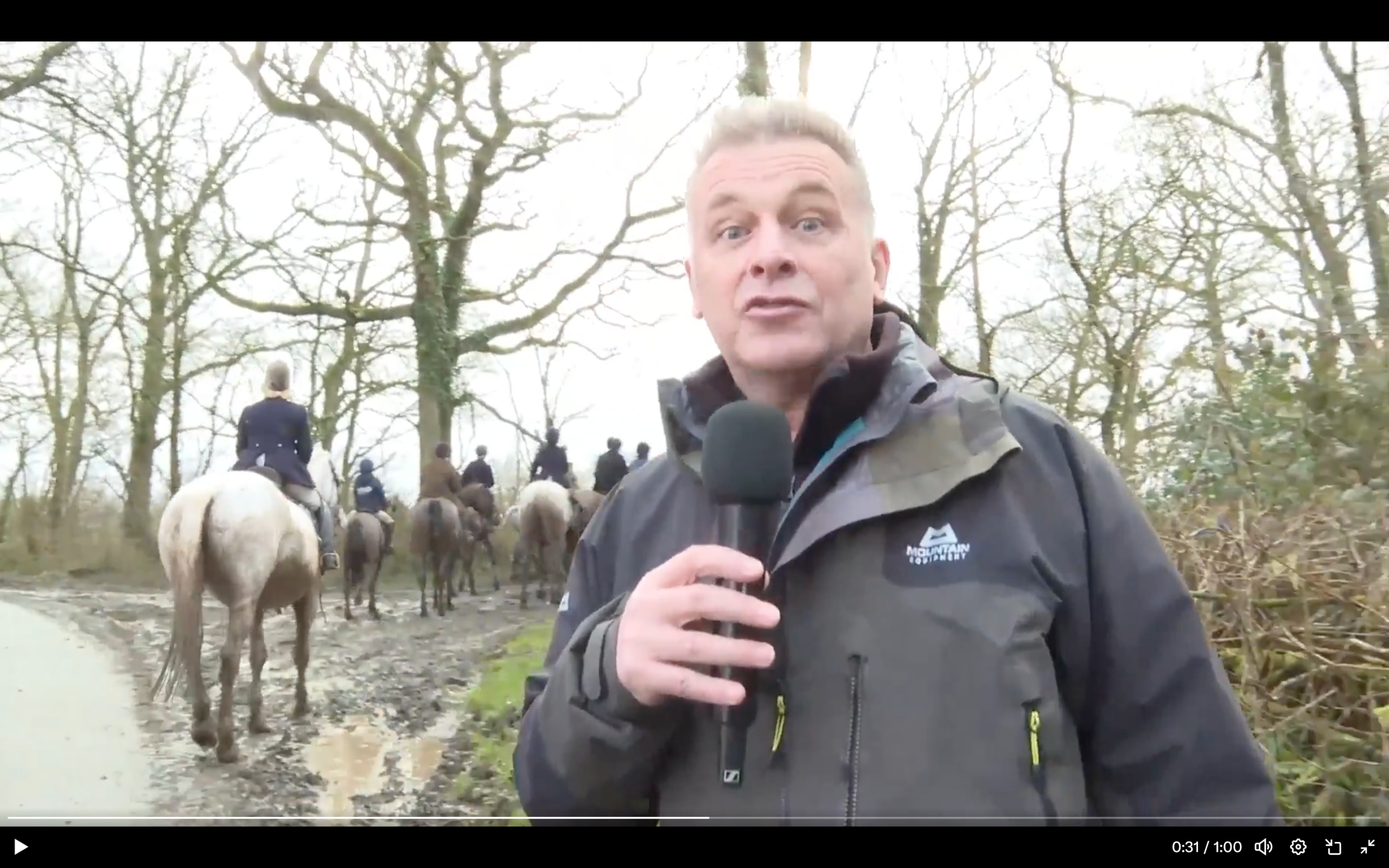
During Operation Smokescreen, a coordinated monitoring effort involving broadcaster and conservationist Chris Packham, zoologist and campaigner Megan McCubbin, and experienced hunt saboteurs, footage emerged that appears to show the Blackmore and Sparkford Vale Hunt engaging in activities explicitly banned under the Hunting Act 2004, which came into force in 2005.
The operation, carried out in the West Country, documented what monitors say was not “trail hunting”, the legal fiction used by hunts since the ban, but the active pursuit of a live fox.
The evidence, shared publicly by those involved, is stark.
It’s like we’ve got a tardis and have gone back in time to an ancient medieval savagery! Watching these people who are clearly not laying and following a scent trail but instead are actively hunting foxes on a Saturday morning! Help to stop fox hunting: https://t.co/gV6owKxh94 pic.twitter.com/8FkSMZHkoh
— Chris Packham (@ChrisGPackham) February 7, 2026
Coming to you LIVE from #OperationSmokeScreen We're out with the Blackmore & Sparkford Vale Hunt, famous for their violence and their illegal fox hunting. We're streaming all day @NDHuntSabs @HuntSabs pic.twitter.com/iJtJ5nC73v
— Chris Packham (@ChrisGPackham) February 7, 2026
“Shouldn’t you be looking at a tit somewhere?” “I am!”
— Chris Packham (@ChrisGPackham) February 7, 2026
Locals and those speaking up have to deal with intimidation from fox hunts and it’s not right. #OperationSmokescreen@MeganMcCubbin @NDHuntSabs @HuntSabs pic.twitter.com/TLyfTEA8AR
They’ve been openly fox hunting. They simply don’t care because they know they won’t be held accountable. Well it's time to hold them accountable for the crimes they are committing against wildlife, against people & against simple decency in the UK: https://t.co/gV6owKxh94 pic.twitter.com/MI5XkumhUV
— Chris Packham (@ChrisGPackham) February 7, 2026
Video clips show hounds digging frantically in woodland, behaviour consistent with a fox being driven to ground rather than following an artificially laid scent. In another clip, a rider is seen with visible blood smeared on their jacket, raising serious questions about contact with a hunted animal. Perhaps most damning is footage of a terrier man riding a quad bike, a practice tightly restricted under law and widely associated with flushing foxes from underground, an act illegal unless carried out under highly specific exemptions.
As Packham and McCubbin both stated during the operation, these are not incidental details. They are precisely the behaviours Parliament sought to outlaw twenty years ago.
A Hunt with a Record
The Blackmore and Sparkford Vale Hunt is no stranger to controversy or the courts. In April 2025, four members of the hunt were convicted for offences relating to illegal hunting activity, a fact that casts a long shadow over claims that this was merely lawful trail hunting gone awry.
Trail hunting, introduced after the ban, was intended to involve hounds following a pre-laid, artificial scent, with no live quarry present. In practice, critics argue it has functioned as a loophole, allowing hunts to continue traditional fox hunting under a different name. Operation Smokescreen was designed specifically to test that claim and, according to those involved, the Blackmore and Sparkford Vale Hunt failed that test spectacularly.
The presence of terrier men, the behaviour of the hounds, and the apparent lack of any genuine attempt to divert them away from wildlife all point, monitors argue, to deliberate lawbreaking rather than accident.
Intimidation and Public Danger
Getting abuse shouted at us by the Blackmore & Sparkford Vale Hunt, known for their violence and their illegal fox hunting. #OperationSmokescreen @MeganMcCubbin @NDHuntSabs @HuntSabs pic.twitter.com/e5Rsy7lWtv
— Chris Packham (@ChrisGPackham) February 7, 2026
The operation also exposed the collateral harm hunts can cause to local communities.
Residents reported road safety risks, with hounds, horses, and quad bikes moving unpredictably across public highways. Such incidents are a recurring complaint in hunting areas, where rural roads become temporarily hazardous due to hunt activity.
“I just want to go to the shop and it’s turned into a nightmare”
— Chris Packham (@ChrisGPackham) February 7, 2026
Local reports of the chaos and distress the hunt that we are following in Dorset today cause. #OperationSmokescreen @MeganMcCubbin@NDHuntSabs @HuntSabs pic.twitter.com/hEj6iwcnIf
Meanwhile, hunt monitors and saboteurs reported being shouted at and verbally abused by hunt supporters. This aggressive response to scrutiny has become a familiar feature of hunt monitoring across the UK, reinforcing concerns about a culture of entitlement and impunity within sections of the hunting world.
As McCubbin noted during the operation, the reaction of hunt supporters often appears less like that of people confident in their legality, and more like that of those angered by the presence of witnesses.
Political Pressure Mounts
Operation Smokescreen takes place against a rapidly shifting political backdrop. The Labour government, elected amid widespread public concern over animal welfare, has committed to ending trail hunting altogether, citing overwhelming public support for a complete ban.
Polling consistently shows that the majority of the British public believes fox hunting should remain illegal and that trail hunting is being abused. The evidence emerging from operations like this one strengthens the argument that the current law is unenforceable in practice, relying too heavily on trust in organisations with a documented history of non-compliance.
And remember Nigel Farage has stated clearly his support for hunting animals and will remove all prohibitory legislation if elected.
For campaigners, the Blackmore and Sparkford Vale Hunt is not an anomaly; it is a case study.
Beyond “Tradition”
Hunt supporters frequently frame criticism as an attack on rural tradition. But Operation Smokescreen cuts through that rhetoric. What it documents is not heritage or countryside stewardship, but a pattern of alleged criminal behaviour, intimidation of observers, and disregard for both animal welfare and public safety.
The Hunting Act was passed because Parliament concluded that causing unnecessary suffering to animals for sport was morally indefensible. Two decades on, the footage from Somerset suggests that for some hunts, the law remains an inconvenience rather than a boundary.
As pressure mounts for legislative reform, one thing is increasingly clear: the debate is no longer about whether fox hunting still happens, but about how long it will be tolerated in plain sight.