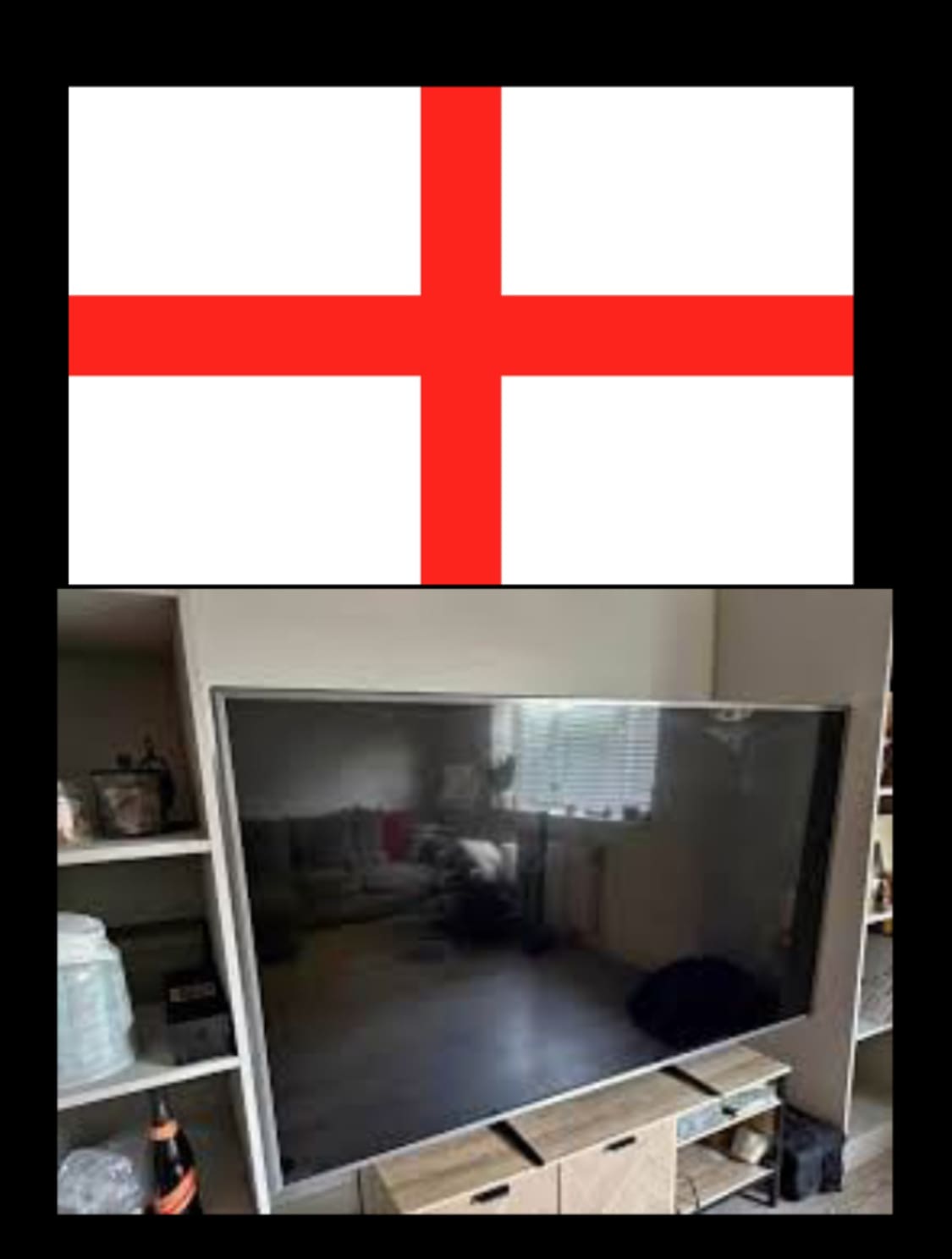
We know that many working-class people on the borderline or over the borderline of poverty are vulnerable to nationalist ideologies. History has taught us that. Thus, when we are confronted with housing estates flying St. George and Union flags in their gardens or lamp posts, we have a symbol of class deprivation. The middle classes and upper classes would rarely be so vulgar. Yet we also know that the very system that has crushed them is the very system many declare their support for. There are multiple reasons for this, ranging from their level of critical thinking skills to their choice of news outlets. This article, however, is not attempting to discuss the sociological reasoning of deprived people to fly a nationalist flag but to focus on why so many of this group of people pour their incomes into large TVs.
Let us start with some Germanic humour and then assess sociologically the reasons for those big TVs.
Nenning Wehn on St. George and big TVs.
The Big Screen on the Estate: More Than Just a Television
Walk through any housing estate in Britain, from the sprawling post-war developments to the more modern complexes, and you’ll spot a common feature in the windows: the unmistakable blue glow of a large, flat-screen television. To some, it’s a puzzling sight, a symbol of misplaced priorities. Why, critics might ask, would someone on a tight budget invest in a 55+-inch TV?
The answer, however, is far more nuanced than simple frivolity. The presence of a large TV in a working-class home is not a paradox; it’s a rational choice rooted in economics, social reality, and a very human need for comfort and escape.
The Economics of Entertainment
Let’s start with the cold, hard maths. A decent, large-screen TV is no longer the luxury item it once was. Technological advancement and mass production have driven prices down dramatically. You can now purchase a capable 50+-inch smart TV for well under £300, less than many monthly grocery bills or the cost of a family-of-four’s monthly energy direct debit.
Compare this to the ongoing, often prohibitive, cost of other forms of leisure. A single night out for a couple—covering drinks, a meal, a cinema ticket, and a babysitter—can easily exceed £100. A season ticket for a Premier League football club runs into the thousands. A family holiday abroad? Often an unimaginable expense.
In this context, a large TV is a one-off, relatively affordable purchase that provides thousands of hours of entertainment for the entire household. It’s not an extravagance; it’s a highly cost-effective investment in home-based leisure.
The Hub of the Home
For many families, the living room revolves around the television. It’s a communal space for bonding. It’s where parents unwind after a long shift, where kids watch their favourite programmes, and where everyone gathers to watch a film together on a Friday night. In a culture where ‘corner shop conversations’ have dwindled and local community centres have closed, the home has become an even more crucial sanctuary.
The large screen facilitates this. It makes the experience more immersive and shared, a focal point for family life. It’s the modern equivalent of gathering around the hearth, a centre of warmth and togetherness.
Escape and Aspiration
Life on a limited income can be stressful and often grim. The pressure of making ends meet, navigating a complex benefits system, or working unstable hours takes a significant psychological toll. Television offers a vital form of escape.
A large, high-definition screen amplifies this escape. It’s a window to another world, whether it’s the dazzling glamour of a Hollywood blockbuster, the sun-drenched beaches of a travel documentary, or the thrilling drama of a football match played in a pristine stadium. It allows for a temporary respite from immediate financial worries and the sometimes oppressive environment of a struggling estate.
Furthermore, it’s a symbol of normalcy and aspiration. Owning a nice, modern television is something that everyone, regardless of class, is ‘supposed’ to have. It’s an attainable piece of the middle-class dream, a marker of participation in mainstream consumer culture.
The Digital Social Life
In the 21st century, a TV is rarely just a TV. Most are now ‘smart’, functioning as the family’s portal to the internet, streaming services, YouTube, and social media. For younger generations, this digital access is not a luxury; it’s essential for social connection, homework, and understanding the world.
A larger, better-quality screen enhances this experience, making video calls with relatives clearer, gaming more engaging, and streaming educational content more accessible. In an age where so much of our lives are lived online, criticising the means to access it is to misunderstand a fundamental modern need.
A Question of Judgement
The criticism of ‘big TVs on estates’ often reeks of a patronising and outdated class prejudice. It implies that those with less money should not enjoy the same quality of leisure as those with more, and that their spending should be micromanaged according to an outsider’s values.
The reality is that working-class families are expert budgeters out of necessity. They make calculated decisions on how to maximise their limited resources for happiness and stability. A large television represents immense value for money, providing family entertainment, escapism, and a connection to the wider world—all from the comfort and safety of their own front room.
Perhaps instead of questioning the screen in their window, we should be questioning the systems that make it one of their most affordable and valuable forms of respite. The big TV isn’t the problem; it’s a symptom of a much larger picture.