

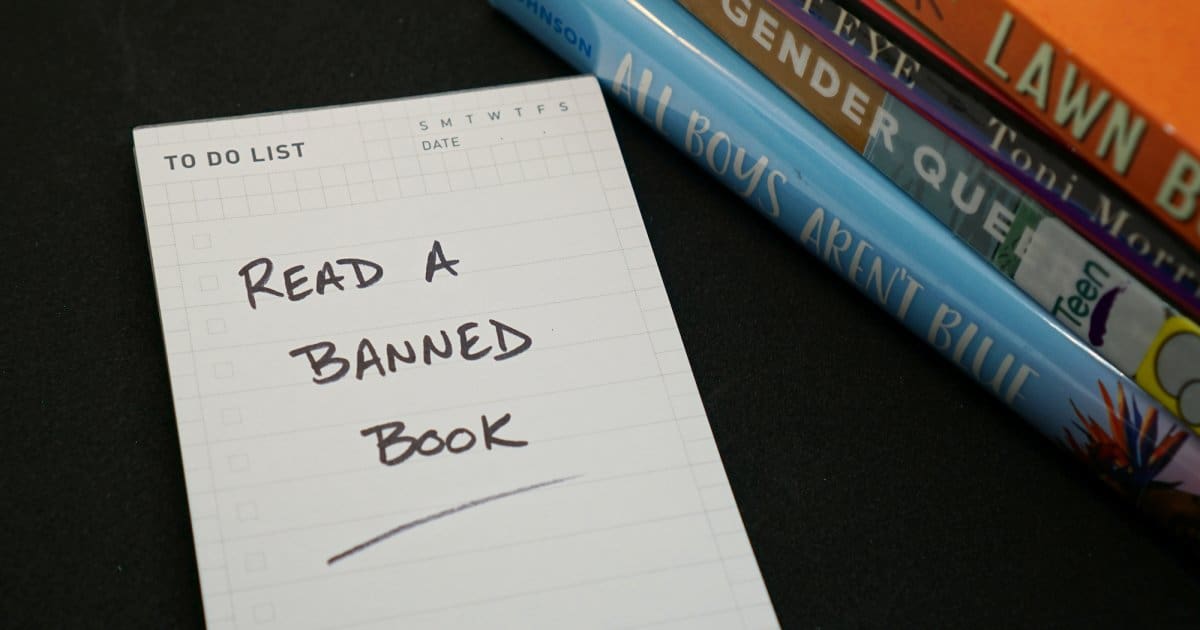
Every year, Banned Books Week celebrates the freedom to read and draws attention to the dangers of censorship. It’s a stark reminder that throughout history and even today, books are challenged, restricted, or removed from shelves for their ideas. Reading these works is an act of intellectual defiance, a way to understand different perspectives, and a celebration of the very liberty that censorship seeks to suppress.
Here are some seminal works, all banned at one time or another, that deserve a place on your reading list.
1. Lady Chatterley’s Lover by D.H. Lawrence
- The Banning: The unexpurgated version of Lawrence’s novel was the subject of a landmark obscenity trial in the UK in 1960. Penguin Books was prosecuted under the Obscene Publications Act for its explicit descriptions of sexual acts and its use of four-letter words. The prosecution famously asked the jury, “Is it a book you would wish your wife or your servants to read?” The defence won, marking a pivotal moment in the liberalisation of publishing in Britain.
- Why You Should Read It: Beyond its notoriety, the novel is a powerful critique of the class system and a passionate argument for the importance of sexual and emotional fulfilment. Reading it today is to engage with a work that fundamentally changed the landscape of British literature and free expression.
2. The Well of Loneliness by Radclyffe Hall
- The Banning: Published in 1928, this novel was groundbreaking for its sympathetic portrayal of a lesbian protagonist. It was declared obscene in a UK court for its subject matter alone, with the magistrate stating the book would “corrupt and deprave” those who read it. All copies were ordered destroyed.
- Why You Should Read It: It is a cornerstone of LGBTQ+ literature. While its portrayal may seem dated now, its historical significance is immense. Reading it is an act of acknowledging a history that was systematically silenced and understanding the long struggle for representation.
3. A Clockwork Orange by Anthony Burgess
- The Banning: Burgess’s dystopian classic faced numerous challenges for its extreme depictions of “ultra-violence” and sexual assault. In the UK, it was withdrawn by its own publisher for years after critics linked it to copycat crimes. Schools and libraries in the US and elsewhere have frequently challenged it for its disturbing content.
- Why You Should Read It: The novel is a profound philosophical exploration of free will, morality, and the nature of evil. Burgess argues that a person forced to be good is no longer a person at all. It’s a challenging but essential read about the cost of stripping away individual choice, however flawed that individual may be.
4. Ulysses by James Joyce
- The Banning: This modernist masterpiece was banned in the UK and the US upon its publication in the 1920s for its perceived obscenity and sexual content. It was famously smuggled into the United States and was the subject of a pivotal 1933 US court case that ruled it was not pornographic, setting a new legal standard for literary merit.
- Why You Should Read It: Ulysses is a monumental celebration of human consciousness, following the stream of thought of its characters over a single day in Dublin. To read it is to conquer a mountain of literary censorship and to experience one of the most innovative and influential novels ever written.
5. Animal Farm by George Orwell
- The Banning: Orwell’s allegorical satire of the Soviet Union was rejected by multiple publishers, including T.S. Eliot, who felt its critique of a wartime ally (Stalin’s Russia) was ill-timed. It was later banned in the USSR and other Eastern Bloc countries, as well as in places like the UAE for its themes that contradicted Islamic values. It has also been challenged in US schools for being “anti-communist.”
- Why You Should Read It: It is a timeless and devastating fable about how revolutions can be betrayed by tyranny and propaganda. Its warning about the corruption of power is universally applicable and remains as relevant today as it was in 1945.
6. The Country Girls by Edna O’Brien
- The Banning: Upon its publication in 1960, O’Brien’s frank depiction of the sexual lives and desires of young women in rural Ireland was considered scandalous. The book was banned by the Irish Censorship Board for its “indecency,” and was even publicly burned by O’Brien’s own parish priest.
- Why You Should Read It: This novel broke the silence on female experience in a deeply conservative society. It paved the way for generations of Irish women writers. Reading it is to witness a courageous act of literary rebellion that gave voice to suppressed stories.
7. Trainspotting by Irvine Welsh
- The Banning: Upon its publication in 1993, Welsh’s novel shocked readers with its graphic, unflinching portrayal of a group of heroin addicts in Edinburgh. While not officially banned in the UK, it was denied an entry for the Booker Prize on the grounds of being “too offensive,” and many booksellers refused to stock it. It has faced countless challenges in schools and libraries worldwide for its extreme profanity, violent scenes, and graphic depictions of drug use and sex.
- Why You Should Read It: Trainspotting is a vital social document that gives a voice to a marginalised, disenfranchised underclass. Its use of raw Scots dialect and its chaotic, non-linear structure immerse the reader in the fragmented consciousness of its characters. It doesn’t glorify addiction but exposes its brutal reality, making it a powerful, if harrowing, work of social realism.
8. Fahrenheit 451 by Ray Bradbury
Why You Should Read It: This is the quintessential novel about censorship. Bradbury doesn’t just warn against state-sponsored censorship, but also against the tyranny of the majority and the dumbing down of culture by mass media. Reading a book about the burning of books that has itself been censored is a powerful, meta-textual experience that underscores the enduring relevance of its warning.
The Banning: In a profound irony, Bradbury’s classic about a future society where books are banned and burned has itself faced numerous challenges and bans. It has been expurgated by publishers to remove “offensive” language and references to abortion, and has been banned in some US schools for its depiction of burning Bibles and its use of profanity.
A Broader Look at Censorship
The impulse to ban books extends far beyond these eight, often targeting stories that challenge the status quo in any era:
- Black Beauty was banned by the Apartheid regime in South Africa purely for the word “Black” in its title.
- Alice’s Adventures in Wonderland was banned in 1930s China for its “disrespectful” anthropomorphism of animals.
- All Quiet on the Western Front was burned by the Nazis for its pacifist, anti-war message.
- I Know Why the Caged Bird Sings, Maya Angelou’s seminal memoir, has been repeatedly challenged in the US for its unflinching account of racism and sexual assault.
- Last Exit to Brooklyn was successfully prosecuted as obscene in the UK in 1967 for its gritty portrayal of urban life.
“These books caught BANS through their own fault—it’s a drug abuse or a homosexual act.
GOOD bans are something innocent; I support books that have caught good BANS because they caught them through no fault of their own.”
[Brass Neck]
All of the following books have received more than 1 million ratings on the Goodreads website.
All of them are or have been removed from public or school libraries because of concerns about some of the language and/or themes:
Romeo & Juliet
Hamlet
Macbeth
Pride & Prejudice
Jane Eyre
Wuthering Heights
Little Women
Frankenstein
The Picture Of Dorian Gray
Dracula
The Adventures Of Tom Sawyer
The Adventures Of Huckleberry Finn
The Great Gatsby
Of Mice & Men
The Catcher In the Rye
To Kill A Mockingbird
Brave New World
Animal Farm
1984
Fahrenheit 451
The Handmaid’s Tale
The Hobbit + the entire Lord Of The Rings trilogy
The Lion, The Witch & The Wardrobe
Charlotte’s Web
The Giving Tree and Where The Sidewalk Ends
Lord Of The Flies
The Outsiders
The Alchemist
The Giver
The Hitchhiker’s Guide To The Galaxy
The entire Harry Potter series
The entire Twilight series
The original Hunger Games trilogy
The entire series of A Court Of Thorns & Roses
The Diary Of A Young Girl [Anne Frank]
The Kite Runner
The Book Thief
The Help
The Fault In Our Stars.
At this time The Hate U Give is 4,346 ratings short of being eligible for inclusion in that list.
Which is still 76,439 ahead of Charlie & The Chocolate Factory.
During Banned Books Week, picking up one of these titles is more than just a choice of what to read. It is a conscious decision to engage with challenging ideas, to listen to silenced voices, and to affirm that in a free society, the reader—not the censor—gets to choose.







