Trump’s War for Survival: Why the President Attacked Iran
When the United States launched strikes on Iran under the orders of Donald Trump, the White House framed the action as a matter of national security. Officials spoke of deterrence, Iranian aggression and the need to prevent nuclear escalation. But outside the carefully crafted language of government statements, a far more cynical explanation has taken hold. With Trump’s popularity sinking and midterm elections looming, critics argue the attack on Iran looks less like strategic necessity and more like political desperation.
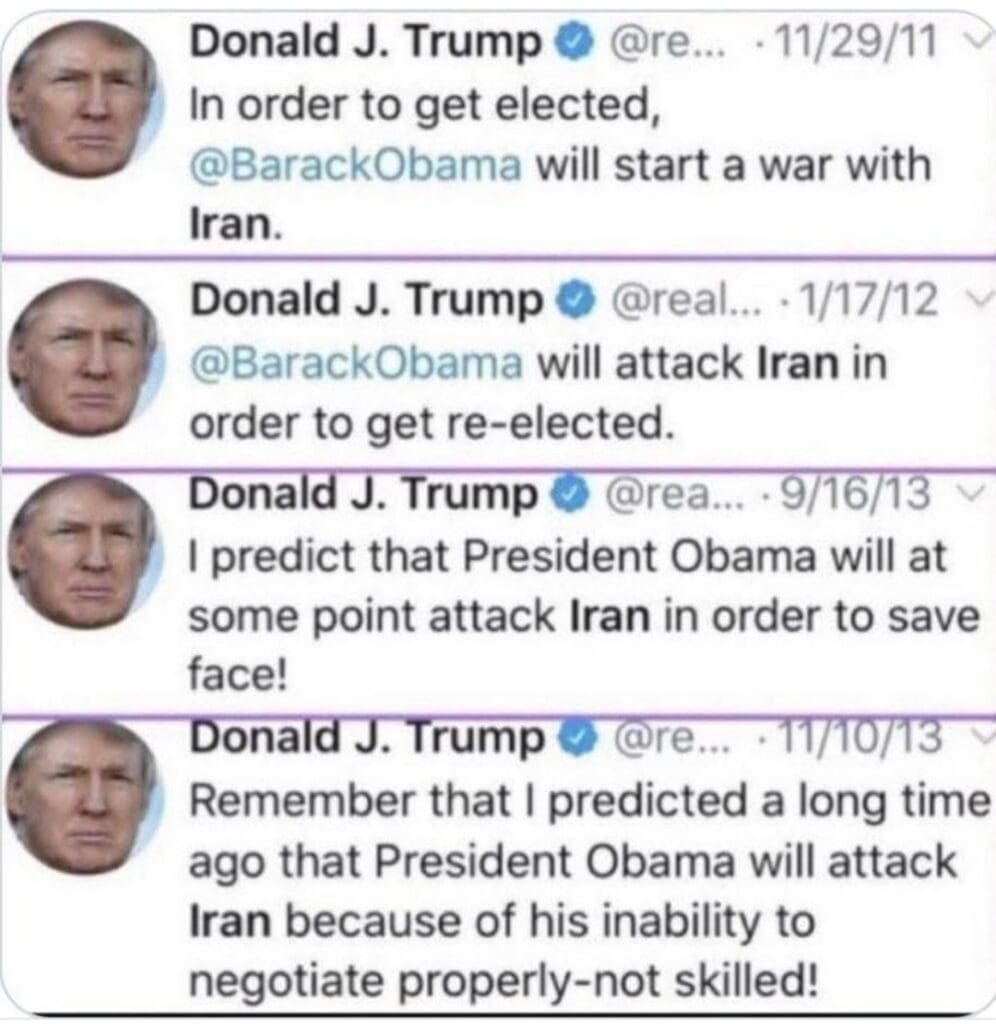
The most damning evidence comes not from Trump’s opponents, but from Trump himself. Years before he entered the White House, Trump repeatedly accused Barack Obama of planning to attack Iran purely to win reelection. In 2011 he wrote that Obama would “start a war with Iran in order to get elected.” In 2012 he doubled down, predicting Obama would attack Iran “in order to get re-elected.” In 2013 he again warned that Obama might attack Iran “to save face.” These posts were not casual remarks. They were statements of belief about how political power works. Trump clearly understood the temptation leaders face when their popularity falters: start a conflict abroad and hope patriotism at home rescues you.
More than a decade later, the circumstances surrounding Trump’s own decision to strike Iran look eerily similar to the scenario he once described.
Trump entered the year facing serious political headwinds. His approval ratings had nosedived, even among some voters who had previously supported him enthusiastically. Economic anxiety, political fatigue, and growing divisions within the Republican coalition were beginning to erode the aura of political invincibility that once surrounded him. At the same time, midterm elections were approaching, elections that historically punish the party of the sitting president.
For a leader who has built his entire career around winning, losing Congress would be a devastating blow. Control of the House of Representatives or the Senate determines the political agenda in Washington. It decides whether a president governs freely or faces endless investigations, blocked legislation, and legislative paralysis. For Trump, losing Congress would mean years of political trench warfare.
In that context, the decision to attack Iran begins to look less like strategic necessity and more like political calculation.
Political scientists have long observed the “rally around the flag” effect. When a nation goes to war or faces an international crisis, public opinion often temporarily swings in favour of the leader in power. Citizens put aside partisan differences in the name of national unity. Approval ratings rise. Criticism softens. The leader appears strong and decisive.
Presidents throughout history have benefited from this effect. Military action, even limited action, can dominate the news cycle, drown out domestic criticism, and reposition a struggling leader as a wartime commander. The political benefits are obvious.
Trump understood this dynamic years before he entered office. His tweets about Obama were essentially an admission that war can function as a political tool.
Now critics argue he may have used the same tactic himself.
The timing is certainly striking. The attack occurred at a moment when Trump was under mounting pressure at home. Economic challenges were dominating headlines. Polling suggested growing skepticism among voters about the administration’s direction. Political allies were openly worrying about the coming elections.
Then suddenly the narrative changed.
The news cycle shifted overnight from domestic political problems to international conflict. Television networks began broadcasting images of missile strikes, military briefings, and escalating tensions. Commentators debated Iran’s nuclear ambitions and regional power rather than Trump’s approval ratings.
For a White House under pressure, the change of subject could hardly have been more convenient.
But war is a dangerous political gamble.
While leaders may hope for a rally effect, military conflicts often produce the opposite result. Initial support can evaporate quickly if a conflict drags on or casualties mount. The Iraq War under George W. Bush offers a powerful reminder of how quickly public opinion can turn once a war becomes prolonged and costly.
Trump also campaigned heavily on a promise to end America’s “endless wars” in the so-called Middle East. That promise resonated strongly with voters tired of decades of conflict in the region. By launching a new military confrontation with Iran, Trump risks betraying the very message that helped him win political support in the first place.
The backlash has already begun inside the conservative movement itself.
Some prominent conservative commentators have supported the strike, arguing that Iran’s regional activities and nuclear ambitions justify decisive action. Others have reacted with alarm, warning that the United States could once again become trapped in a massive ‘Middle Eastern’ conflict with no clear exit strategy.
The split reflects a deeper ideological struggle within modern American conservatism. Traditional foreign policy hawks favor aggressive military deterrence, while the newer populist wing is one of the forces behind Trump’s political rise. tends to favour isolationism and skepticism toward foreign wars.
By attacking Iran, Trump may have satisfied one faction while alienating another.
The international consequences are even more unpredictable. Iran is not a minor power. It possesses significant military capabilities, deep regional alliances, and the ability to destabilise large parts of the ‘Middle East’. Any conflict risks spreading beyond a single set of strikes into a much wider confrontation involving multiple states.
Once war begins, control over events rapidly slips away from those who started it.
That is why Trump’s earlier tweets now appear so hauntingly relevant. When he warned that a president might attack Iran to boost political fortunes, he was acknowledging a dark truth about political power: that leaders under pressure sometimes seek salvation through conflict.
Today those same words hang over his own presidency.
Trump may insist that the attack on Iran was about national security, and perhaps in part it was. Governments rarely act for only one reason. Strategic, ideological, and political motivations often blend together in decisions of war and peace.
But the timing, the domestic political context, and Trump’s own past statements create a deeply uncomfortable question.
Did the president launch a war because it was necessary or because he needed it?
History will eventually judge the answer. For now, the world is left confronting the consequences of a decision that may have been shaped as much by political survival as by national security.
And the most powerful evidence for that suspicion may still be those old tweets, written years ago, in which Donald Trump himself described exactly how such a war might begin.