

The European Green Party has launched a blistering attack on US President Donald Trump after he reportedly threatened to “cut off all trade with Spain” in response to Madrid’s opposition to US-Israeli military strikes on Iran. But their criticism did not stop in Washington. It also landed squarely in Berlin.
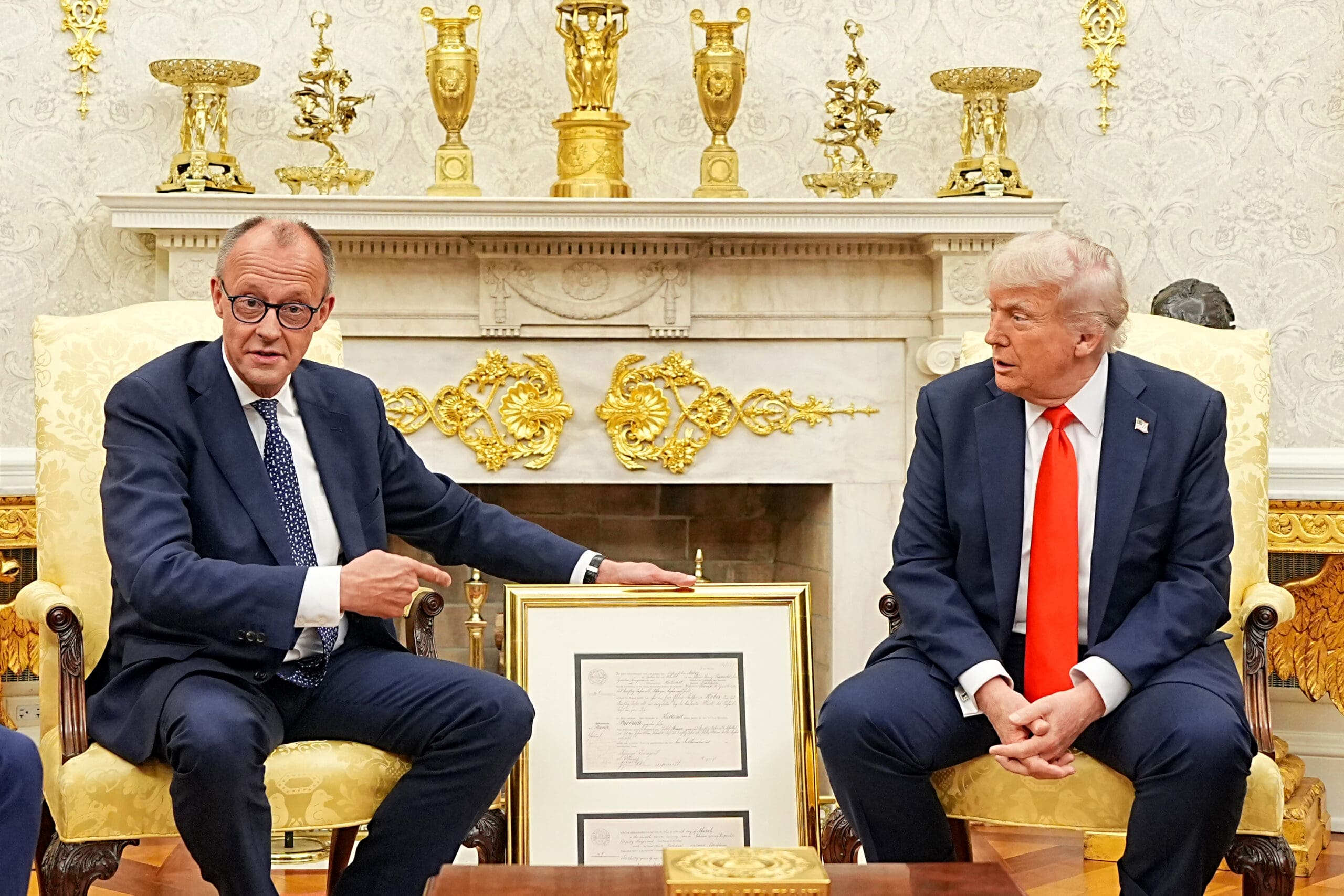
At the centre of the row is German Chancellor Friedrich Merz, accused by the Greens of failing to defend a fellow EU member state when its economy was placed in the rhetorical crosshairs of the White House.
The dispute erupted after Spain’s Prime Minister Pedro Sánchez took a firm stance against the US-Israel attacks, arguing that they lacked a United Nations mandate and fell outside the framework of international law. For Madrid, the issue is not ideological posturing but adherence to established legal norms that underpin global stability.
Vula Tsetsi, co-chair of the European Green Party, was unequivocal. She argued that Spain’s position reflects core European values: respect for multilateralism, international law, and the primacy of diplomatic solutions over unilateral force. “Disagreements over foreign policy positions cannot justify economic retaliation against an EU Member State,” she said, warning that economic threats aimed at one country amount to threats against the entire European Union.
Her point strikes at the heart of the EU’s identity as a single market. Trade policy is not a bilateral plaything; it is an exclusive EU competence. Any attempt to “cut off all trade” with Spain would, by definition, mean confronting the European Union as a whole. The Greens argue that this reality demands unity, not silence.
Yet it is precisely that silence they say characterised Merz’s response. According to the party’s co-leaders, the German chancellor failed to publicly challenge Trump’s threat when it was made. For a country that positions itself as the engine of Europe and the guardian of EU cohesion, that omission is seen as more than a diplomatic oversight, it is portrayed as a dangerous signal of weakness.
Ciarán Cuffe, the party’s other co-chair, framed the issue as one of principle. “Europe must speak with one common voice when the principles of international law are violated,” he said. That common voice, in the Greens’ view, should defend both the rule of law abroad and the integrity of the European project at home.
The Greens are also keen to draw a careful distinction on Iran. They stress full solidarity with the Iranian people and civil society actors seeking democratic reform and freedom. But that solidarity, they argue, cannot be conflated with endorsing military strikes that lack international legal backing. Supporting democracy does not mean suspending international law.
Adding to their criticism is what they describe as inconsistency within the US administration itself. Trump’s public rhetoric, they claim, has not aligned neatly with statements from other senior US figures, including Secretary of State Marco Rubio. If objectives are unclear or shifting, the Greens argue, that only reinforces the need for Europe to anchor its response in stable legal principles rather than volatile geopolitics.
For Merz, the political calculation is delicate. Germany has traditionally balanced strong transatlantic ties with a rhetorical commitment to European autonomy. But critics say that when push comes to shove, Berlin often hesitates to confront Washington directly. In the current climate, such hesitation risks being interpreted not as prudence, but as capitulation.
The Greens’ intervention reflects a broader debate within Europe about strategic sovereignty. If the EU is to be taken seriously as a geopolitical actor, it cannot allow individual member states to be singled out for economic intimidation without response. The single market is not merely an economic arrangement; it is a political commitment to mutual defence of shared interests.
Whether Merz recalibrates his stance remains to be seen. But the message from the European Green Party is unmistakable: Europe’s leaders must defend the bloc collectively when one member is threatened. In their eyes, standing up to Trump is not about antagonism for its own sake; it is about defending the legal and economic foundations of the European Union itself.
In an era of escalating global tensions, the Greens argue, Europe’s credibility depends on consistency. If the EU preaches international law, it must practise solidarity. If it champions unity, it must demonstrate it under pressure. And if its leaders aspire to shape the global order, they cannot shrink when that order is challenged.







