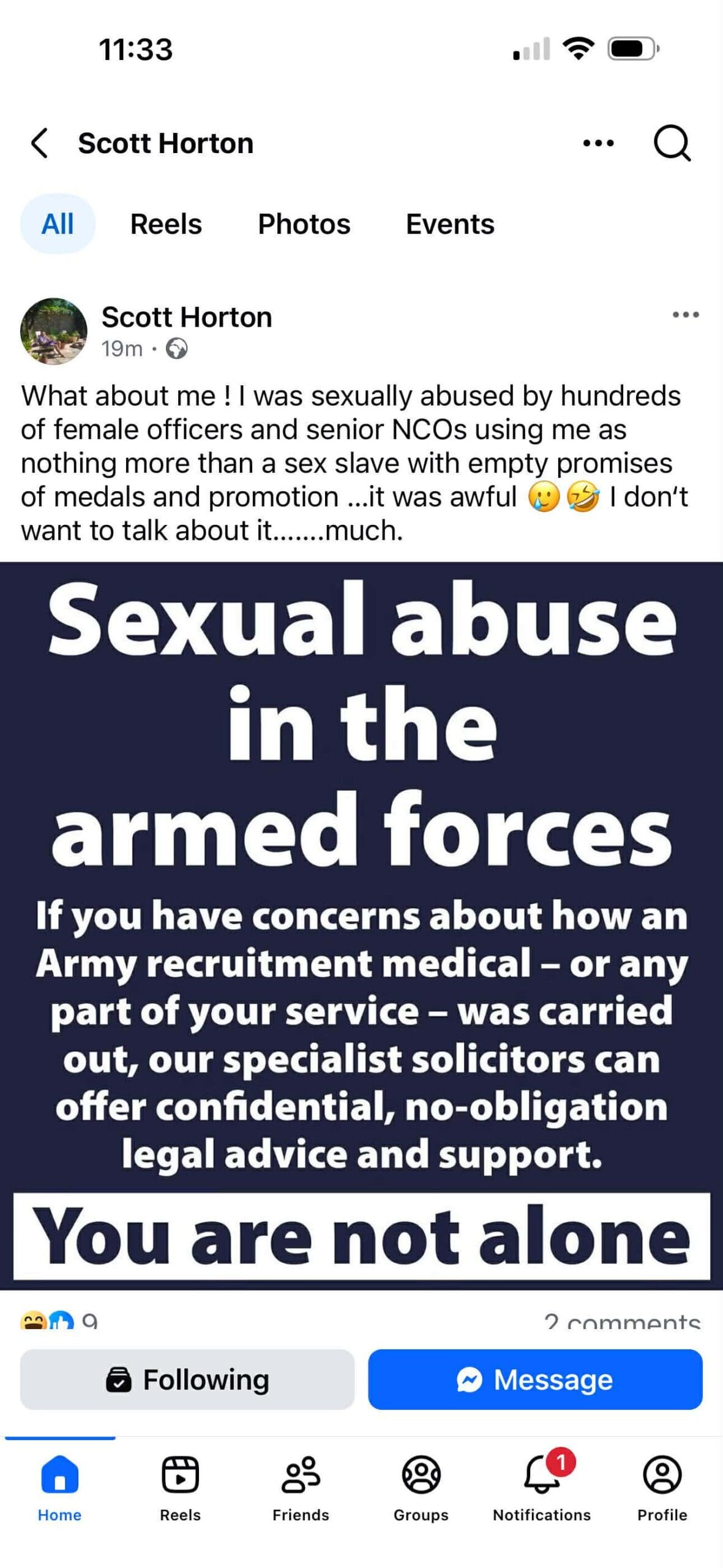
We already know that Horton is an admirer of Reform UK, Donald Trump and Tommy Robinson. He has openly espoused it. What we now need to do is add up the numbers by observing his behaviour.
There are some subjects that demand gravity. Sexual abuse in the armed forces is one of them. Families have buried sons and daughters. Survivors have carried trauma in silence for years. Coroners have described systemic failings. Against that backdrop, Scott Horton’s recent social media post, reducing sexual exploitation to a flippant boast laced with laughing emojis, lands not as satire but as cruelty.
Because the reality is not performative. It is devastating.
In December 2021, 19-year-old Gunner Jaysley Beck took her own life at Larkhill Camp. She had reported being sexually assaulted by a superior at an Army social event. Instead of immediate referral to civilian police, the matter was handled internally. The sanction was administrative. In the months that followed, she was subjected to relentless unwanted attention and messages from another senior figure. At her inquest, the coroner concluded that the Army’s handling of her complaints and the harassment she endured were likely causal factors in her death. Her mother has since warned young people to think carefully before joining. That is the measure of the damage.
Beck’s case was not an anomaly. Investigations by openDemocracy found that between 2016 and 2022, at least a dozen serving women took their own lives, with several having experienced sexual misconduct or gender-based violence before their deaths. One of them, Officer Cadet Olivia Perks, died by suicide at Sandhurst. A pre-inquest review heard that alleged sexual misconduct was “clearly on her mind” before her death. These are not abstract statistics. They are young lives cut short and families permanently fractured.
Beyond individual tragedies, broader patterns have emerged. A recent police investigation has recorded more than 500 allegations of sexual abuse during military medical examinations dating back decades. Recruits, often teenagers, entered assessment rooms expecting routine checks and left with experiences that would shadow them for years. Meanwhile, Ministry of Defence surveys have consistently shown high levels of reported sexualised behaviour within the ranks, particularly affecting women. Many describe environments where complaints feel career-limiting and justice uncertain.
This is the context in which Horton’s remarks must be judged.
To joke about being used as a “sex slave” in exchange for medals and promotion is not edgy. It trivialises the coercive dynamics survivors describe, where power, rank, and career progression are leveraged against them. It caricatures trauma into something theatrical. It invites laughter where there should be listening.
Sexual abuse within hierarchical institutions is about power. It is about the fear of speaking out when your livelihood, your reputation, and your safety depend on those above you. It is about what happens when systems close ranks. Survivors often speak of isolation more than anything else, of feeling that reporting will only deepen the damage. Some endure the abuse in silence. Some leave the forces entirely. Some struggle for years with PTSD, depression, or self-harm. A small but tragic number do not survive it.
For families, the aftermath is relentless. They sit through inquests, sift through text messages, and read internal reports detailing missed opportunities and procedural failures. They campaign not for compensation, but for reform, so that another parent does not receive the same knock at the door. Their grief is compounded by the knowledge that what happened was preventable.
The armed forces speak often of duty of care. In cases of sexual abuse and associated mental health crises, that duty has too often faltered. Reform requires more than slogans about “zero tolerance.” It requires independent reporting mechanisms, transparent investigations, and a culture where rank does not shield misconduct. It requires empathy.
What it does not require is mockery.
Public platforms carry responsibility. When someone treats sexual exploitation as a rhetorical prop, they diminish the voices of those still fighting to be heard. They reinforce the stigma that keeps male victims silent and female victims doubted. They cheapen the pain of families who have already paid the highest price.
There is nothing humorous about abuse. There is nothing performative about suicide. And there is nothing defensible about turning either into a spectacle.
If the armed forces are to confront their failings honestly, the conversation must begin with seriousness. Survivors deserve dignity. Families deserve accountability. And those who would treat suffering as entertainment deserve condemnation, not applause.