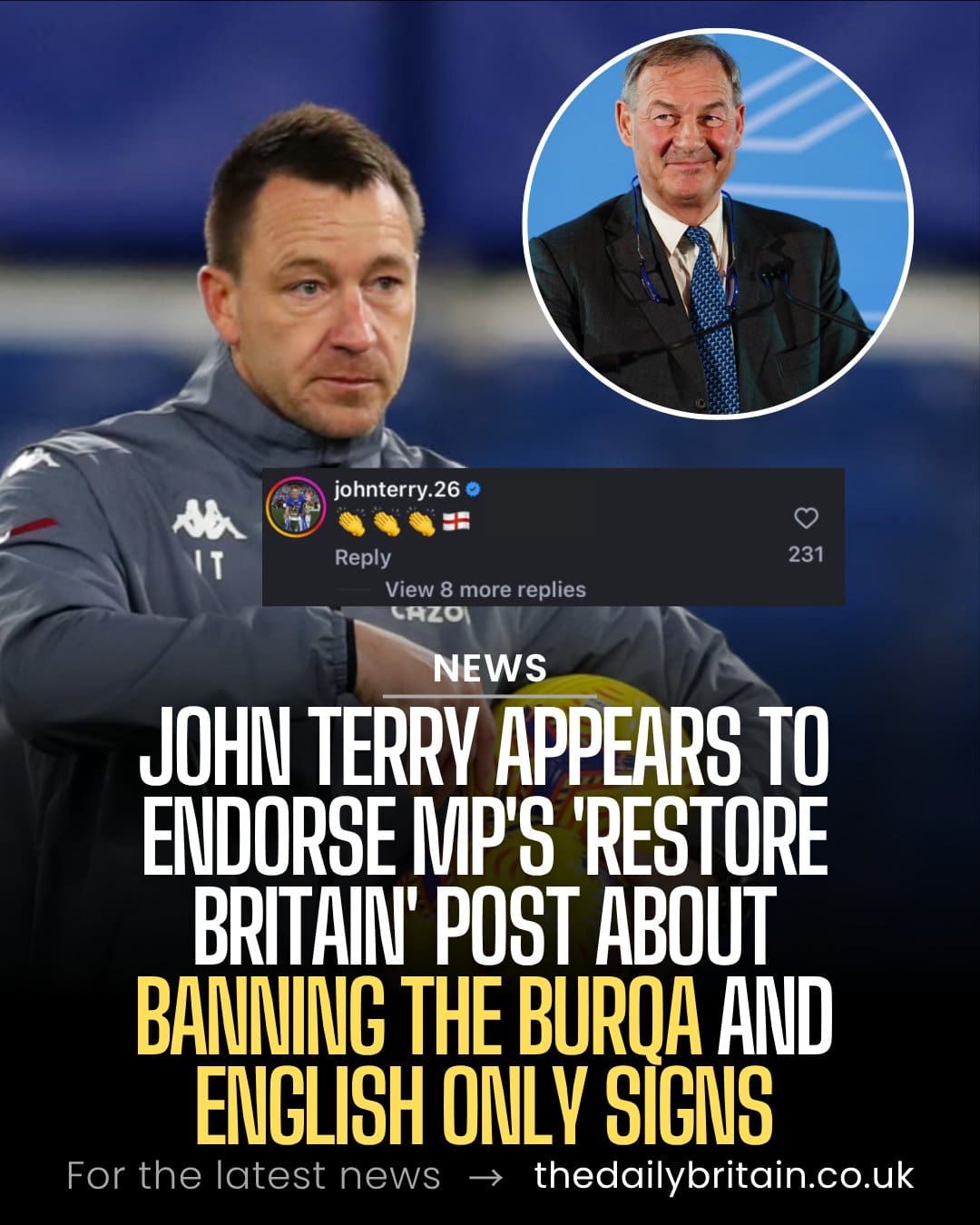
The spectacle of sporting icons drifting into the murky waters of reactionary politics is nothing new, but the case of John Terry is particularly troubling. Once celebrated as a commanding presence for both Chelsea FC and the England national football team, Terry’s legacy has always been complicated. His recent public endorsement, however informal, of rhetoric promoted by Rupert Lowe and his breakaway political project, Restore Britain, raises serious questions not only about his judgment but also about the wider responsibility of public figures in amplifying divisive narratives.
At first glance, Terry’s contribution might seem trivial: a handful of applause emojis and an English flag posted beneath a social media statement. But symbols matter, particularly when attached to individuals with vast platforms and influence. Lowe’s message, calling for a ban on the burqa and insisting on “English only” signage in London, leans heavily into culture war politics that have long been criticised for stoking division rather than solving real societal issues. That Terry chose to publicly endorse such a statement is not a neutral act; it is a tacit alignment with a strand of politics that marginalises minority communities while presenting itself as a defence of national identity.
🚨BREAKING: England legend John Terry has ENDORSED Rupert Lowe's plans to ban the Burqa and ensure that London stations use ONLY the English language
— Inevitable West (@Inevitablewest) March 21, 2026
The finest of England is uniting. 🏴 pic.twitter.com/Oh4lTG4IOE
The facts surrounding the example used by Lowe make the situation even more concerning. The image cited as evidence of cultural erosion—signage at Whitechapel station—was misleadingly framed. The station’s name appears in both English and Bengali, reflecting the local community and a broader commitment to accessibility. This is not an abandonment of English language or identity but an inclusion of others within it. By endorsing Lowe’s claim without scrutiny, Terry has helped legitimise misinformation, a hallmark of the very political movements that thrive on outrage rather than accuracy.
What makes this episode particularly jarring is that it does not exist in a vacuum. Terry’s career has already been marked by one of the most infamous racism controversies in modern English football. In 2011, during a Premier League match, he was accused of directing a racial slur at Anton Ferdinand. Although acquitted in a criminal court, the Football Association conducted its own investigation and reached a different conclusion. In 2012, Terry was found guilty of using racist language, fined £220,000, and handed a four-match ban. The verdict was unequivocal: on the balance of probabilities, he had used abusive and insulting words that included a reference to Ferdinand’s ethnic origin.
That sanction should have been a moment of reckoning, a point at which a high-profile athlete might reflect on the broader impact of words, prejudice, and influence. Instead, over a decade later, Terry appears once again adjacent to rhetoric that targets minority communities, albeit in a different context. The continuity is difficult to ignore. While supporting a policy proposal is not the same as direct abuse, both exist within a wider cultural ecosystem in which certain groups are singled out, othered, and framed as problems to be solved.
The defence mounted by Lowe only deepens the concern. His insistence that such views represent “the vast majority of the British people” is a familiar populist trope, one that claims democratic legitimacy without evidence and one that often seeks to silence dissent by portraying critics as out-of-touch elites. It is precisely this kind of rhetoric that thrives on amplification by high-profile figures. When someone like Terry lends even symbolic support, it grants a veneer of mainstream acceptability to ideas that might otherwise be more robustly challenged.
There is also a broader cultural dimension at play. Footballers occupy a unique position in British society. They are not merely athletes; they are role models, community figures, and, in many cases, global ambassadors. Clubs like Chelsea FC market themselves as inclusive institutions, celebrating diversity both on and off the pitch. Campaigns against racism, from grassroots initiatives to high-profile gestures, have become central to the sport’s identity. Against this backdrop, Terry’s apparent endorsement of exclusionary politics sits uneasily, undermining the very values the game claims to uphold.
None of this is to suggest that former players should be barred from political expression. On the contrary, they have every right to engage in public debate. But with that right comes responsibility, the responsibility to interrogate the claims they support, to consider the impact of their words and actions, and to recognise the weight their platforms carry. In this instance, Terry appears to have fallen short on all counts.
Ultimately, the issue is not about one Instagram comment. It is about the normalisation of a political discourse that thrives on division and the role that influential figures play in accelerating that process. John Terry is no longer just a footballer; he is a public figure whose actions resonate far beyond the pitch. His decision to publicly applaud rhetoric rooted in exclusion and misinformation is not just disappointing, it is a reminder that the battle against prejudice, in all its forms, remains far from won.