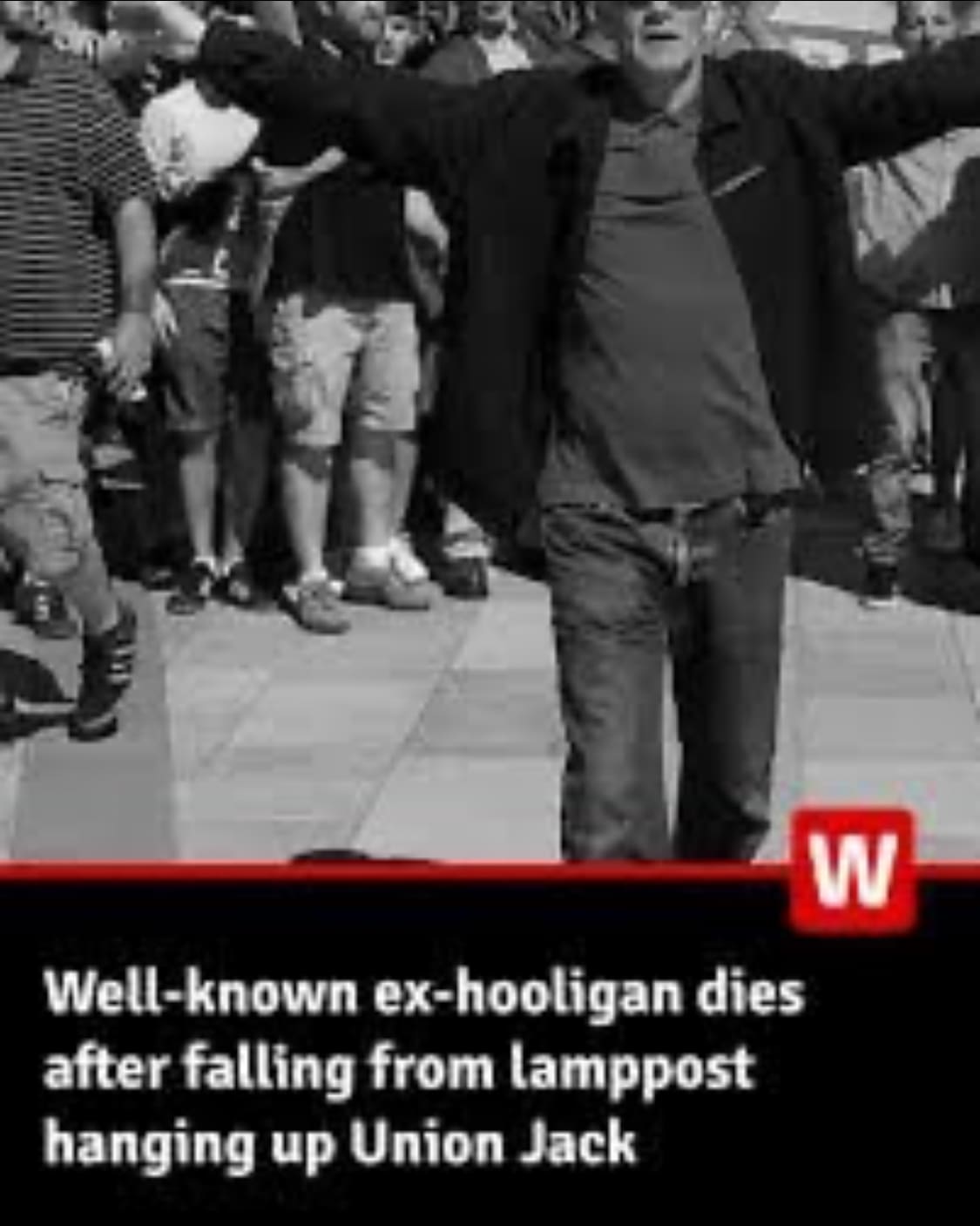
Paul Lumber, a 60-year-old lifelong Bristol City supporter and former football hooligan, has died in a tragic accident, falling from a ladder while hanging Union Jack flags near his home. A painter and decorator by trade, Lumber had recently launched an online fundraising campaign to expand his patriotic display, raising over £1,000 before the incident on 23 November.
Lumber’s life was inseparable from the culture and identity of Bristol. He was a prominent figure in the city’s football casual scene in the 1980s, part of the City Service Firm (CSF), and chronicled this era in his memoir, It All Kicked Off in Bristol. The book details his violent and turbulent youth, the incidents that led to him being permanently barred from Bristol City home fixtures, and his evolution into a man devoted to family and community. Friends remember him as a working-class hero: a man whose life revolved around his partner Michele, his family, and the neighbourhood he cherished.
Yet, Lumber’s story is more than a portrait of a football fanatic or a colourful local character. It is a cautionary tale about patriotism, nostalgia, and the dangers of uncritical devotion. Lumber’s affection for his club, his city, and his country, expressed most visibly in his ‘Raise the Colours’ campaign, was sincere and personal. But this personal patriotism has been cynically exploited by the far right.
These same groups, who have previously celebrated the deaths of refugees at sea and called for the Royal National Lifeboat Institution to leave them to drown, now sanctimoniously demand that we mourn Lumber.
Their calls for grief are not about him as a man; they are about him as a symbol—an emblem of loyalty, nationalism, and “Englishness” that they can co-opt to lend a human face to their ideology. The hypocrisy is stark and disturbing. While communities of the living suffer and die in crisis, the far right celebrates their deaths. Yet when a man like Lumber dies—an ordinary man, flawed but devoted—they demand our sympathy and use it to advance their agenda.
Lumber’s death is tragic in its own right, but it is also emblematic of the perils of uncritical patriotism. His love for tradition and identity, expressed through flags and public displays of loyalty, made him both vulnerable and visible. It is a reminder that personal devotion, even when rooted in innocence or nostalgia, can be co-opted by movements entirely unworthy of it. Lumber’s patriotism, which should have been his private joy, has been twisted into a political prop.
Despite his troubled past, Lumber’s life after football violence was defined by care, community, and commitment. While serving prison sentences during the 1980s, he received match programmes and personal notes from then-Bristol City manager Terry Cooper, assessing the team’s performances—a gesture of connection and recognition he recalled with pride. Later in life, he married Michele, his partner of 23 years, and devoted himself to family, friends, and the local community. Sean Donnelly, landlord of the Three Lions pub in Bedminster, where Lumber was a familiar figure, described him as “unbelievably loyal. If you were in a trench, you wanted Paul shoulder to shoulder with you. But of all his achievements, marrying Michele was the biggest.”
Lumber’s life, with all its flaws and passions, reflects the reality of ordinary men caught between past violence and present responsibility, between public identity and private devotion. He was not a martyr for a political cause; he was a man trying to celebrate his heritage in the simplest way he knew. Yet, in death, the far right seeks to turn him into something he never was. They demand our tears while having previously cheered the deaths of those fleeing danger, revealing a grotesque moral calculus. Lumber’s story is being instrumentalised to give legitimacy to ideologies that are fundamentally indifferent to life and community.
This is not to diminish the loss felt by family, friends, and the South Bristol community, where Lumber’s absence is already keenly felt. His legacy should belong to them: to the people who knew him, who laughed at his stories, who felt his warmth and devotion, and who remember him not as a symbol but as a person. The flags he hung, the stories he told, the love he expressed for his city and his club—all these belong to the living, not to those who traffic in ideology.
Paul Lumber’s passing is tragic, and it should be mourned. But his story is also a warning: patriotism and loyalty, when unexamined and expressed uncritically, can be exploited by those with no loyalty at all. While the far right rushes to sanctify him, their hypocrisy is undeniable: they glorify grief selectively, demand sympathy when it serves their narrative, and disregard human life when it challenges them.
Lumber’s life reminds us that devotion and love are inherently human, not ideological. His death should not be hijacked to advance cruelty. It is a call to recognise the difference between genuine community and political theatre, between human grief and calculated propaganda. Paul Lumber, in his colours, his stories, and his warmth, belongs to his friends, family, and city—not to the opportunistic narratives of the far right.
In the end, he is a cautionary figure: a man whose patriotism and nostalgia were his own, yet whose death illuminates the opportunism and hypocrisy of those who claim to mourn him. True remembrance honours the person, not the ideology. And in remembering Paul Lumber, we should hold both grief and perspective together, recognising a life lived passionately, imperfectly, and, above all, humanly.
He will be fondly remembered by family and friends and quickly forgotten by the ‘Tommy Robinsons’ and Nigel Farages of this world who exploited him.