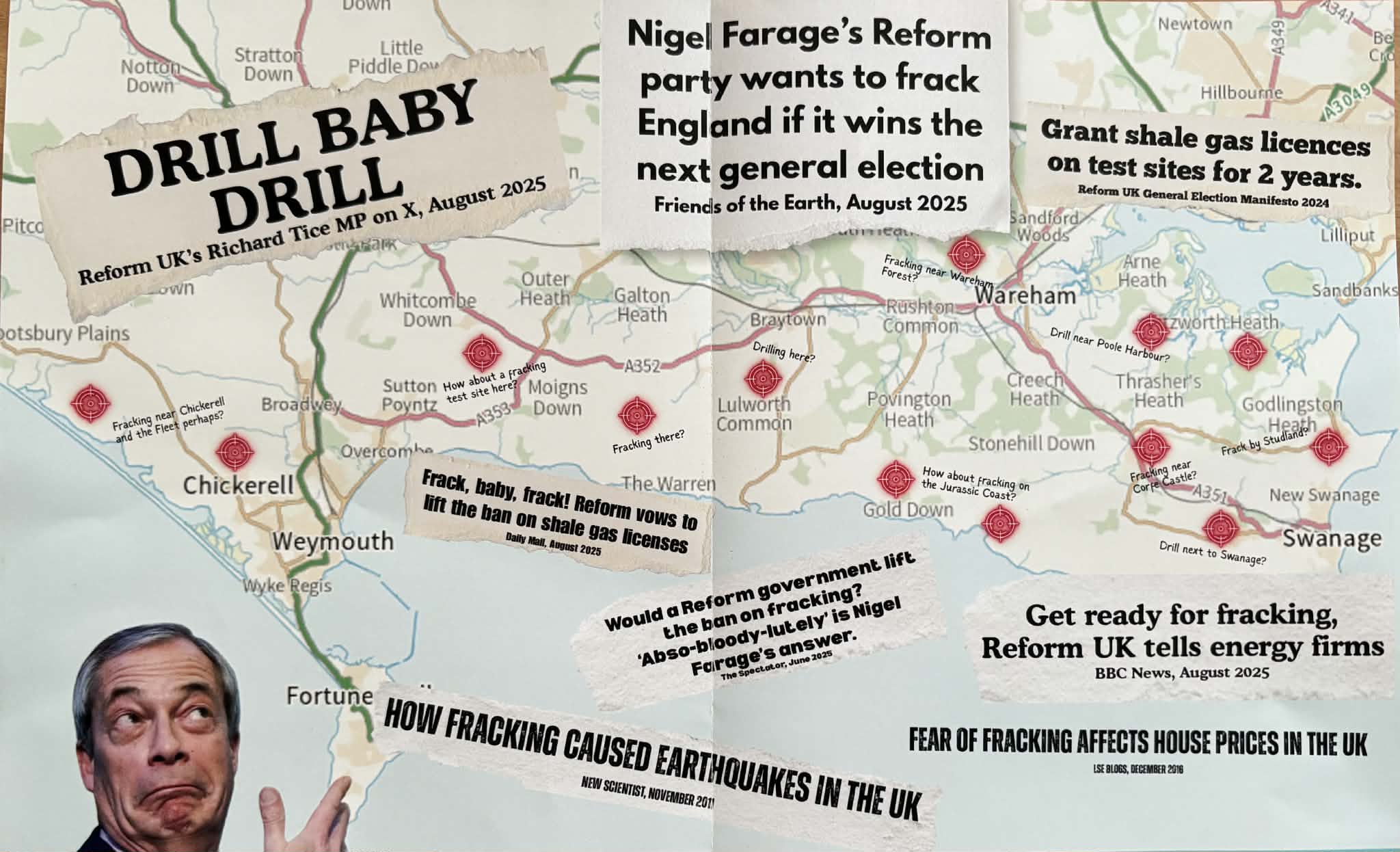
Drill, Baby, Drill — And Dorset Pays the Price
For many residents of South Dorset, the idea that drilling rigs and gas wells could one day puncture the county’s peaceful countryside seems almost unimaginable. Yet the policies promoted by Reform UK suggest that such a future may not be far-fetched. The party led by Nigel Farage has made it clear that it would lift restrictions on shale gas extraction and rapidly expand fracking across England if it came to power.
For a region defined by natural beauty, tourism and fragile ecosystems, the consequences could be devastating.
South Dorset is home to landscapes recognised across the world. The sweeping cliffs and fossil beds of the Jurassic Coast form a UNESCO World Heritage Site and attract millions of visitors each year. Inland lie rolling chalk downs, heathlands and ancient countryside stretching between towns such as Weymouth, Wareham and Swanage.
This landscape is not simply scenic, it is the foundation of the region’s economy and identity. Tourism supports thousands of jobs, from hotels and restaurants to small independent shops and outdoor activity businesses. Visitors come for the open skies, unspoiled countryside, and quiet villages that feel far removed from industrial Britain.
Fracking would change that overnight.
Hydraulic fracturing involves drilling deep wells and blasting high-pressure fluids into shale rock to release trapped gas. Each drilling site requires large well pads, storage tanks, pipelines and heavy machinery. The process also demands enormous quantities of water, sand and chemicals, all transported by road.
For South Dorset’s narrow country lanes, the impact would be immediate. Thousands of lorry journeys are typically required to support a single fracking site. Quiet rural roads could quickly become clogged with heavy industrial traffic, bringing noise, pollution and safety concerns to villages that have never experienced such disruption.
The visual transformation could be just as dramatic. Drilling rigs, flare stacks and industrial infrastructure would rise above landscapes currently dominated by farmland, woodland and open heath. Areas close to the Jurassic Coast—celebrated worldwide for their natural beauty—could find themselves overshadowed by gas extraction sites.
Environmental concerns run even deeper.
Fracking has long been controversial because of its potential to contaminate groundwater. The process involves injecting chemical-laced fluids deep underground, and if well casings fail or waste fluids escape, nearby aquifers may be put at risk. Dorset’s groundwater supplies drinking water to large parts of the county, making any contamination potentially serious.
There is also the issue of earthquakes. Previous fracking operations in the United Kingdom were halted after they triggered measurable seismic activity. While these tremors were relatively small, they were significant enough for regulators to suspend drilling. In a county already dealing with coastal erosion and fragile geology, the prospect of induced seismic events is understandably alarming.
Yet despite these risks, Reform UK continues to champion fracking as a cornerstone of its energy policy. Party figures such as Richard Tice have repeatedly argued that Britain should exploit domestic shale gas reserves and abandon what they describe as excessive environmental restrictions.
Critics, however, say there is another reason for the party’s enthusiasm: money.
Across the political landscape, fossil fuel interests have long invested heavily in lobbying efforts designed to promote continued oil and gas extraction. Campaign groups and researchers have pointed out that individuals and organisations connected to the fossil fuel industry have provided financial support to Reform UK and to figures associated with it.
While political donations are legal and regulated, critics argue that such funding raises serious questions about influence. When a party strongly backed by fossil fuel interests proposes opening large parts of the country to fracking, it inevitably prompts concern about whose interests are truly being served.
Environmental organisations warn that the fossil fuel lobby has spent years attempting to weaken restrictions on fracking in Britain. Backing political movements willing to remove those restrictions is an obvious strategy.
For communities in South Dorset, the result could be the same: their countryside becoming the testing ground for a new wave of gas extraction.
The economic consequences could be profound. Tourism remains one of Dorset’s largest industries, built on the county’s reputation as one of Britain’s most beautiful places. If drilling rigs and industrial sites begin appearing across the countryside, that reputation could quickly suffer.
Visitors do not travel to the Jurassic Coast to see gas wells and industrial pipelines. Even the perception that Dorset’s landscape is being industrialised could deter tourists who might otherwise spend their holidays there.
Property values could also fall. In regions where fracking has taken place elsewhere, homes located near drilling sites have sometimes lost value due to concerns over noise, traffic and environmental risks. For many residents, their home is their largest financial asset. A sudden drop in property values could have serious personal consequences.
And then there is the climate question.
Expanding shale gas extraction directly conflicts with the United Kingdom’s legal commitments to reduce greenhouse gas emissions. Critics argue that investing in new fossil fuel infrastructure delays the transition to renewable energy sources such as wind and solar power.
For a coastal region like South Dorset—already vulnerable to rising sea levels and more extreme storms—the long-term effects of climate change are not theoretical. They are visible in collapsing cliffs, flooding risks and increasingly unpredictable weather patterns.
Ultimately, the debate over fracking is about the future of places like South Dorset.
Is the region destined to remain one of Britain’s most cherished landscapes, defined by natural beauty and heritage? Or could it become the site of a vast new fossil fuel frontier driven by political ambition and industry backing?
If Reform UK’s energy plans ever became government policy, the answer might arrive far sooner than many Dorset residents expect and the consequences could reshape the county for generations.