

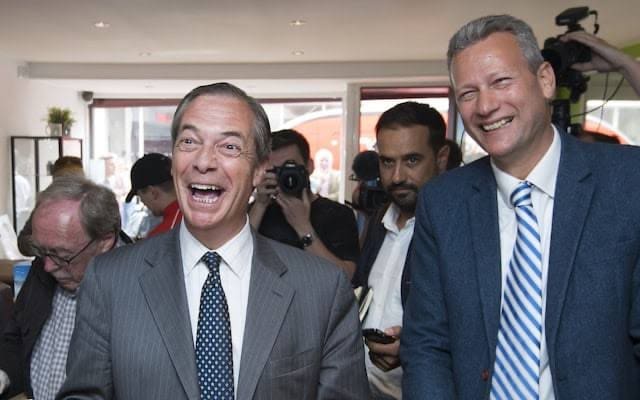
Following on from last week’s conviction of Nathan Gill, seen here out campaigning with Nigel Farage,
a former assistant to a far-right Member of the European Parliament has been convicted of espionage for China. This highlights not only the ongoing security concerns about foreign influence within EU institutions but also the alliances of UK political parties. An example being Reform UK and its leader, Nigel Farage.
Jian G., a German national whose full name has been withheld under privacy laws, worked in the parliamentary office of Maximilian Krah, a member of the Alternative for Germany (AfD) party. He was found guilty by the Dresden Higher Regional Court of having worked for a Chinese intelligence service.
Prosecutors detailed that Jian G. had been an agent for China’s secret service since 2002. The court heard that between September 2019 and April of last year, while employed by Mr Krah, he repeatedly passed on sensitive information concerning negotiations and decisions within the European Parliament.
He was sentenced to four years and nine months in prison.
The conviction comes amidst heightened tensions and repeated accusations from Western nations about Chinese espionage activities. Beijing has consistently denied such claims. A spokesperson for China’s foreign ministry has previously dismissed reports on spying as “hyping up with an aim to smear and suppress China.”
The case also casts a further shadow over his former employer, Maximilian Krah. A controversial figure even within his own party, Krah is currently facing separate accusations of money laundering and accepting bribes from China during his time as an MEP, which he denies, claiming the allegations are politically motivated.
The AfD distanced itself from Krah last year, banning him from campaigning in the EU elections. This move came weeks after he caused widespread outrage by telling an Italian newspaper that not all members of the Nazis’ notorious SS unit were war criminals.
Despite the controversy, Krah was elected to the German federal parliament, the Bundestag, earlier this year. His success formed part of the AfD’s significant gains in the national election, marking a historic breakthrough for the party.
The relationship between Germany’s Alternative für Deutschland (AfD) and Nigel Farage is fundamentally rooted in a shared, hardline Eurosceptic ideology, which was most clearly demonstrated through their voting record within the European Parliament. Both Farage’s various political groupings, first the Europe of Freedom and Democracy (EFD) and later the Europe of Freedom and Direct Democracy (EFDD), and the AfD were members of the same parliamentary bloc for several years. This institutional alliance meant their MEPs frequently voted as a cohesive unit against further European integration, against the EU budget, and against initiatives they perceived as expanding the federal power of Brussels. This coordinated opposition transformed their philosophical alignment into a practical political force, systematically challenging the mainstream consensus from within the institution they sought to radically reform.
This partnership extended beyond mere parliamentary procedure to one of active mutual promotion and symbolic endorsement. The AfD, particularly in its earlier years, looked to Farage and his successful Brexit campaign as a tangible blueprint for their own ambitions, even floating the concept of a ‘Dexit’. Farage, in turn, readily appeared at AfD rallies and events, where he was fêted as a champion of national sovereignty who had proven that leaving the EU was a viable political goal. His presence lent the AfD a significant dose of international credibility and media attention, directly transferring the momentum of the Brexit victory to bolster the German party’s domestic struggle against the Merkel government and the European project.
Two allies of Farage and Reform UK found guilty of being traitors in just seven days. Makes one think, doesn’t it?







