

There is a moment in All Quiet on the Western Front when the machinery of war is laid bare not as heroism but as administration. Young men are processed, drilled, stripped of individuality and sent to kill people they have never met, for reasons they did not choose, under slogans they barely understand. Erich Maria Remarque’s novel endures because it exposes a truth that polite societies prefer to obscure: war is not an eruption of ancient hatred between ordinary people, but a system designed and maintained by those far from the consequences.
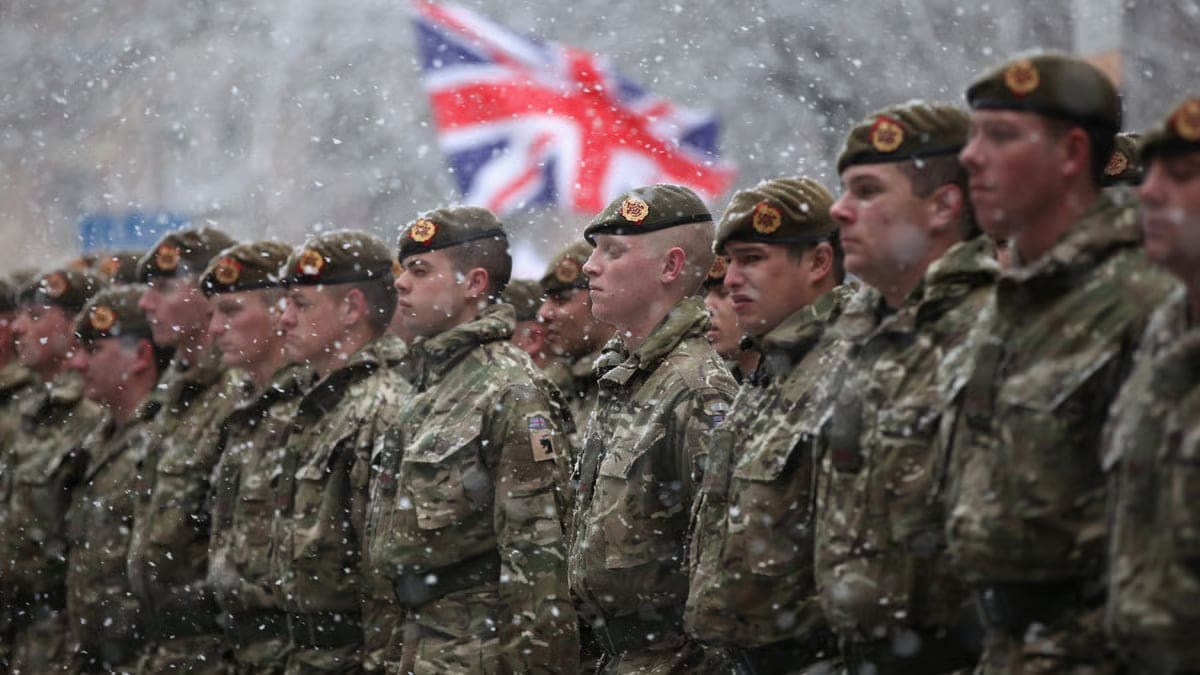
That truth feels uncomfortably close to home as the UK government prepares a new “military gap year” scheme for under-25s. Framed as opportunity, skills and adventure, it is in reality another step in normalising the idea that Britain’s young people should be ready to fight — and, if required, to kill — strangers they hold no personal animosity towards.
Details revealed by the i Paper show the scheme will open in March 2026, initially recruiting around 150 young people for placements of up to two years, before expanding to more than 1,000 per year. It will be paid, though the level of pay remains undisclosed. Participants will not be deployed on active operations, but they will be immersed in military culture: 13 weeks of basic training for the Army across a two-year placement, a one-year “profession agnostic” Navy scheme, and a still-developing RAF option.
The language used by ministers is careful and reassuring. Defence Secretary John Healey speaks of “a taste of the incredible skills and training” on offer, of conversations around the dinner table, of transferable skills, and of no obligation to continue serving. But the aim is explicit: to introduce citizens to military life early in the hope that they will stay.
This is not neutral careers advice. It is targeted cultural conditioning.
The Army already offers gap year placements, but engagement has been minimal — fewer than 10 people enrolled in 2024/25 — and the scheme has been limited to those considering officer training. The new programme widens the net precisely because enthusiasm for military service among young people has collapsed. A YouGov and Public First poll earlier this year found that only 11% of Gen Z adults in the UK would choose to fight for their country, half the figure recorded 20 years ago.
Rather than ask why this reluctance exists, the establishment has chosen to engineer around it.
Young people today grew up during the wars in Iraq and Afghanistan, watching governments lie, pivot and quietly forget. They saw veterans abandoned, inquiries delayed, and accountability evaporate. They inherited economic insecurity, unaffordable housing and shrinking public services — all while being told that “duty” still runs in one direction only. Their scepticism is not cowardice; it is pattern recognition.
Yet senior military figures now openly talk of sacrifice in chillingly abstract terms. Earlier this month, Air Chief Marshal Sir Richard Knighton warned that the UK’s “sons and daughters” would need to be “ready” to fight if required. His French counterpart spoke just as bluntly about being ready to lose the nation’s children in a potential war with Russia. These statements are not accidental slips. They are part of a narrative shift: preparing the public psychologically for casualties that would be borne by the young, not the powerful.
All Quiet on the Western Front describes how schoolteachers, politicians and officers glorified war to boys who had no context to resist it. The novel’s most devastating passages are not the battles themselves, but the training camps — where obedience is drilled into bodies not yet old enough to question the orders they will one day receive. The enemy, Remarque makes clear, is not the man in the opposing trench, but the system that put both there.
The government insists that the new scheme will teach “transferable skills” and offer opportunity. That framing is revealing. When the state cannot provide secure work, meaningful education or hope, it repackages militarisation as social mobility. Discipline replaces stability; uniform replaces belonging. For some participants, the scheme may indeed offer structure or confidence. But it also lowers the psychological barrier to future conflict by making military life familiar, routine, even benign.
The scheme will take inspiration from Australia’s voluntary military programme, where just over half of participants went on to permanent roles. That statistic is presented as success. It should instead raise a question: success for whom?
Across Europe, governments are moving in the same direction. France, Germany and Belgium are all expanding or introducing similar schemes amid escalating rhetoric about threats from Russia. The Cold War peace that allowed most Britons to live without direct experience of the Armed Forces is now treated as an aberration rather than a hard-won achievement.
The establishment wants to correct that “problem”.
The tragedy, as Remarque understood, is that the people being prepared to kill have nothing to gain from doing so. They are not defending personal grievances or protecting families under immediate threat. They are serving abstractions — borders, prestige, deterrence — decided by people who will never share their risks.
A society that truly respected its young would hesitate before placing them on that path. It would exhaust diplomacy before drills, welfare before weaponry, and honesty before recruitment drives dressed up as gap years. Instead, Britain is quietly teaching another generation to accept the unacceptable: that killing strangers is a reasonable extension of citizenship and that the loss of “sons and daughters” is a strategic consideration rather than a moral catastrophe.
All Quiet on the Western Front ends not with victory, but with silence — the silence left behind when a generation is spent. The lesson has never changed. Only the marketing has.







