Speculation about a third world war has an unsettling way of surfacing whenever global tensions rise. While no one can predict how a future large-scale conflict would unfold, geography, infrastructure and strategic value would almost certainly shape which places face the greatest risk and which might be comparatively insulated.
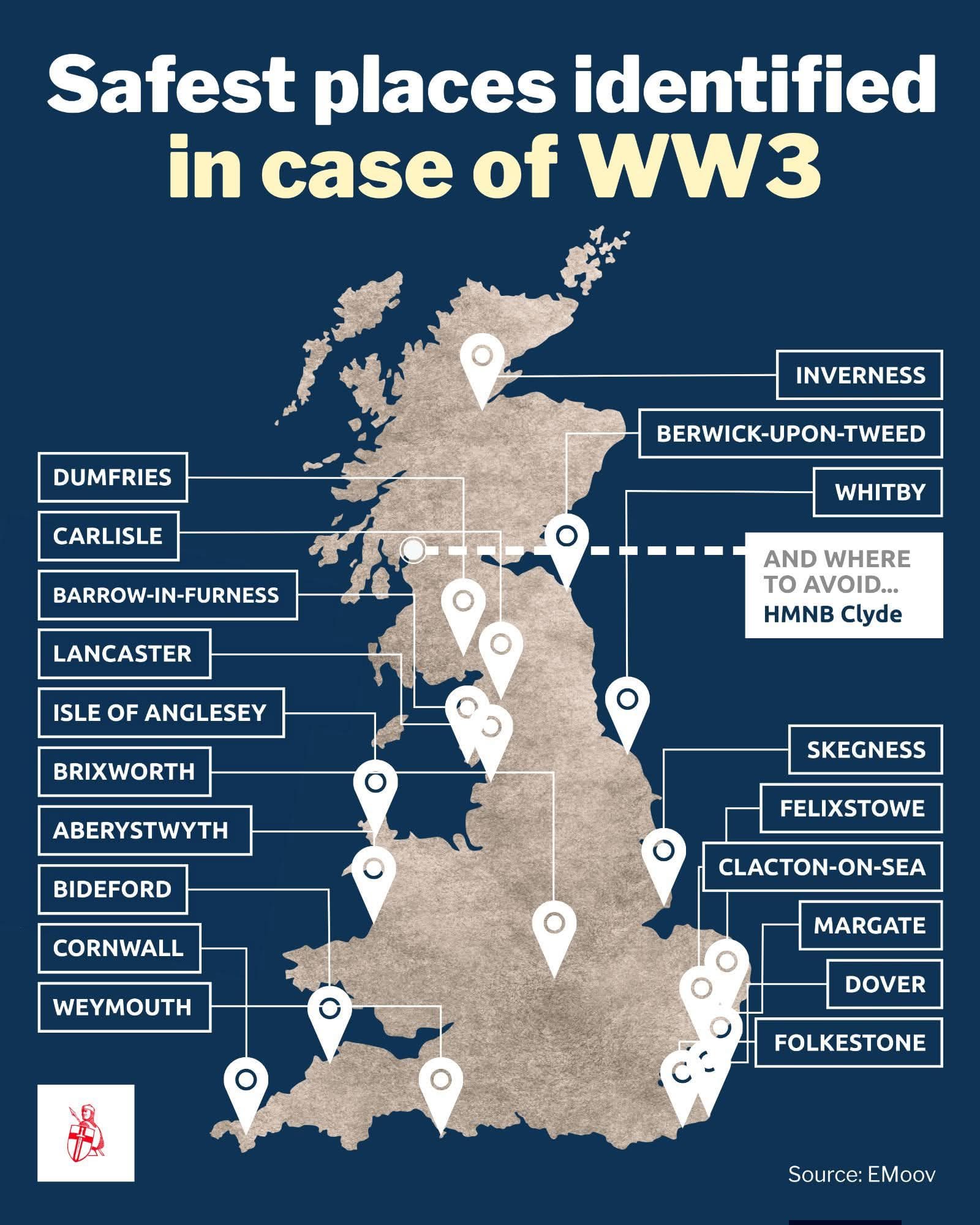
Recent analysis by property platform EMoov identified a number of UK towns and regions that could be considered among the “safest” in the event of a major global conflict. Their assessment was based on distance from obvious military targets such as large naval bases, major ports, strategic transport hubs and nuclear facilities.
At the top of the list in Scotland was Inverness. Often described as the capital of the Highlands, Inverness is relatively remote, lightly industrialised and far from major strategic installations. Its distance from high-value military targets could make it less likely to be directly affected in the early stages of a conflict. By contrast, the analysis suggested avoiding areas near HMNB Clyde, the Faslane naval base that hosts the UK’s nuclear submarine fleet — due to its obvious strategic importance.
Along the Anglo-Scottish border, Berwick-upon-Tweed was highlighted for similar reasons: modest population size, limited heavy industry and no immediate proximity to nationally critical defence assets. On the west side of the border, Dumfries and Carlisle were also cited. While Carlisle has significant rail connections, it lacks the concentration of military infrastructure seen in larger urban centres.
In north-west England, Barrow-in-Furness and Lancaster made the list, though the former’s shipbuilding heritage means its status would depend heavily on the nature of any conflict. Coastal and rural Wales also featured prominently. Isle of Anglesey and Aberystwyth benefit from lower population density and relative distance from major strategic command centres. Smaller inland communities such as Brixworth were similarly noted for their lack of obvious military value.
In the South West, coastal towns including Bideford, Cornwall and Weymouth were identified as comparatively low-priority targets. The reasoning is straightforward: fewer large bases, limited heavy industry and distance from London and the South East’s dense network of infrastructure. However, this assessment would vary depending on whether conflict were conventional, cyber, nuclear or maritime in nature.
On the east coast, towns such as Skegness, Felixstowe and Clacton-on-Sea were highlighted. Although Felixstowe is home to one of the UK’s busiest container ports, its civilian economic role may not necessarily make it a primary military target in every scenario. Further south, Margate, Dover and Folkestone were included, though their proximity to continental Europe and key shipping lanes means assessments could shift rapidly depending on the circumstances.
It is important to stress that any ranking of “safe” places in a hypothetical world war is speculative. Modern warfare extends far beyond traditional battlefields. Cyber attacks could disrupt utilities nationwide, while long-range missile systems would render simple distance a less reliable safeguard than in the past. Economic and energy infrastructure, power stations, data centres, fuel depots, may be as strategically significant as barracks or airfields.
Furthermore, resilience is not solely about avoiding direct attack. Access to food supply chains, fresh water, healthcare and transport links would all be crucial in a prolonged crisis. Rural or coastal isolation can be protective in one sense but may also mean reduced access to emergency resources.
The UK’s geography does offer certain advantages. As an island nation, it has natural maritime boundaries and a professional armed forces integrated into alliances such as NATO. Yet its global economic integration and concentration of financial services in London make parts of the country symbolically and strategically prominent.
Ultimately, the safest place in any conflict is one where communities are prepared, infrastructure is resilient and tensions never escalate into open warfare at all. While lists of low-risk towns can provide a momentary sense of reassurance, they are no substitute for diplomatic stability, robust civil planning and international cooperation.
For most people, the practical takeaway is not relocation but awareness: understanding local emergency procedures, maintaining basic preparedness and supporting policies that reduce the likelihood of conflict in the first place. In that sense, the safest future is one shaped less by geography and more by collective commitment to peace.