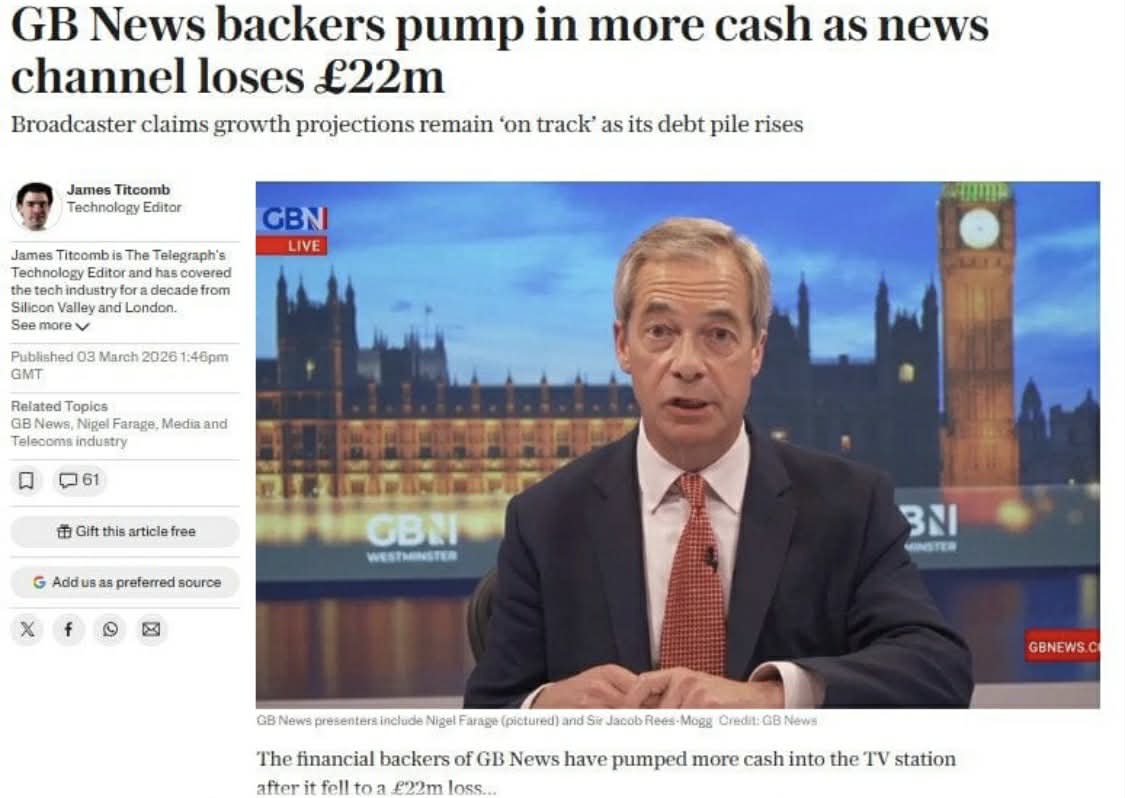
When GB News launched in 2021, it promised to disrupt Britain’s broadcast landscape. Styled as a brash alternative to the perceived consensus of the BBC and Sky News, it vowed to give voice to audiences who felt ignored by metropolitan media elites. Backed by wealthy investors and fronted by high-profile presenters, it spoke the language of insurgency and market competition. Nearly five years on, however, its continued existence appears to owe less to commercial success and more to the deep pockets of its billionaire backers.
The latest financial disclosures show the channel recording fresh losses of £22 million, adding to a long line of deficits that stretch back to its launch. By its own accounts, the station has never turned a profit. Cumulative losses now run into tens of millions. In most industries, such a performance would trigger restructuring, sale or closure. Yet GB News continues to broadcast, hire talent and expand programming. The reason is simple: shareholders continue to inject capital.
From the outset, the channel relied on wealthy investors willing to bankroll a long-term project rather than seek short-term returns. Among its most prominent early backers was Dubai-based billionaire Paul Marshall, a hedge fund manager who has played an increasingly visible role in the UK’s right-leaning media ecosystem. Other high-net-worth individuals have also participated in funding rounds designed to keep the station solvent. Without these injections, the balance sheet would make for bleak reading.
The commercial difficulty facing GB News is not mysterious. Advertising revenue, the lifeblood of free-to-air commercial television, has persistently lagged behind expectations. Within months of its launch, major brands began pulling advertising after campaigns by activists highlighted controversial on-air comments and regulatory investigations. Companies wary of reputational risk opted to avoid the channel altogether. Some advertising slots were reportedly filled by low-cost direct response adverts or promotions for gold dealers and niche financial products, a far cry from the blue-chip brands that sustain mainstream broadcasters.
This advertiser reluctance has had structural consequences. Media buyers typically assess channels not only by viewing figures but also by brand safety. Even when GB News has secured respectable audience spikes, particularly during headline-grabbing monologues by political presenters, those numbers have not translated into proportional advertising demand. For many corporations, the risk of social media backlash outweighs the relatively modest audience reach.
It is important to note that ratings alone do not determine profitability. Television is an expensive medium. Studio space, satellite distribution, technical crews and on-screen talent command substantial costs. Recruiting recognisable figures from politics and journalism may generate headlines, but it also inflates payroll. If advertising revenue fails to cover those fixed costs, losses accumulate quickly.
Supporters of GB News argue that the channel is still young by broadcasting standards and that building a brand takes time. They point to the early struggles of other media ventures that eventually found their footing. Yet critics counter that the repeated need for shareholder bailouts suggests a business model that has not achieved escape velocity. A commercially viable broadcaster should, in theory, be able to sustain itself through a mix of advertising, sponsorship and ancillary revenue streams. GB News has yet to demonstrate that capacity.
The political dimension complicates matters further. Several of its presenters are sitting or former politicians, blurring the line between journalism and opinion. Regulatory scrutiny from Ofcom has at times intensified advertiser caution. While the channel insists it operates within broadcasting rules, the perception of controversy can be enough to deter risk-averse brands.
This is where billionaire patronage becomes decisive. Wealthy owners can afford to absorb losses in pursuit of influence, ideology or long-term positioning. Media outlets have historically served not only as profit-making enterprises but also as vehicles of political power and cultural leverage. In that context, a £22 million annual loss may be seen less as a commercial failure and more as the cost of maintaining a platform.
Critics argue that such a model raises uncomfortable questions about sustainability and accountability. If a broadcaster depends indefinitely on the fortunes of a small group of ultra-wealthy individuals, it operates in a different ecosystem from competitors reliant on mass-market advertising. The discipline imposed by market forces is softened. Losses can be written off; programming decisions need not prioritise broad commercial appeal.
Supporters respond that many media organisations, including newspapers, have long relied on wealthy proprietors willing to subsidise editorial missions. They argue that diversity of ownership and viewpoint strengthens democracy. In their telling, GB News represents pluralism rather than plutocracy.
Yet the financial facts remain stark. Another £22 million in losses adds to an already substantial deficit. Advertisers continue to tread carefully. And absent the willingness of billionaire shareholders to “pump in” further funds, the channel’s future would look uncertain. For now, GB News survives not because the market has decisively endorsed it, but because its owners have chosen to underwrite it.
Whether that patronage will continue indefinitely is an open question. What is clear is that, in its current form, the channel’s existence depends less on commercial profitability than on the strategic patience and deep pockets of those at the top.