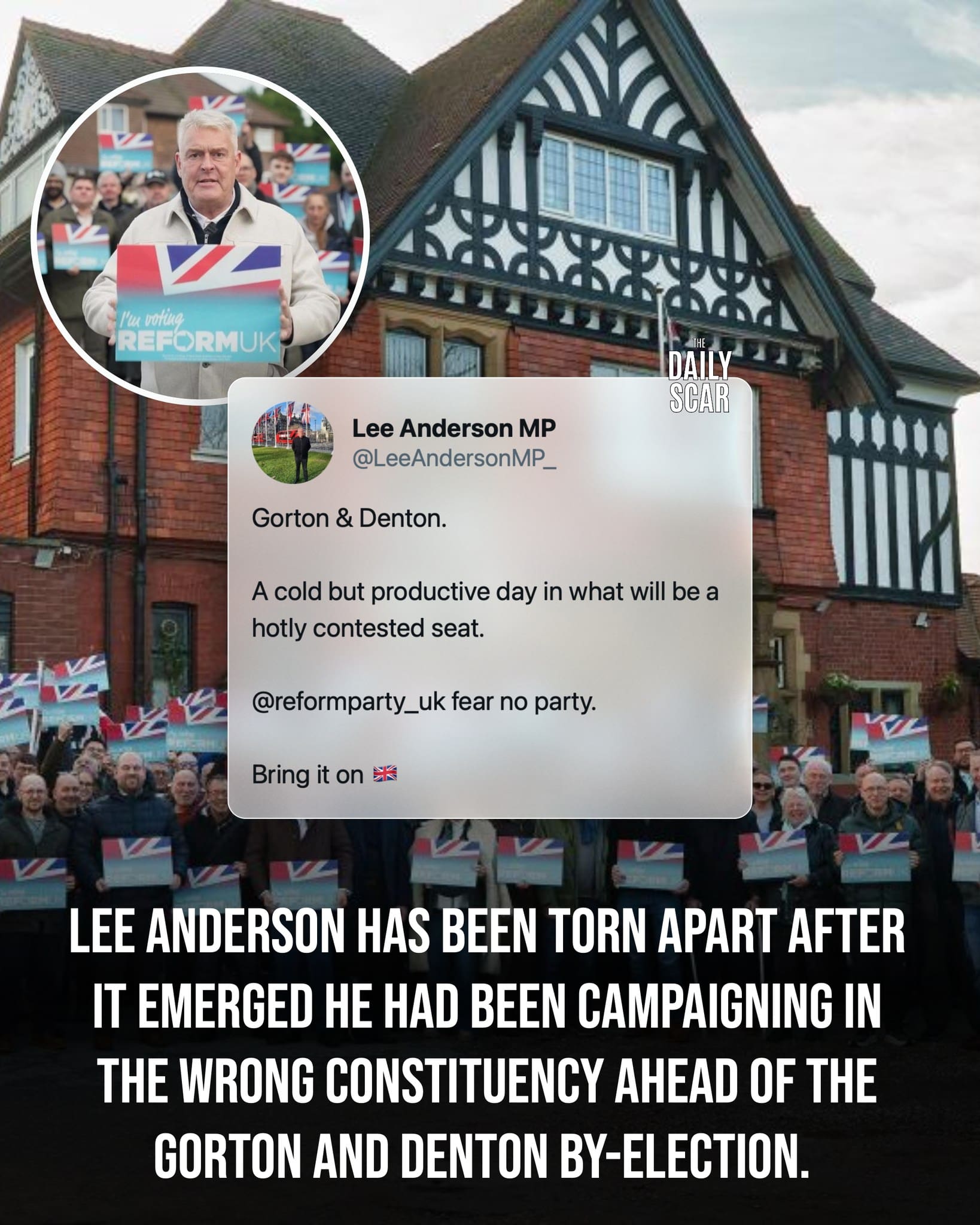
Lee Anderson has always prided himself on saying what others won’t. This week, he went further and did what others wouldn’t: campaigned enthusiastically in a constituency that isn’t actually having the by-election he was campaigning for.
The Reform UK chief whip proudly shared photographs of himself and fellow activists outside Stanley House Function Rooms, beaming against the cold and declaring the day “productive” ahead of the Gorton and Denton by-election. The message was defiant. The tone bullish. The geography, alas, fictional.
Because Stanley House Function Rooms is not in Gorton and Denton. It sits, stubbornly and unmoved by Reform’s electoral ambitions, in Ashton-under-Lyne – Angela Rayner’s constituency. Roughly half a kilometre outside the area where anyone might reasonably expect a Gorton and Denton campaign to take place. Close enough for satire, far enough for maps.
“Gorton & Denton,” Anderson proclaimed online. And in a sense he was right. The words were there. They just weren’t attached to the location.
This may be the first recorded instance of a political party attempting to win a by-election through sheer force of vibes, hoping the constituency boundary would politely shuffle over out of respect. It did not.
Angela Rayner, whose constituency Anderson had accidentally adopted for the day, responded with the sort of gentle mockery usually reserved for people who turn up to the wrong wedding. Reform, she suggested, might benefit from learning how to use Google Maps, once they’ve finished recruiting “former Tories who failed the country”.
It was a line that landed because it barely needed embellishment. The photographs did the heavy lifting.
Anderson’s supporters insist this is nit-picking, the sort of petty obsession with facts and borders that ordinary people are tired of. Why should lines on a map matter? Isn’t this exactly the kind of anti-establishment thinking voters crave? If Reform say it’s Gorton and Denton, who are we to argue?
Still, local residents may reasonably ask why a party that claims to “fear no one” appears mildly confused by constituency boundaries, one of the core concepts of representative democracy. Knowing where your voters live is not usually considered an optional extra.
Perhaps this is all part of a wider Reform UK vision: campaigning beyond constraints, rejecting the elite notion that elections must take place in the right place. Today Ashton-under-Lyne, tomorrow the moon.
Or perhaps it’s just another reminder that for all the talk of plain speaking and common sense, some politicians still can’t find the right spot even with a postcode, a smartphone, and a map that literally says where they are.
A cold but productive day, indeed. Just not, unfortunately, in Gorton and Denton.