Reform’s Britain: Longer Hours, Lower Wages, No Safety Net
Know your enemy. Vote for this rabble and get all these benefits.
1. No paid Holiday Leave
2. No Sick Pay
3. Obligatory 12-hour workdays.
4. Min wage of £7 an hour
5. No more free NHS
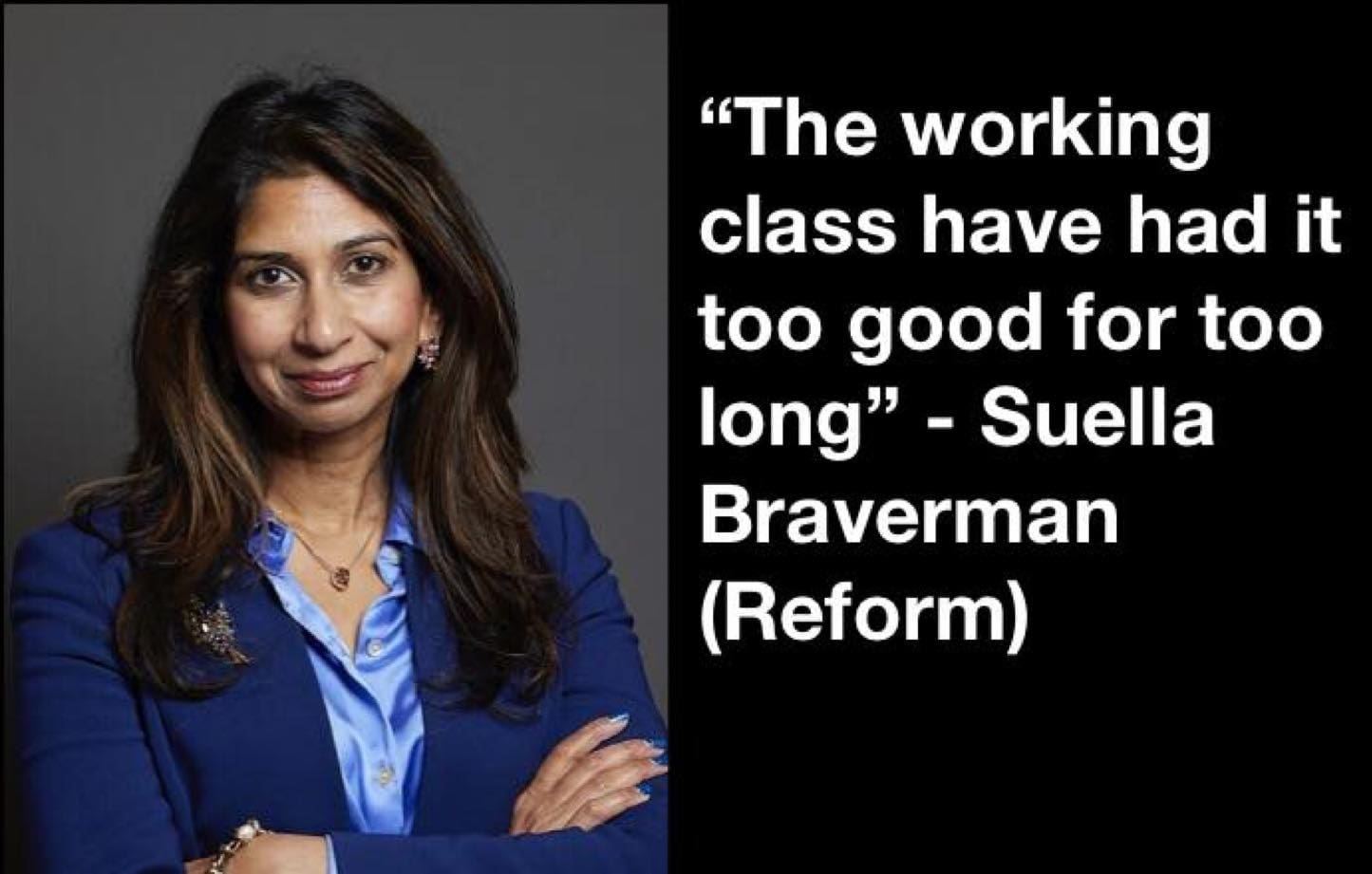
This quote reveals what Suella Braverman really thinks about the working classes. “Had it too good for too long”, alongside an implied programme attributed to Reform UK that reads like a demolition plan aiming to transfer yet more power and wealth to the state and the establishment class.
Let us not sanitise what this would mean if such thinking were translated into power.
Strip away paid holiday and you do not create productivity; you create exhaustion. You create parents who never see their children in daylight. You create a culture where burnout is normal and rest is suspect. Remove sick pay and you guarantee that infectious workers turn up ill because they cannot afford not to. In a post-pandemic society, that is not just cruel; it is reckless.
Mandate 12-hour workdays and slash the minimum wage to £7 an hour and you are not “cutting red tape”; you are manufacturing poverty. At £7 an hour, even full-time work would leave millions below subsistence level. The state would end up subsidising low-paying employers through in-work benefits — socialising costs while privatising profit. The losers would be, amongst others the:
Bricklayer
Electrician
Plumber
Carpenter
Roofer
Scaffold labourer
Factory worker
Warehouse operative
Delivery driver
HGV driver
Care assistant
Cleaner
Refuse collector
Farm labourer
Mechanic
Security guard
Bus driver
Retail assistant
Kitchen porter
Construction labourer
And abolish free access to the National Health Service? That is not reform; it is social rupture. Healthcare in Britain is not merely a service; it is a covenant. To dismantle it would mean two-tier treatment: swift care for those who can pay, waiting and suffering for those who cannot. Illness would once again become a financial catastrophe.
The cumulative effect would be brutal.
• Widened inequality as wealth concentrates even faster at the top.
• Increased child poverty as low wages fail to meet rising costs.
• A public health crisis as overwork and untreated illness proliferate.
• A workforce too exhausted and insecure to organise or resist.
History is instructive. When labour protections are eroded, workplace injuries rise. When wages fall, demand in the domestic economy contracts. When healthcare becomes commodified, preventable deaths increase. These are not ideological claims; they are observable patterns.
Politicians who argue that working people have “had it too good” are not engaging in tough love; they are signalling a worldview in which dignity is conditional and security is suspect. It is a worldview that reframes rights as indulgences and solidarity as weakness.
If enabled to legislate along these lines, the consequences would not be abstract. They would be felt in cold homes, empty fridges, crowded A&E departments and longer food bank queues. Britain would not become freer or more prosperous. It would become harsher, angrier and more divided.
The danger is not rhetorical excess on social media. The danger is normalisation, the steady drift towards accepting that the floor beneath working people should be lowered rather than lifted.
Democracy allows voters to choose their direction. But choices have material outcomes. Policies that weaken labour rights, depress wages and privatise essential services do not punish an abstract “other”. They punish the majority.
The question is not whether the working class have had it too good. The question is whether Britain is prepared to abandon the post-war settlement that made security, healthcare and basic dignity universal rather than earned through wealth.
Because once dismantled, those foundations are not easily rebuilt.