


A deeply troubling incident in Dorset has once again shone a light on the growing problem of hate crime in our local communities.
Dorset Police are appealing for witnesses after a racially aggravated public order offence took place in Heathcote Road at around 11.40am on Saturday, 28 March 2026. According to police, a man shouted racial abuse from a dark grey vehicle at a woman who was walking with her daughter.
Police Constable Ollie Chant said officers “take all reports of hate crime very seriously” and are pursuing all lines of enquiry.
For many people, this may appear to be an isolated act of ugliness. In reality, it reflects a far wider and deeply worrying national trend.
Official Home Office figures show that hate crime remains stubbornly high across England and Wales. In the year ending March 2025, police recorded 137,550 hate crimes, with race-related offences making up the overwhelming majority. Even excluding Metropolitan Police figures for comparison purposes, hate crime rose by 2%, while race hate crime increased by 6%.
That means incidents like the one reported in Bournemouth are not rare exceptions. They are part of a growing social problem.
Race hate crimes alone accounted for more than 82,000 offences, representing around 71% of all recorded hate crimes.
According to Dorset police hate crime is on the up.
Dorset hate crime data from 2022 to 2024.
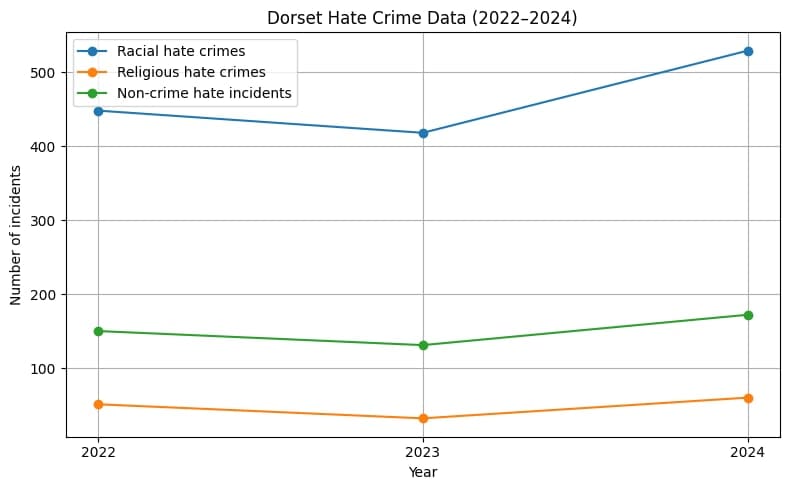
The clearest trend is the sharp increase in racial hate crimes in 2024, rising from 418 to 529, which is a significant jump and the highest figure in this three-year period.
Religious hate crimes and non-crime hate incidents also rose in 2024 after falling in 2023, suggesting a broader upward trend rather than a one-off fluctuation.
The obvious question is: why is this happening?
One major factor is the increasingly toxic tone of public discourse, both online and offline. Social media has become a breeding ground for hostility, conspiracy theories and dehumanising rhetoric aimed at minorities, migrants, religious groups and LGBTQ+ people. What once remained on the fringes is now amplified through algorithms that reward outrage and division.
People who spend hours immersed in online spaces where prejudice is normalised can begin to feel emboldened enough to bring that hatred into real life.
Recent parliamentary concerns over the UK’s ability to tackle evolving extremism have also highlighted how online subcultures are fuelling hostility and hate in communities.
Another cause is economic and social anxiety.
Periods of financial hardship often create fertile ground for scapegoating. When people feel insecure about jobs, housing or the cost of living, there is a danger that blame is redirected towards visible minorities or marginalised groups rather than towards the structural causes of those pressures.
History shows us time and again that when political narratives exploit fear, prejudice grows.
This is why leadership matters.
Language used by public figures, commentators and politicians can either calm tensions or inflame them. When those in positions of influence use divisive rhetoric about immigration, identity or religion, it can legitimise the prejudices already held by a minority of individuals.
Words have consequences.
The person shouting abuse from a car window may have acted alone, but such behaviour does not emerge in a vacuum. It grows in an environment where hostility is tolerated, repeated and sometimes politically weaponised.
There is also the issue of confidence in reporting.
Some increases in hate crime figures may reflect improved reporting rather than a simple rise in offending. Victims today may feel more able to come forward than in the past, and that is a positive development. But even allowing for that, the scale of the numbers remains alarming.
At its core, hate crime is about more than individual incidents. It damages the sense of safety that binds communities together. When a mother and daughter cannot walk down the street without being targeted because of their race, it sends a message of fear far beyond the immediate victim.
Communities cannot flourish where people feel threatened for simply existing.
The Bournemouth incident should serve as a warning that hate is not something that happens elsewhere. It is here, in our towns and streets, and confronting it requires policing, education, responsible leadership and a collective refusal to allow prejudice to become normal.
Silence only gives hate room to grow.







