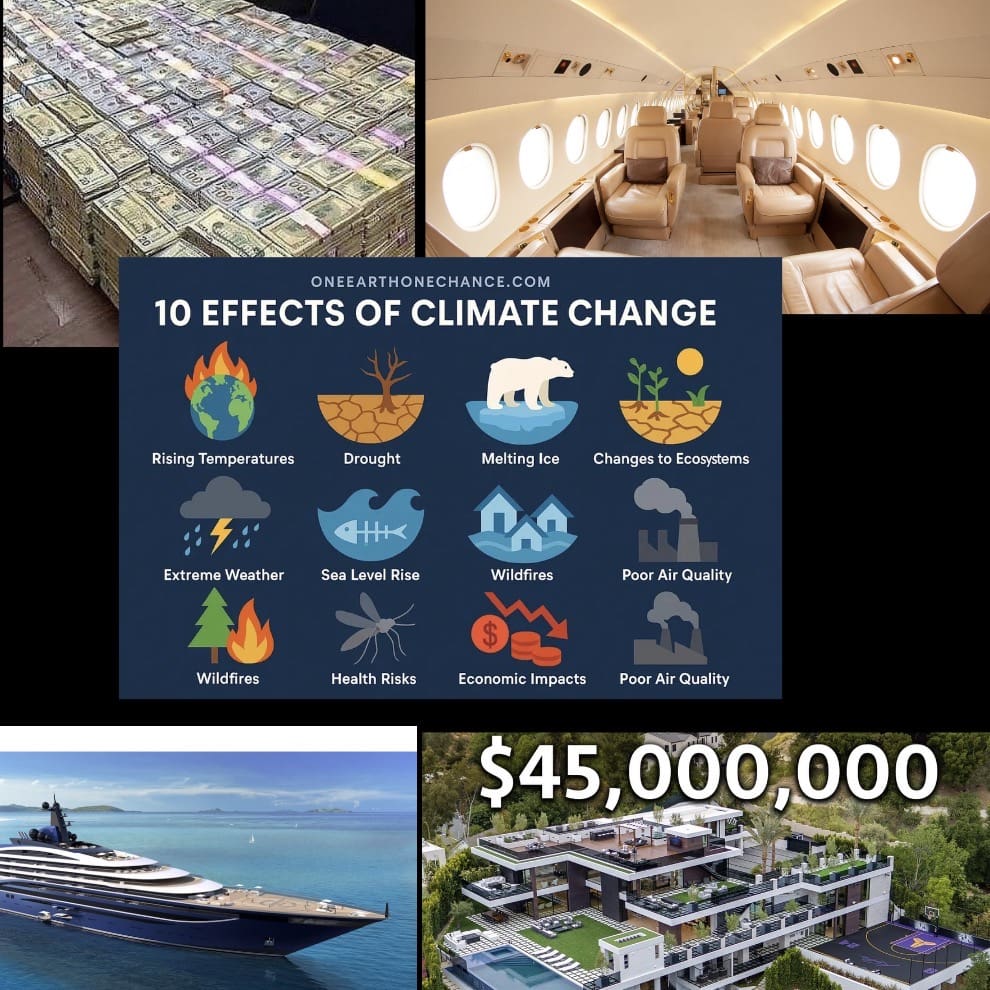
The Planet Is in Crisis and the Wealthy Are Burning It
Every few years the same uncomfortable claim resurfaces: the Earth has too many people and I admit I am one of them. With almost nine billion humans sharing the planet, there is an argument to suggest that environmental collapse is simply the inevitable result of population growth. Forests are disappearing, oceans are filling with plastic, the climate is heating, and wildlife populations are collapsing. Surely, the argument goes, there are simply too many of us.
But this narrative hides a far more troubling truth. The environmental crisis is not driven equally by all people. It is driven disproportionately by a small group whose wealth, consumption and political influence allow them to damage the planet on a scale that billions of ordinary people never could.
The problem is not simply population. It is power.
The richest one per cent of humanity produces vastly more carbon emissions than the poorest half of the world combined. While billions struggle to meet basic needs, a tiny global elite consumes energy, resources and land at staggering levels, through private jets, superyachts, multiple mansions and investment empires tied directly to fossil fuels.
Yet many among that same elite and the political figures who represent their interests continue to deny or downplay the crisis they are helping to fuel.
Few public figures have been as openly dismissive of climate science as former United States President Donald Trump. During his presidency he repeatedly mocks the scientific consensus around global warming. At one rally he declared that climate change was a “hoax”, while on social media he famously wrote: “The concept of global warming was created by and for the Chinese in order to make U.S. manufacturing non-competitive.”
Trump also withdrew the United States from the Paris Climate Agreement and rolled back dozens of environmental regulations in the name of economic growth. The message was clear: environmental protections were obstacles to business.
Across the Atlantic, Nigel Farage has expressed similar sentiments about environmental policy. Farage has frequently criticised efforts to move away from fossil fuels, arguing that climate policies harm economic prosperity and energy security. At one point he dismissed the growing climate movement as “climate hysteria” and mocked environmental campaigners for wanting to “deindustrialise the Western world”.
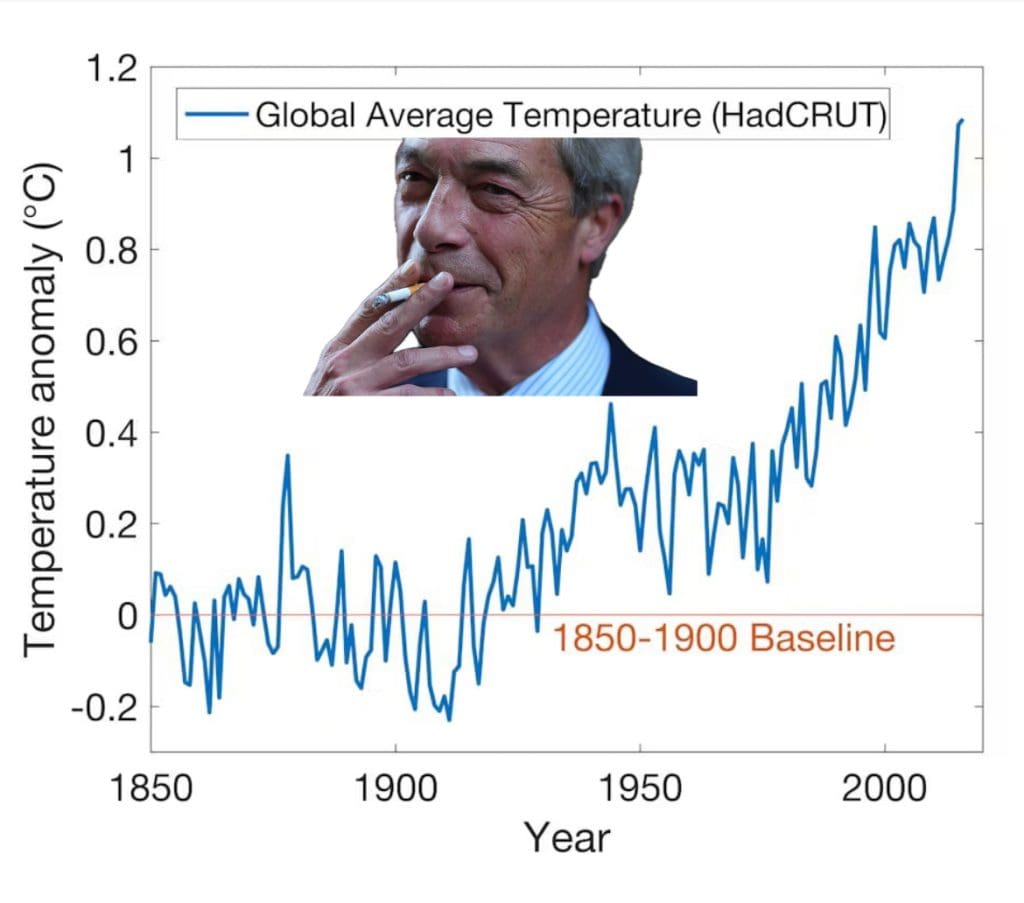
Both Trump and Farage are funded by the fossil fuel lobby.
The billionaire industrialist Charles Koch, whose vast fortune is deeply entwined with the American fossil fuel industry, has long funded organisations dedicated to questioning climate science. His company once dismissed global warming concerns as “alarmism”, arguing that environmental regulations would threaten economic growth and prosperity.
Former ExxonMobil chief executive Rex Tillerson similarly downplayed the urgency of climate change for years, once suggesting that global warming was “an engineering problem” that humanity would simply adapt to.
And in Britain, figures within finance and industry have often echoed a similar sentiment: economic growth must come first.
The hedge fund billionaire Ken Griffin once argued that efforts to rapidly move away from fossil fuels could cause “significant economic disruption”. Others in global finance warn that aggressive climate policies risk slowing markets or threatening investment returns.
These arguments share a common theme: the defence of economic growth above environmental limits.
But growth for whom?
Economic expansion within the modern global system rarely distributes its rewards evenly. Instead, the benefits accumulate overwhelmingly at the top, while the environmental consequences are shared by everyone, particularly the poorest communities who are least responsible for causing them.
The uncomfortable reality is that the environmental crisis is less about how many people exist and more about how the most powerful among them choose to live and invest.
A single private jet flight can emit more carbon per passenger in a few hours than some people produce in an entire year. Superyachts burn enormous quantities of fuel simply to maintain luxury travel for their owners. Vast estates consume extraordinary levels of energy and land.
Behind many of these fortunes lie industries that depend directly on extraction: oil and gas drilling, industrial agriculture, mining, mass aviation and large-scale manufacturing.
Meanwhile, billions of people live modestly, with minimal environmental footprints. A smallholder farmer in rural Africa or Asia contributes almost nothing to global emissions compared with a billionaire investor whose wealth is tied to fossil fuel production.
Yet it is often these poorer populations who are implicitly blamed when the conversation turns to “too many people”.
This framing is politically convenient. If the problem is humanity itself, then responsibility becomes diluted across the entire species. Governments can ask individuals to recycle more, reduce plastic use, or take shorter showers while continuing to approve new oil fields, subsidise fossil fuel exploration and protect corporate interests.
But if we recognise that environmental destruction is driven largely by extreme wealth and consumption, the solutions become far more radical.
It would mean imposing strict limits on the most polluting luxuries. Private jets, mega-yachts, and excessive energy consumption could no longer exist without scrutiny. Extreme wealth could be taxed and redirected towards renewable infrastructure, conservation and ecological restoration.
It would also mean holding corporations accountable for decades of environmental damage and misinformation. Many fossil fuel companies knew the dangers of climate change as early as the 1970s yet continued to expand production while funding campaigns designed to sow doubt about the science.
Most significantly, it would require questioning the economic model itself, a system built on the assumption that endless growth can occur on a planet with finite resources.
For many among the global elite, this is the real taboo. The idea that growth must have limits threatens the very foundations of modern capitalism and the fortunes it has produced.
So instead, the narrative shifts. Population becomes the convenient scapegoat. The blame moves quietly from the boardroom to the billions.
But the Earth is not collapsing because ordinary people exist.
It is collapsing because a small number of extremely powerful individuals and the politicians who defend them have built an economic order that treats the natural world as expendable and then insisted that any attempt to restrain that destruction would be bad for business.
If humanity truly wants to protect the planet, the debate must move beyond the myth that “too many people” are the problem.
The real issue is not the number of people on Earth.
It is the extraordinary power of the few who are burning it.