Yesterday we found out that Nigel Farage had sold out Brexit for £14 million.
Now let us move on to his antisemitism and vile racism that is dominating investigative media practices.
I. Why This Matters
Allegations of racism and antisemitism in a school setting are never trivial, especially when they concern language referencing the Holocaust. They matter not simply because of the individuals involved, but because of what such behaviour represents in a society still grappling with the legacies of genocide, empire and racial inequality.
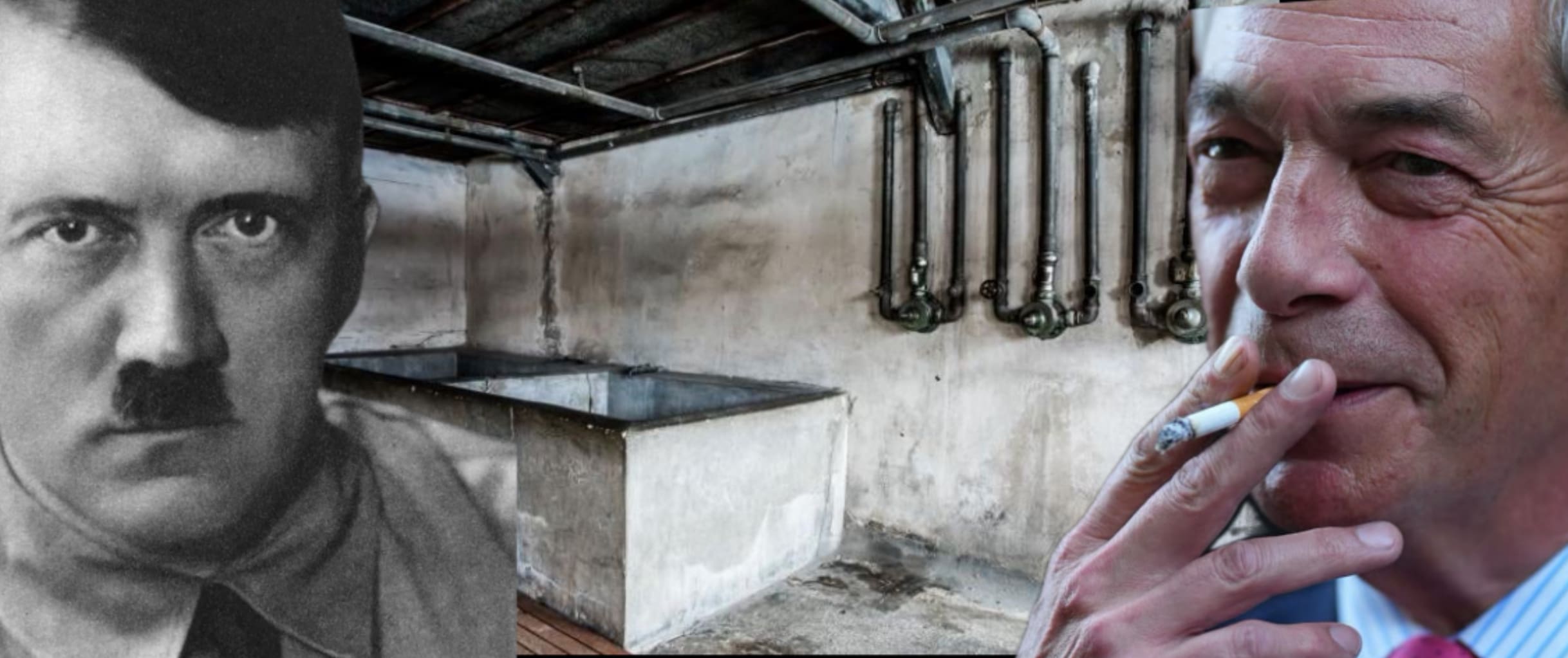
Recent testimonies from former pupils and teachers at Dulwich College have brought to light a pattern of alleged racist and antisemitic behaviour in the late 1970s and early 1980s by Nigel Farage. These accounts are remarkable not only for their consistency but also for their gravity: repeated references to Hitler, Holocaust imagery, taunts involving gas chambers, and targeted racist abuse.
In response, eleven Holocaust survivors—people who experienced Nazi policies first-hand—have issued a public letter urging full honesty about what transpired. Their intervention is not about party politics. It is about the moral danger of normalising language that has historically accompanied persecution, segregation and mass murder.
This piece synthesises the accounts of former pupils, the insights and warnings of Holocaust survivors, and the broader historical understanding of how hateful speech functions. It does not advance a political argument. It aims to clarify why these allegations carry such profound weight.
II. The Testimonies: A Pattern of Racism and Antisemitism
1. Allegations from Jewish pupils
Central to the published accounts is the testimony of Peter Ettedgui, now a Bafta- and Emmy-winning director, who recalls repeated antisemitic taunts during his school years.
According to Ettedgui and eight corroborating witnesses:
- Farage would approach him saying “Hitler was right”.
- He would allegedly add: “Gas them.”
- In some versions, the phrase was accompanied by a long hissing noise, intended to mimic the sound of gas chambers at Auschwitz-Birkenau.
These alleged taunts were not, as multiple witnesses describe, one-off provocations. They were said to be frequent, deliberate, and targeted at Jewish pupils.
Another former pupil recalls similar behaviour directed at a different Jewish boy by Farage—again involving gas-hissing sounds and references to Nazis and the Holocaust. This suggests that the conduct may not have been isolated to a single individual but part of a broader pattern.
2. Allegations from pupils of Asian heritage
The testimonies extend beyond antisemitism. Several former pupils of Asian backgrounds describe overtly racist behaviour by Farage during their time at Dulwich.
Among the reported experiences:
- Being called a “Paki”, a racist slur widely recognised as abusive.
- Being told “Enoch Powell was right”, a phrase referencing the politician’s inflammatory “Rivers of Blood” speech predicting societal collapse due to immigration.
- Having attention drawn to “foreign” names in school assemblies, particularly Patel, in ways intended to signal that such names were un-British or unwelcome.
One pupil recalls an incident during a full school assembly in which names were read out for administrative purposes. When Patel was called, Farage repeatedly shouted out loudly and aggressively to draw attention to the name. According to the witness, this occurred only for the name Patel, and was intended to underscore its “foreignness”.
Another witness recounts the burning of a school roll in a year when there were more Patels than Smiths—an act presented, in his memory, as a warped commentary on demographic change.
These accounts are not identical, but they cohere in describing a school environment in which racialised taunts and derision of minority identities occurred in a targeted manner.
3. Corroboration across individuals
Several features of the testimonies stand out:
- Multiple independent witnesses: More than two dozen individuals—pupils and teachers—have provided accounts.
- Consistency: Descriptions of phrases, behaviours, and targets align closely across witnesses.
- On-the-record statements: Many of the testimonies were given openly, with names attached.
- Variety of backgrounds: Witnesses include Jews, British Asians, and non-minority pupils who observed the behaviour as bystanders.
These patterns lend weight to the survivors’ concern that the allegations represent more than youthful mischief: they point to a persistent pattern of behaviour grounded in racial and antisemitic verbal abuse.
III. Why the Survivors’ Intervention Matters
1. The survivors’ letter: a warning, not a prosecution
The eleven Holocaust survivors who signed the letter include some of the most respected educators and witnesses of the Shoah. Their life stories represent almost the full range of Nazi persecution:
- Auschwitz and Bergen-Belsen survivors
- Ghetto survivors
- Children hidden by strangers
- Families wiped out by deportation or mass shootings
Their letter is grounded not in political strategy but in lived experience of how dehumanisation begins.
They write:
“Praising Hitler, mocking gas chambers, or hurling racist abuse is not banter. Not in a playground. Not anywhere.”
Their concern is rooted in historical fact: the Holocaust did not begin with deportations. It began with normalised slurs, public ridicule, and the trivialising of violence against minorities.
2. The moral significance of their question
The survivors ask directly whether the phrases “Hitler was right” or “gas them” were said, and whether racist abuse was targeted at Jewish or Asian pupils.
They also highlight the moral gravity of dismissing such claims:
“As Holocaust survivors, we understand the danger of hateful words – because we have seen where such words lead.”
Their plea is not for retribution. It is for recognition of the harm such language causes—and the danger of treating it as harmless.
3. Why survivors have a unique voice in this debate
Holocaust survivors are among the last living witnesses to genocide. Their interventions in public discourse are rare and typically reserved for issues they regard as existential:
- the distortion of Holocaust history
- the rise of antisemitism
- the normalisation of racist rhetoric
- the trivialisation of genocide-related language
When survivors speak collectively, it reflects a belief that silence in the face of such reports would be a dereliction of memory.
IV. Understanding the Historical Weight of Antisemitic and Racist Language
1. Antisemitism as a precursor, not an epilogue
Extensive historical scholarship—by Yehuda Bauer, Saul Friedländer, Timothy Snyder, Deborah Lipstadt and others—demonstrates that antisemitic violence is almost always preceded by antisemitic speech.
From medieval blood libels to 20th century propaganda, the pattern is similar:
- Derision
- Dehumanisation
- Vilification as a threat
- Social isolation
- Violence
When survivors warn that words matter, they speak from experience of a world where “jokes” became laws, where taunts became policies, and where ordinary citizens became perpetrators through gradual moral erosion.
2. Why gas-chamber “humour” is uniquely harmful
The alleged gas-hissing noises and mocking references to “gassing” evoke a killing process used to murder about one million Jews at Auschwitz-Birkenau alone.
For survivors:
- Such noises are not metaphors.
- They represent the last sound heard by their parents, siblings, cousins.
- They evoke real spaces—sealed chambers, Zyklon B pellets dropped through hatches, cries, silence.
Mocking this process is not comparable to ordinary dark humour. It is an invocation of industrialised mass murder.
3. The historical significance of “Hitler was right”
The phrase “Hitler was right” has featured in:
- neo-Nazi graffiti,
- extremist slogans,
- hate-motivated attacks,
- online radicalisation.
In educational contexts, such taunts are used to intimidate Jewish students, implying that genocide was justified. Even if not meant ideologically, repeating such phrases reproduces the logic of extermination.
4. Racism against South Asian pupils: Britain’s own post-war context
The racist behaviour described by former Dulwich pupils sits within the broader British social landscape of the 1970s and 1980s:
- The National Front’s electoral presence
- Anti-immigrant marches
- Violence against Asian communities in Southall and elsewhere
- Frequent use of slurs in schoolyards across the country
- Heated debates around immigration and national identity
References to “Enoch Powell was right” in a school setting were not neutral. Powell’s “Rivers of Blood” speech remains one of the most influential articulations of anti-immigrant fear in postwar Britain.
Thus, these alleged schoolyard chants sit within a wider environment of racial tension and exclusion.
V. Patterns, Memory and Social Responsibility
1. Testimonies suggest targeted, not incidental, behaviour
Witnesses consistently describe:
- specific individuals being targeted
- repeated phrases
- deliberate mimicry of Holocaust mechanisms
- racially-charged commentary on names and identity
This suggests the behaviour was systematic rather than impulsive. Survivors emphasise that such patterns reflect not only individual attitudes but a school culture that may have permitted racialised bullying.
2. Why “banter” is an insufficient framing
Although no defence or denial is considered here, the concept of “banter” warrants examination.
Modern studies in education, psychology and sociology show that:
- Language that undermines a group’s humanity causes measurable harm.
- School communities shape lifelong beliefs.
- Ethnic and religious minorities disproportionately carry the burden of “jokes” at their expense.
Thus, even without malicious intent, the impact of such language is real.
3. Survivors’ perspectives: safeguarding historical truth
Survivors are acutely aware that the fewer of them remain alive, the more vulnerable society becomes to:
- Holocaust distortion
- minimisation
- trivialisation
- appropriation of Nazi imagery in public discourse
Their letter serves as a reminder that remembrance is not passive. It requires active resistance to the normalisation of dehumanising speech.
VI. Why This Conversation Matters Beyond One Individual
1. A marker of broader societal issues
The allegations illuminate wider concerns:
- the persistence of antisemitic tropes
- the lingering effects of imperial-era racism
- the vulnerability of minority pupils in elite educational settings
- the question of how societies confront past wrongdoing
This is not a story confined to a single school or a single generation. It mirrors experiences reported across Britain during that era.
2. The responsibility of historical literacy
Understanding why Holocaust references are so painful is a civic responsibility. Survivors emphasise this because they have seen how societies collapse when contempt is allowed to go unchallenged.
3. Keeping memory alive as survivors age
The youngest child survivors of the Holocaust are now in their eighties. Their interventions are increasingly precious. Each testimony connects present behaviour with historical truth.
VII. Unless Farage Takes Ownership And Apologies He Must Resign From UK Politics
The allegations emerging from Dulwich College describe a pattern of behaviour in which Jewish and Asian pupils were targeted with racist and antisemitic taunts. These testimonies come from multiple witnesses, across multiple years, and include references to Hitler, gas chambers, ethnic slurs, and attempts to intimidate pupils because of their heritage.
The intervention of eleven Holocaust survivors underscores the moral stakes of dismissing or minimising such allegations. Their message is simple and unwavering: language that mocks genocide or dehumanises minorities is dangerous, wherever it occurs and whoever speaks it.
This examination has not addressed political implications or the contemporary reactions of the individuals named in the testimonies. It focuses instead on the core concerns: the experiences reported by former pupils, the historical weight of the language allegedly used, and the reasons survivors believe that words—especially these words—must never be taken lightly.
The survivors’ challenge remains a human one rather than a political one:
How do we respond when confronted with allegations of racist and antisemitic behaviour?
What do we owe to those who lived through the consequences of such language?
And how do we ensure that history’s darkest lessons remain alive in our collective conscience?
Their answer is clear: by listening, by acknowledging harm, and by refusing to treat words that echo genocide as harmless or forgettable.
There is only on course of action for Nigel Farage and Reform UK. Hold their hands up and take full responsibility or get rid of their leader and sing a different song.