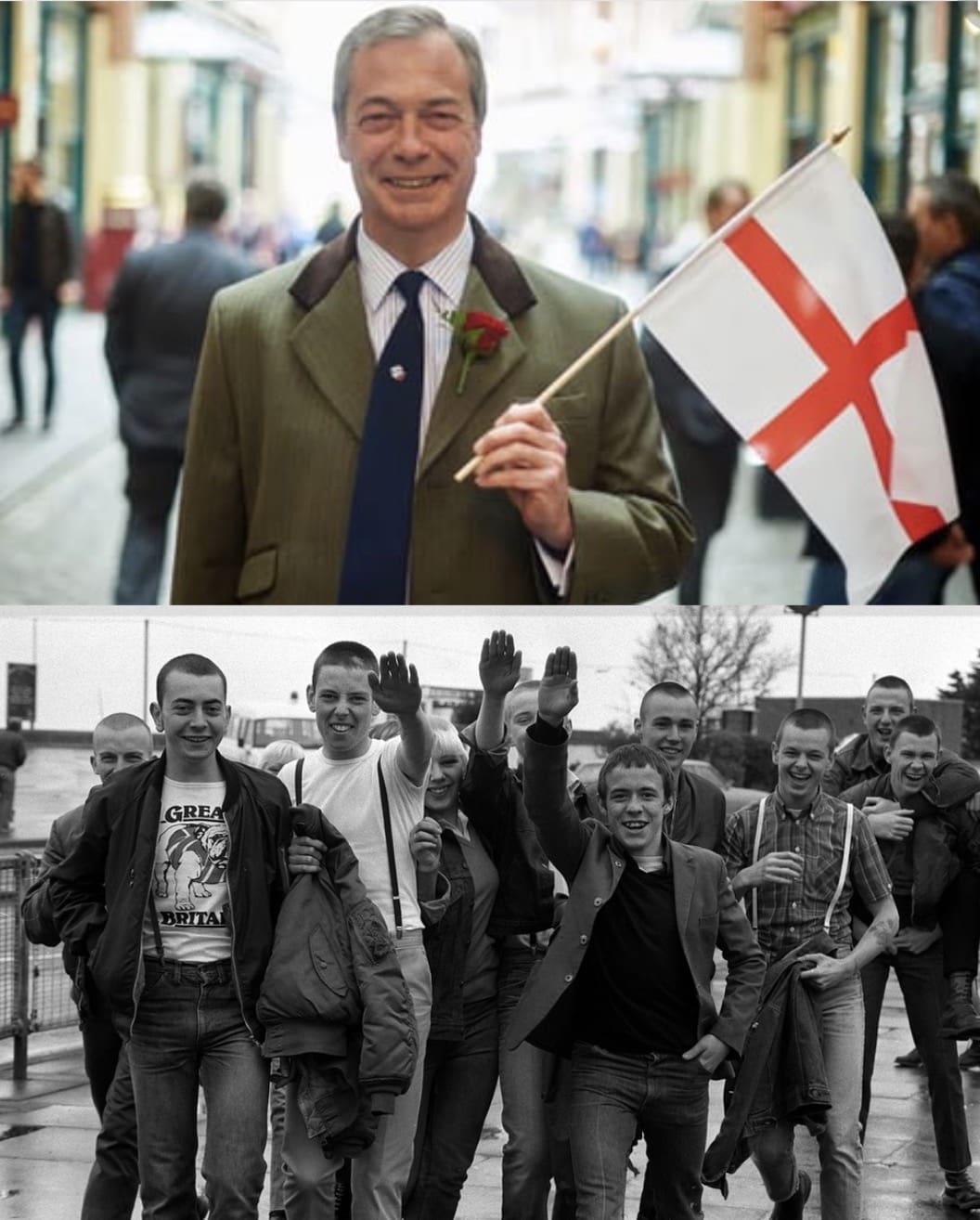
The journey from the shaven-headed street movements of the 1970s to the electoral rise of Reform UK in the 2020s is neither a straight line nor a simple story of inheritance. There is no formal organisational thread binding the violent neo-fascist fringes of that earlier era to a modern political party contesting parliamentary seats. Yet there is a discernible evolution of themes, grievances and strategies that helps explain how ideas once confined to the margins have, in altered form, travelled closer to the centre of British politics.
To understand that shift, we must return to the turbulent Britain of the 1970s. Economic decline, industrial unrest and demographic change created fertile ground for racialised politics. The most visible far-right force of the decade was the National Front, of which Nigel Farage is reported to have been a member, which capitalised on anxieties about immigration and national identity. Its marches through urban areas with significant Black and Asian populations were deliberately provocative, often ending in confrontation. The infamous clashes at the Battle of Lewisham in 1977 symbolised a period in which far-right politics was expressed as much on the streets as at the ballot box.
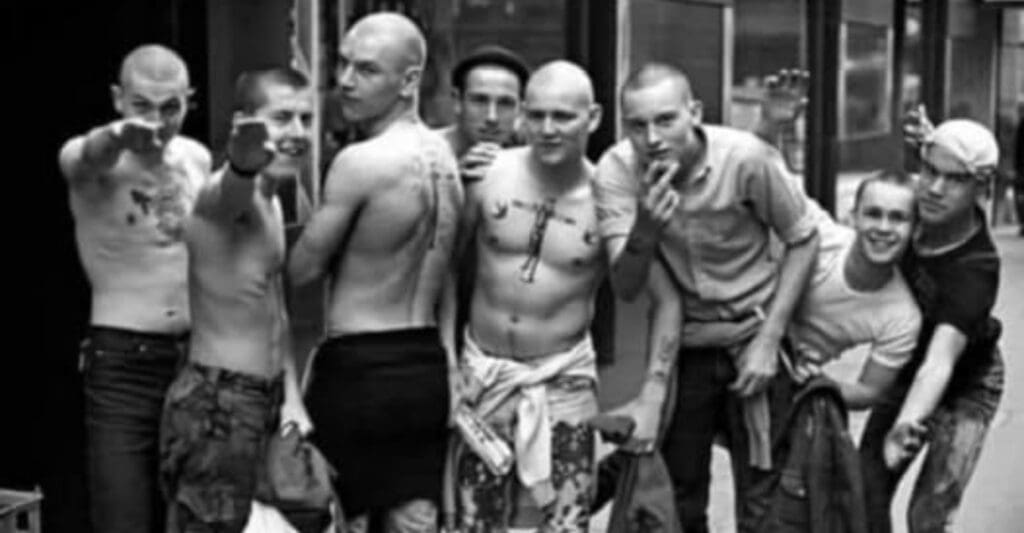
The skinhead subculture, which had emerged in the late 1960s as a multi-ethnic working-class youth scene influenced by Jamaican ska and reggae, became in the public imagination entangled with this politics. While many skinheads rejected racism, a visible and aggressive minority aligned themselves with the National Front and similar groups. The image of the booted, bomber-jacketed street activist became shorthand for British extremism. Politics at this edge was tribal, performative and often violent. It was also electorally marginal.
By the 1980s and 1990s, that overtly confrontational model was faltering. The National Front splintered. In its place, the British National Party attempted a different strategy: suits rather than street brawls, council seats rather than chaotic marches. Under leaders who sought a veneer of respectability, the BNP achieved limited local and European electoral success in the 2000s. Yet its ideological baggage and internal dysfunction prevented it from breaking through nationally. The lesson was clear: explicit neo-fascism had a hard ceiling in modern Britain.
At the same time, a broader current was developing on the right, one less overtly racial but equally animated by questions of sovereignty, borders and cultural change. The UK Independence Party (UKIP), founded in the early 1990s, focused primarily on opposition to Britain’s membership of the European Union. For years it lingered at the periphery. But under the leadership of Nigel Farage, UKIP refined a populist message that fused Euroscepticism with a broader critique of political elites and immigration policy.
This marked a crucial shift. Whereas the National Front and BNP were defined by explicit racial nationalism, UKIP framed its case in terms of democratic accountability and border control. The language was less incendiary, the imagery more professional. Yet it tapped into overlapping reservoirs of discontent: a sense that globalisation had hollowed out communities, that Westminster was detached, that rapid social change had occurred without consent. UKIP’s electoral breakthroughs in European Parliament elections demonstrated that such sentiments, repackaged, could command significant support.
The 2016 referendum on EU membership was the hinge moment. UKIP’s long campaign for withdrawal helped bring about the vote and the victory for Leave transformed the political landscape. In the referendum’s aftermath, UKIP struggled to redefine its purpose. Farage departed and returned; internal divisions resurfaced. In 2018 he launched the Brexit Party, a vehicle designed to pressure Parliament to deliver Brexit in full. Its success in the 2019 European elections underscored how a tightly focused populist message could mobilise voters frustrated with the political class.
In 2021, the Brexit Party rebranded as Reform UK. The new name signalled an attempt to broaden its appeal beyond the singular issue of EU withdrawal. Reform UK positioned itself as an insurgent force advocating lower taxes, institutional reform and stricter immigration controls. It criticised what it described as bureaucratic inertia and cultural orthodoxies. In doing so, it entered terrain once occupied, in cruder form, by earlier far-right movements: the defence of national sovereignty, scepticism towards multiculturalism and distrust of established elites.
The differences, however, are as important as the similarities. Reform UK operates squarely within the democratic system. It contests elections, fields candidates and articulates policy platforms aimed at a national electorate (although very obscurely). It does not organise paramilitary-style marches or espouse openly fascist doctrines directly. Its leadership has sought to distance the party from extremist imagery and rhetoric. The transformation from the skinhead-associated activism of the 1970s to the polished campaign launches of the 2020s reflects a strategic calculation: that cultural grievance travels further when shorn of overt extremism.
Yet politics does not unfold in a vacuum. The social conditions that once nourished the National Front, i.e., economic insecurity, regional inequality, rapid demographic change have not vanished. Deindustrialisation, austerity and stagnant wages have left scars across many parts of the country. Trust in institutions has declined. Social media has accelerated the circulation of polarising narratives. In this environment, messages that promise to restore control, reassert borders or challenge perceived orthodoxies find receptive audiences.
The story, then, is not one of a hidden organisational pipeline from 1970s skinheads to Reform UK. It is a story of adaptation. Ideas that were once shouted on street corners have been reframed in the language of policy papers and broadcast interviews. Explicit racial hierarchies (although those like Matthew Goodwin still seek to ensure this resonates) have largely given way to arguments about culture, legality and national cohesion. The aesthetic has changed from boots and braces to suits and social media graphics. But certain underlying themes, i.e., sovereignty, identity, resentment of elites have proved remarkably durable.
British politics has always contained a nationalist undercurrent. What has altered over five decades is the route by which it expresses itself. Where the far right of the 1970s relied on confrontation and spectacle, later movements learned the value of ballots over brawls. UKIP demonstrated that populist energy could reshape mainstream debate. The Brexit Party showed that a single issue, sharply defined, could disrupt established parties. Reform UK represents the latest iteration: a party seeking to consolidate a broader right-wing populist constituency in a post-Brexit landscape.
Whether Reform UK endures as a significant force will depend on factors that extend beyond history: the performance of the major parties, economic conditions and the party’s own ability to balance insurgent rhetoric with electoral pragmatism. But the path from the fringes of the 1970s to the ballot papers of the 2020s illustrates a wider truth. Political ideas rarely disappear; they mutate. They soften their edges, change their vocabulary and search for new vehicles. The Britain of today is not the Britain of the skinhead era. Yet the anxieties that animated that period have not entirely faded; they have simply found new forms of expression.