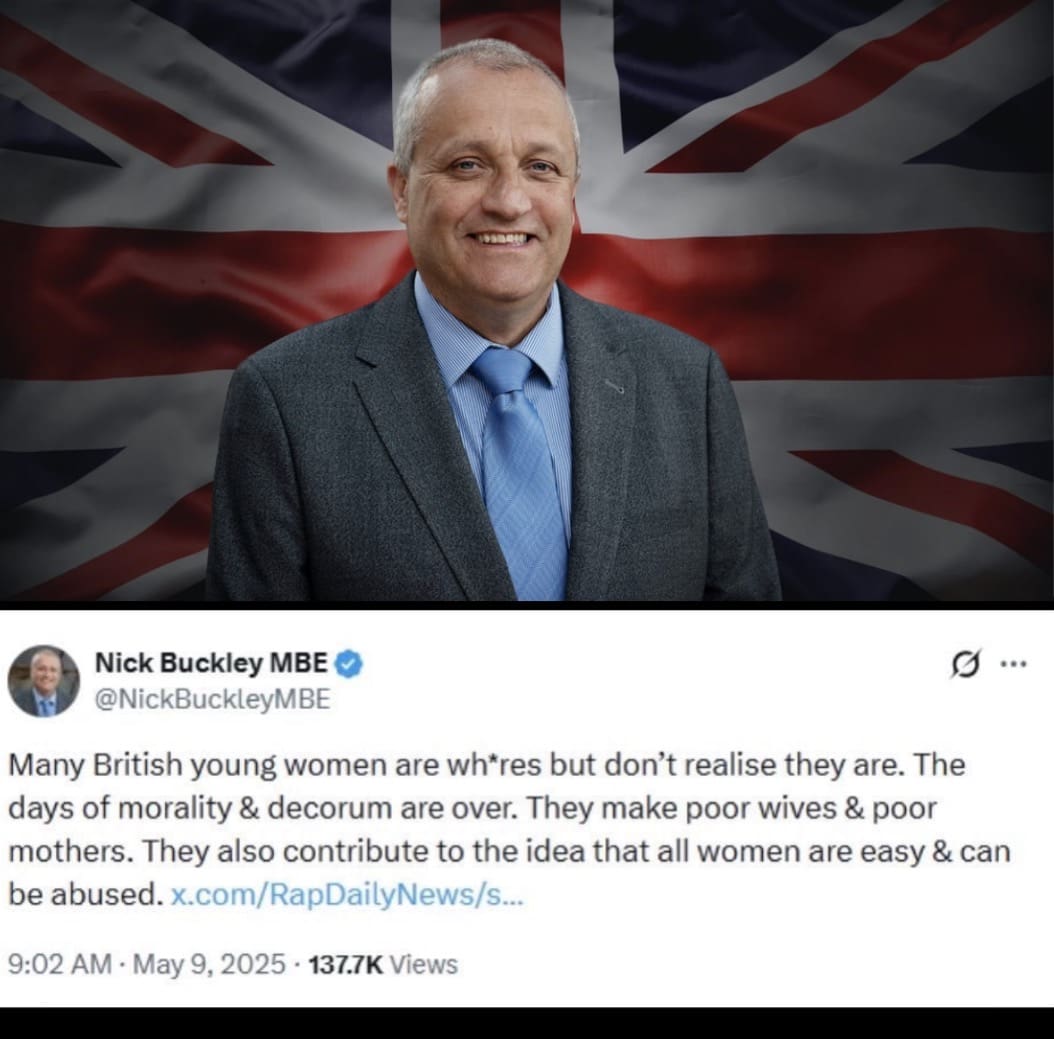
There is a particular strain of British right-wing politics that no longer even pretends to be motivated by compassion, evidence, or public good. Its fuel is resentment. Its method is cruelty. Its targets are predictable: women who will not conform, minorities who will not stay silent, and the poor who will not disappear politely. Nick Buckley MBE has emerged as one of the clearest avatars of this politics of contempt—less a thinker than a disciplinarian, cloaking hostility in the language of “common sense” and demanding respect by virtue of a state honour rather than moral authority.
Buckley’s politics are not built around solutions. They are built around targets. Migrants. Feminists. Single mothers. Child-free women. “Woke” women. The poor. Anyone whose existence complicates his rigid, nostalgic fantasy of social order becomes fair game. This is not conservatism in any meaningful intellectual sense; it is reactionary grievance masquerading as virtue. He does not ask why social problems exist. He assigns blame downwards, relentlessly, and almost always at women.
The screenshots attributed to Buckley are not aberrations. They are ideological confessions.
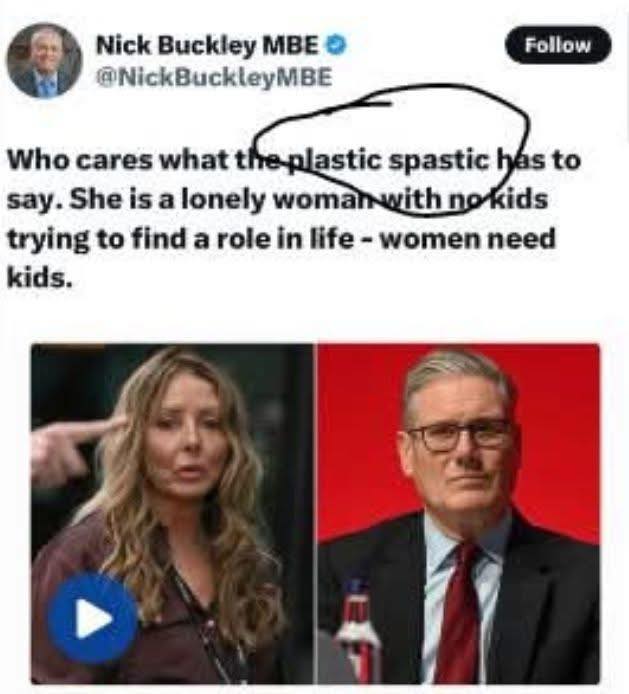
Dismissing a woman as “plastic,” “lonely,” and “with no kids,” and declaring that “women need kids,” is not a casual insult. It is political doctrine. It asserts that a woman’s legitimacy—her right to speak, to criticise, to exist meaningfully in public life—is conditional on motherhood. No children? Then you are frivolous. Incomplete. Not worth listening to. This is gender hierarchy stated plainly, without apology.
That is authoritarian gender politics. Full stop.
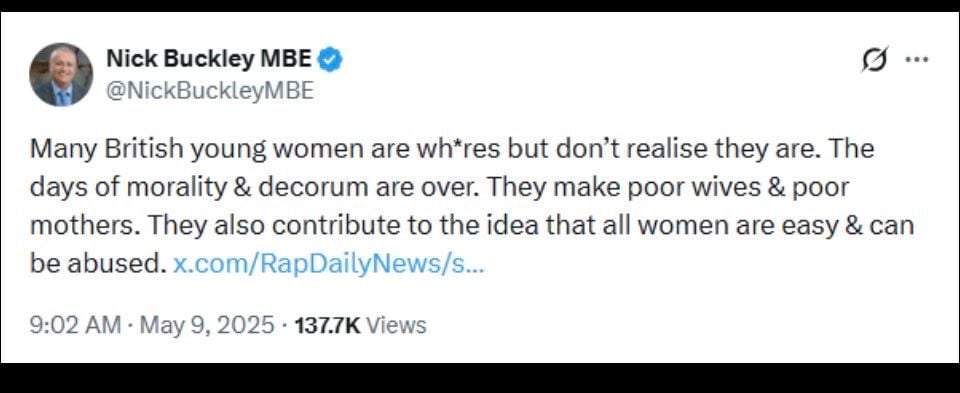
But the second tweet obliterates any remaining ambiguity. Describing “many British young women” as “whores” is not commentary or cultural critique—it is dehumanisation. And dehumanisation is never neutral. It is always political.
The most revealing line is not even the slur itself, but the claim that these women “contribute to the idea that all women are easy & can be abused.” This is victim-blaming elevated to worldview. Responsibility for misogynistic violence is shifted away from abusers and placed onto women who fail to meet Buckley’s moral code. Abuse becomes a consequence rather than a crime. Harm becomes something women earn through disobedience.
This is not merely offensive. It is dangerous.
This is the same logic that has historically justified sexual violence, workplace discrimination, and the policing of women’s bodies. It is a worldview that insists women must be controlled “for their own good,” and then punished when men harm them. And here it is being articulated not by an anonymous troll, but by a man with an MBE, routinely platformed as a serious voice on social policy.
Which brings us to the honour itself.
MBEs are not participation trophies. They are meant to signal public trust—recognition that someone has contributed positively to civic life and embodies values the state is willing to endorse. When a recipient uses that legitimacy to publicly degrade women, normalise misogynistic slurs, and advance rhetoric that excuses abuse, the honour does not remain neutral. It becomes compromised.
At that point, the scandal is no longer just what Buckley says. It is what the state continues to tolerate.
Keeping an MBE attached to a figure who openly describes young women as “whores” and implies they are responsible for their own abuse is not harmless oversight. It is institutional endorsement by inertia. It sends a clear message: that contempt for women is compatible with public honour, that cruelty can coexist with civic recognition and that misogyny is a forgivable excess so long as it is delivered in the right ideological accent.
Buckley’s defenders often insist he is merely expressing opinion. But honours are not awarded for opinions; they are withdrawn for conduct. And this conduct—repeated, public, unapologetic—falls far below the standard any honour system should tolerate. If honours are to mean anything at all, they must be revocable when a recipient demonstrates sustained contempt for basic human dignity.
Otherwise, the system becomes a farce.
Buckley’s obsession with women’s sexuality also exposes the fraud at the heart of his supposed moral concern. There is no serious interest here in reducing poverty, supporting families materially, expanding childcare, or addressing male violence. Moral failure is sexualised, feminised, and projected onto young women, while structural power is quietly absolved. Men’s behaviour is barely interrogated. Authority is never questioned.
This is culture-war misogyny doing the work of political evasion.
What Buckley offers is not moral leadership but moral panic. Not solutions, but scapegoats. Not social responsibility, but sanctioned cruelty. His politics demand that women be silent, compliant, maternal, and grateful—or else publicly shamed and blamed for the violence inflicted upon them.
That is not conservatism. It is reactionary misogyny, stripped of euphemism.
And it should not merely be criticised. It should have consequences.
Because when a politics requires the public degradation of women to sustain itself—and when that degradation is delivered by someone wearing a state honour—the problem is no longer just the man. It is the institution that continues to honour him.