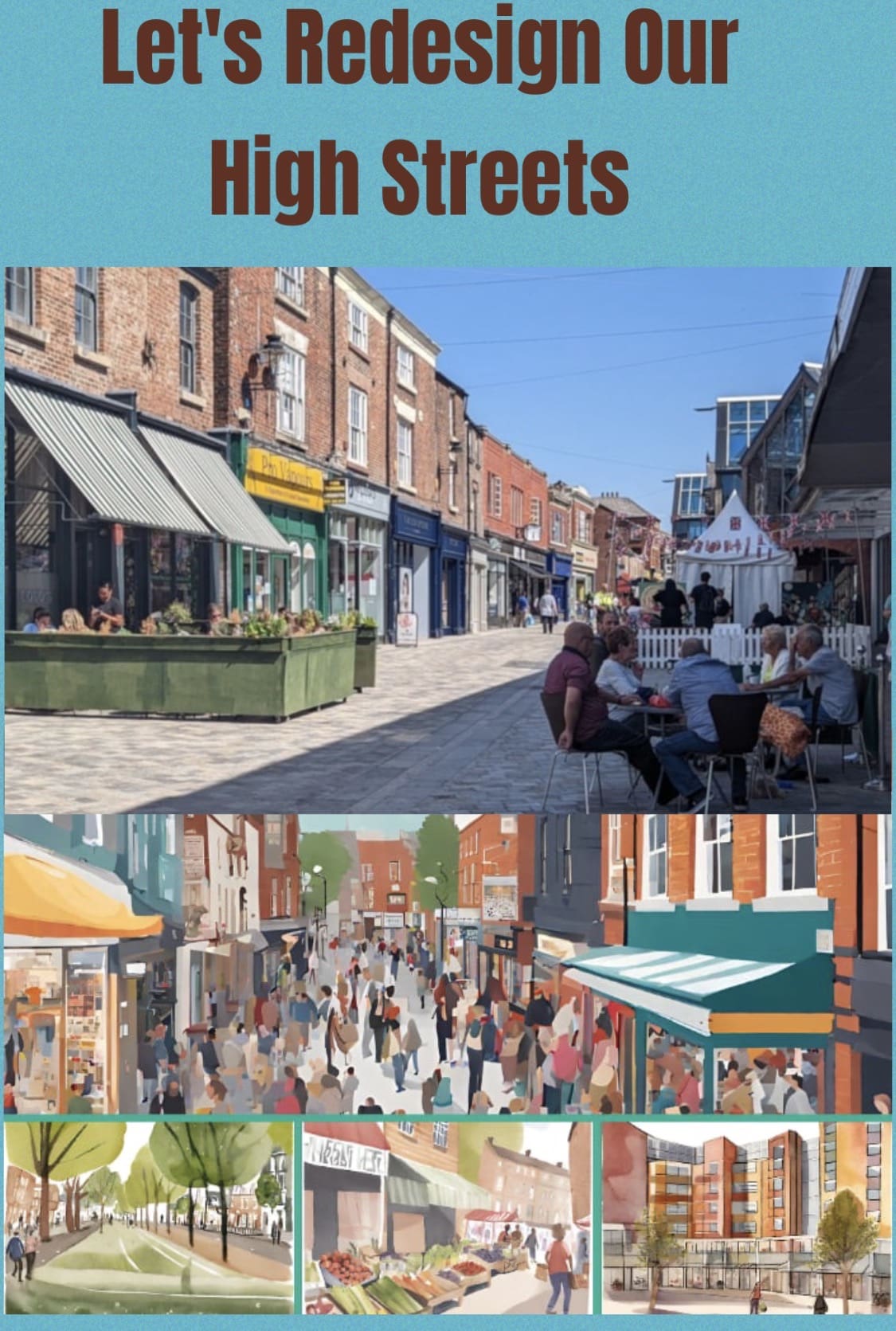
Britain’s High Streets are in crisis but they are not beyond saving. Empty shops, rising rents, failing chains and declining footfall are not signs of inevitable decline; they are symptoms of political and personal choices, economic imbalance and outdated thinking.
This article sets out two radical but practical blueprints to save the High Street, not just for shoppers, but for residents, workers, disabled people, young people, older people, small businesses, nature and communities. The High Street must no longer exist solely to sell things. It must exist to serve people and the local environment.
OPTION 1
1. Redefining the High Street: From Retail Strip to Living Place
🏠 👩👩👧👦 🧑💻 🎭
The central mistake of past policy has been treating the High Street as a retail-only zone. Shopping alone cannot sustain town centres in the age of online retail.
The New High Street Model
| Old Model ❌ | New Model ✅ |
|---|---|
| Shops only | Homes, services, culture & shops |
| Daytime-only use | 24-hour living neighbourhood |
| Chain-dominated | Independent & community-led |
| Car-first | People-first |
Key Actions
- Convert empty shops into affordable homes
- Ensure upper floors are always in use
- Encourage mixed-use buildings (living + working + social)
📌 Accessibility note: All conversions must meet Lifetime Homes and inclusive design standards — step-free access, lifts, hearing loops and adaptable layouts.
2. Homes on the High Street
🏘️ 🔑 🛠️
Housing brings footfall, safety and economic stability.
What Should Change
| Measure | Impact |
|---|---|
| Zero VAT on converting empty shops | Cuts costs, speeds regeneration |
| Mandatory use of upper floors | Ends wasted space |
| Social & key worker housing quotas | Keeps towns affordable |
| Long-term tenancies | Stable communities |
🧩 Pictogram logic:
🏠 = Homes → 👣 Footfall → ☕ Local spending → 💼 Jobs
3. Saving Independent Businesses
🛍️ 🧑🍳 📚
Independent traders are the soul of the High Street — and the most unfairly punished.
Business Rates: The Single Biggest Problem
| Current System ❌ | Proposed System ✅ |
|---|---|
| Property-based tax | Turnover-based tax |
| Penalises small shops | Progressive & fair |
| Rewards empty units | Incentivises occupation |
Radical Proposal
- Replace business rates with a progressive turnover tax
- 0% tax for start-ups in their first 3 years
- Automatic small business relief (no forms, no delays)
4. A High Street Bank
🏦 🤝 💷
Britain once had building societies rooted in place. We should bring that idea back.
High Street Bank – What It Does
| Function | Who Benefits |
|---|---|
| Low-interest loans | Local traders |
| Refurbishment finance | Community groups |
| Start-up capital | Young entrepreneurs |
| Green retrofits | Climate & costs |
💡 Publicly owned. Regionally run. Community accountable.
5. Making Online Retail Pay Its Fair Share
📦 💻 🏙️
Online shopping didn’t kill the High Street alone — unfair taxation helped.
E-Commerce Contribution Levy
| Who Pays | What It Funds |
|---|---|
| Large online retailers | Town centre renewal |
| Warehousing giants | Digital tools for independents |
| Multinationals | Public realm upgrades |
📌 Ring-fenced — the money must go back to High Streets.
6. Digital High Streets (Not Digital Deserts)
📱 🏬 🧑💼
Independents shouldn’t be forced to compete alone online.
Digital Support Hubs
| Service | Purpose |
|---|---|
| Shared e-commerce platforms | Level the playing field |
| Click-and-collect hubs | Boost footfall |
| Digital skills training | Future-proof traders |
| Local online marketplaces | Keep spending local |
🧠 Key idea: Online and offline should support, not destroy, each other.
7. Streets for People, Not Just Cars
🚶♀️ 🌳 ♿
High Streets should feel welcoming, safe and usable for everyone.
People-First Design Principles
| Feature | Benefit |
|---|---|
| Wide pavements | Wheelchairs & buggies |
| Seating & shade | Older people & carers |
| Public toilets | Dignity & inclusion |
| Clear signage | Neurodivergent access |
| Pedestrian priority | Safer, calmer streets |
🧭 Town centres must be places people want to stay — not rush through.
8. Community Ownership and Power
👥 🏢 🔑
When communities own places, they protect them.
Right to Buy Local Assets
| Asset | Community Use |
|---|---|
| Empty shops | Co-operatives |
| Closed banks | Advice centres |
| Old pubs | Social hubs |
| Vacant cinemas | Arts spaces |
📌 Funded through community shares, council backing and the High Street Bank.
9. Culture as Economic Infrastructure
🎶 🎨 🎪
Culture isn’t decoration — it drives footfall.
Always-On High Streets
| Activity | Frequency |
|---|---|
| Markets | Weekly |
| Performances | Monthly |
| Festivals | Seasonal |
| Workshops | Year-round |
🎭 A busy High Street feels safer, friendlier and more prosperous.
10. A National High Streets Act
📜 🏛️
All of this needs legal force.
What the Act Would Do
| Measure | Outcome |
|---|---|
| Guaranteed funding | Long-term planning |
| Place-based decision making | Local solutions |
| Community-first rules | Public good over profit |
| Strong planning powers | Stop land-banking |
Conclusion: The High Street as a Shared National Project
❤️ 🇬🇧 🏬
Saving the High Street is not about nostalgia or resisting change. It is about fairness, inclusion and community power.
A thriving High Street:
- Reduces loneliness
- Creates jobs
- Supports small business
- Provides homes
- Builds pride and belonging
This is not a market failure — it is a political choice. And it can be reversed.
The High Street can live again — not as a relic of the past, but as a living, breathing, inclusive heart of modern Britain.
OPTION 2
Saving the High Street: A Radical, Inclusive and Green Plan for Britain’s Town Centres
🏬 ❤️ 🌳 🏘️ 🐝
Britain’s High Streets are in crisis but they are also one of the country’s greatest untapped assets. If we continue to treat them purely as shopping corridors, they will continue to fail. If instead we reimagine them as green, social, living places, they can become healthier, happier and more resilient than ever before.
This is a people-first, climate-aware blueprint for saving the High Street for residents, businesses, disabled people, older people, young people, wildlife and future generations.
1. Redefining the High Street: From Retail Strip to Living, Green Place
🏠 🌳 👩👩👧👦 🧑💻
The future High Street must be mixed-use and nature-rich, not a concrete funnel between car parks.
The New High Street Model
| Old Model ❌ | New Model ✅ |
|---|---|
| Hard paving everywhere | Green streets & pocket parks |
| Retail-only | Homes, culture, nature & services |
| Traffic-dominated | People- and wildlife-friendly |
| Empty at night | Lived-in and safe 24/7 |
🌱 Key Principle: Nature must be woven into the High Street, not pushed to the edges.
2. Green Space at the Heart of the High Street
🌳 🪑 🐦 🌼
Every High Street should contain accessible green areas for rest, recovery and wildlife, particularly for people who do not have gardens.
Types of Green Space
| Green Feature | Purpose |
|---|---|
| Pocket parks | Quiet rest & socialising |
| Parklets (former parking bays) | Seating & greenery |
| Green squares | Events & markets |
| Courtyard gardens | Calm, low-sensory spaces |
| Living walls & roofs | Cooling & biodiversity |
🧩 Pictogram logic:
🌳 Shade → 😌 Calm → 👣 Longer visits → ☕ More local spending
3. Designing Green Space for Everyone
♿ 👵 🧠 👶
Green areas must be inclusive, not decorative.
Inclusive Green Design Standards
| Feature | Why It Matters |
|---|---|
| Step-free access | Wheelchair & mobility users |
| Frequent seating | Older people & carers |
| Quiet zones | Neurodivergent people |
| Shade & shelter | Heat & weather resilience |
| Clear sightlines | Safety & comfort |
📌 Green space is public health infrastructure, reducing stress, loneliness and heat-related illness.
4. Homes on the High Street — With Nature Built In
🏘️ 🌱 🔑
New homes must not be stacked above grey streets.
Green Housing Measures
| Measure | Benefit |
|---|---|
| Mandatory green roofs | Insulation & wildlife |
| Shared gardens | Social connection |
| Rain gardens | Flood prevention |
| Tree-lined streets | Cooling & air quality |
🐝 Every residential conversion should contribute to urban biodiversity, not deplete it.
5. Wildlife-Friendly High Streets
🐝 🐦 🦔 🌼
High Streets can be urban nature corridors, connecting parks, rivers and gardens.
Simple Wildlife Interventions
| Action | Impact |
|---|---|
| Native planting | Pollinators thrive |
| Bee bricks & bird boxes | Nesting spaces |
| Reduced night lighting | Protects bats & insects |
| Pesticide-free zones | Healthier ecosystems |
🌍 Small changes, multiplied across towns, create national-scale ecological benefits.
6. Saving Independent Businesses — Greened and Local
🛍️ 🌿 📚
Green High Streets support local business.
Green Business Support
| Support | Outcome |
|---|---|
| Grants for planters & seating | Welcoming shopfronts |
| Outdoor trading zones | Cafés & markets thrive |
| Green retrofit loans | Lower energy bills |
| Local supply chains | Reduced emissions |
🌱 A greener High Street is a more commercially successful one.
7. Reclaiming Space from Cars
🚶♀️ 🌳 🚲
Traffic-heavy High Streets are hostile to people and nature.
Street Rebalancing
| Change | Result |
|---|---|
| Fewer through-roads | Cleaner air |
| Tree-lined walking routes | Cooler streets |
| Cycle priority | Less congestion |
| Green buffers | Noise reduction |
📌 Car access remains — but people, nature and safety come first.
8. Community-Owned Green Assets
👥 🌿 🔑
Green space should never be an afterthought or a luxury.
Community Green Ownership
| Asset | Community Use |
|---|---|
| Vacant plots | Community gardens |
| Empty courtyards | Sensory gardens |
| Closed car parks | Urban parks |
| Roof spaces | Allotments & solar |
💚 Community stewardship increases care, pride and long-term protection.
9. Culture, Nature and Everyday Life Together
🎭 🌳 🎶
Green spaces should be active, not ornamental.
Living Green High Streets
| Activity | Space Used |
|---|---|
| Outdoor performances | Green squares |
| Reading & rest | Pocket parks |
| Nature play | Family zones |
| Wellbeing classes | Shaded lawns |
🌞 This creates High Streets that are joyful, not exhausting.
10. A Green High Streets Act
📜 🌍 🏛️
This vision needs legal backing.
What the Act Must Guarantee
| Requirement | Outcome |
|---|---|
| Minimum green space per High Street | Equal access to nature |
| Biodiversity net gain | Nature recovery |
| Climate-resilient design | Cooler, safer towns |
| Long-term maintenance funding | No neglected spaces |
Conclusion: The High Street as a Green Civic Commons
❤️ 🌳 🇬🇧
A future-proof High Street is:
- Greener
- Calmer
- Fairer
- Healthier
- More human
Green space is not a luxury. It is as essential as housing, transport and shops.
If we choose to invest in nature, people and place together, the High Street can become the most democratic green space in Britain, open to all, owned by all, and alive again.
It is now not about just deciding which option is best but coming together to negotiate and discuss. Then it is about devising a working group who can help to make it reality. Political promises are for those who believe in tooth fairies. The only people who can make this work are the local communities who want to make it work.