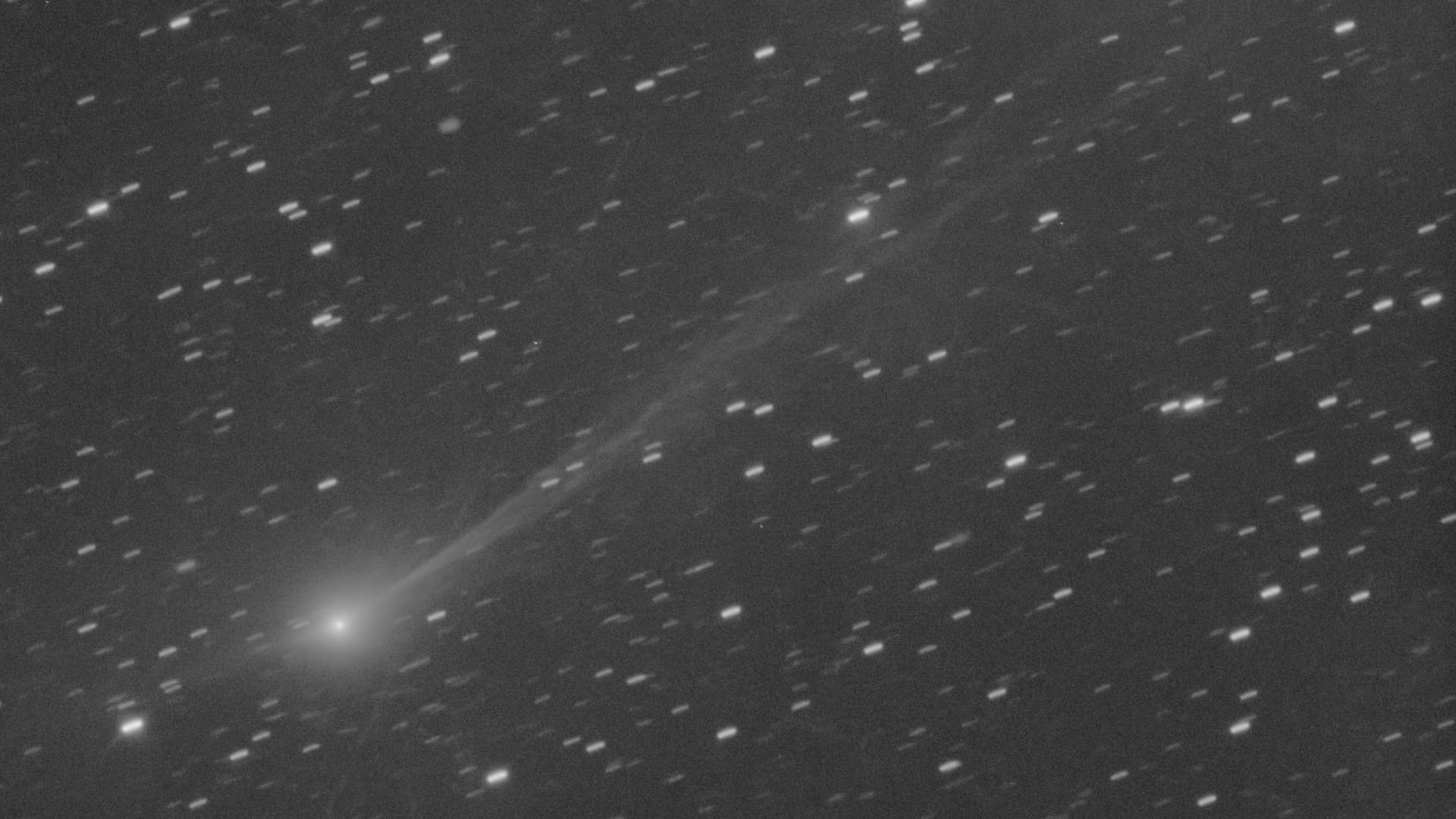
If extraterrestrials are indeed watching us, as one controversial scientist has suggested, they might already be regretting the decision.
On Friday, a mysterious object known as 3i/ATLAS reached its closest point to Earth, racing through space at 130,000mph and passing at a distance of 170 million miles – roughly twice as far away as the sun. While there is near-unanimous agreement among astronomers that it is an interstellar comet, the Harvard astrophysicist Professor Avi Loeb has ignited a global debate by arguing that we cannot entirely rule out the possibility that it is alien technology – even, potentially, a hostile craft.
Professor Loeb warned of a possible “black swan event”: something extremely unlikely but with potentially catastrophic consequences. Comparing humanity’s cosmic encounter to “a blind date of interstellar proportions”, he suggested that alien technology could pose a threat, particularly when its behaviour appears unusual. Images of 3i/ATLAS show a strange tail that Loeb argues could resemble a propulsion system, traces of nickel in its gas cloud that might hint at metal mining, and a trajectory oddly aligned with planetary orbits.
Most scientists are unconvinced. NASA’s Amit Kshatriya has stated bluntly: “This object is a comet. It looks and behaves like a comet.” The object is thought to be around eight billion years old, a cosmic fossil from the birth of another star system. Professor Chris Lintott of Oxford dismissed Loeb’s claims as “nonsense”, likening them to speculation that the moon might be made of cheese.
Yet whether 3i/ATLAS is a comet or a battleship may ultimately be irrelevant. If aliens are watching, the more pressing question is why they would want anything to do with us at all.
From orbit, humanity must look like a civilisation determined to sabotage itself. Across much of the world, right-wing politics has embraced grievance over governance, culture wars over cooperation, and nationalism over shared survival. Democratic norms are being hollowed out, elections questioned or undermined, and independent institutions attacked whenever they prove inconvenient. Authoritarian leaders increasingly present themselves as strongmen saviours, while steadily eroding freedoms, silencing critics and normalising corruption.
At the same time, we are conducting a slow-motion act of planetary vandalism. Climate change is accelerating, ecosystems are collapsing, and biodiversity is vanishing at a rate unseen in human history. The science is clear, yet political movements built on denial, delay and deregulation continue to hold disproportionate power. Forests are felled, oceans poisoned, and the atmosphere treated as a free dumping ground, all in service of short-term profit and ideological stubbornness.
Meanwhile, the public sphere is choked by media lies and disinformation. Large sections of the press and online platforms amplify falsehoods, distort scientific consensus, and turn complex global crises into tribal shouting matches. Facts are treated as optional, expertise as elitism, and humility – the very quality Professor Loeb argues is essential to science – as weakness.
Even where democracy technically survives, it often feels threadbare. Voters are offered narrow choices, influence is skewed towards wealth and power, and genuine accountability is rare. Many governments appear more responsive to donors, lobbyists and ideological bases than to evidence or the long-term public good.
So if 3i/ATLAS were an alien probe, what would it report back? A species with extraordinary technological potential, yes – but also one locked in self-destructive patterns, unable or unwilling to act collectively in the face of existential threats. A civilisation arguing over flags and slogans while its house burns.
Professor Loeb has accused his colleagues of intellectual arrogance, arguing that science must remain open to the unexpected. Perhaps that humility should extend beyond astrophysics. The most unsettling possibility is not that aliens are visiting us, but that they are quietly observing – and concluding that humanity is not ready to be taken seriously.
If they are out there, watching our politics, our environmental recklessness, our flirtation with authoritarianism and our casual disregard for truth, they may decide the safest course of action is simply to fly on by. And who could blame them?