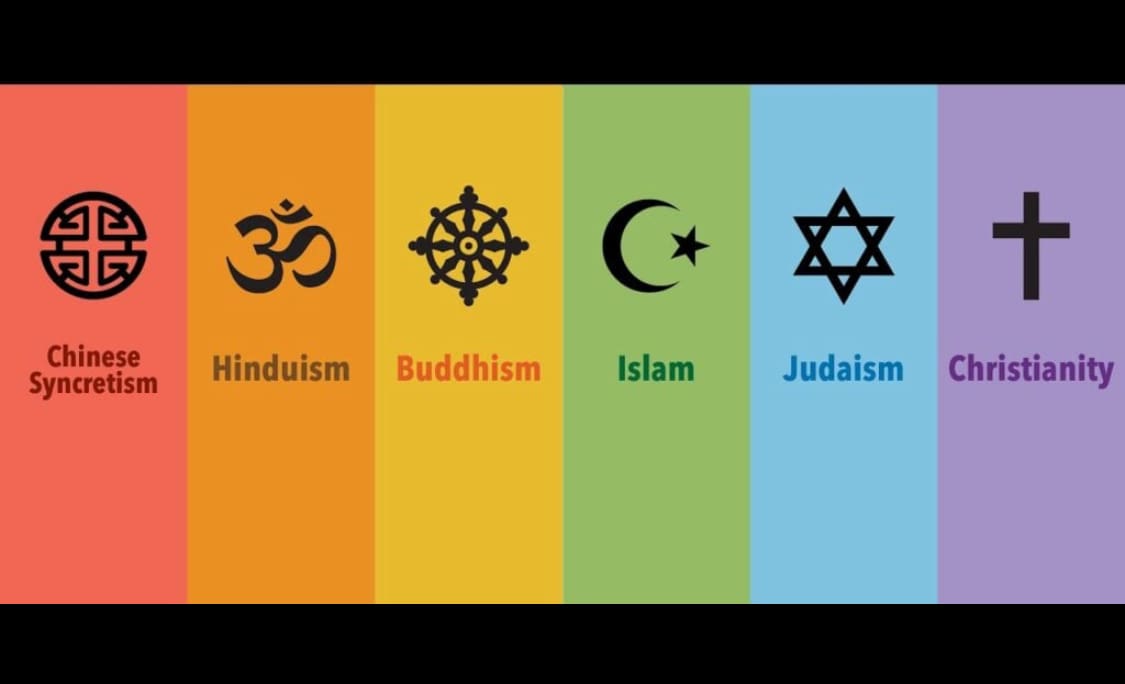
In our contemporary discourse, criticism of Islam is frequent and often vociferous. It focuses on issues of religious texts, social policies, and the actions of fundamentalist groups. While scrutiny of any powerful institution is a vital component of a free society, such criticism frequently falls into the trap of inconsistency. It holds Islam to a standard to which other major world religions are not subjected. If we are to engage in this critique meaningfully and not merely perpetuate prejudice, we must be fair. And being fair means applying the same critical lens to Christianity, Judaism, and Hinduism with equal intellectual rigour.
“Islamophobia is rife in our society, and I say this as a Jewish man.”
“Islamophobia is rife in our society and I say this as a Jewish man.”
— Zeteo (@zeteo_news) October 21, 2025
Rising star and new leader of the UK’s Green Party @ZackPolanski joined @mehdirhasan to discuss the dangerous anti-Islam rhetoric in UK politics. pic.twitter.com/xw6Ets7gYD
Let us begin with the very foundation of criticism: the literal interpretation of sacred texts. The Qur’an, like any ancient text, contains passages that, read in isolation, are deeply troubling to the modern conscience. Verses discussing warfare, the treatment of unbelievers, or gender roles are often cited as proof of Islam’s inherent bellicosity.
Yet, this is a blade that cuts all ways. The Hebrew Bible (the Old Testament) is replete with narratives that, taken literally, are equally jarring. It commands the stoning of adulterers and disobedient children (Deuteronomy 21:18-21), sanctions genocide against rival tribes (1 Samuel 15:3), and prescribes death for a multitude of transgressions. The Christian Gospels, while often focused on peace, contain their own severe pronouncements, such as Jesus’s statement that “I have not come to bring peace, but a sword” (Matthew 10:34), or the chilling theological assertion that non-believers will be condemned to eternal damnation (Mark 16:16). To single out the Qur’an for its challenging passages, while overlooking or metaphorically reinterpreting those in the Bible, is an exercise in selective outrage.
Moving to social structures, Islam is frequently condemned for its rulings on gender. The hijab, polygamy, and inequalities in inheritance law are legitimate topics for debate. However, these are not uniquely Islamic concerns. Orthodox Judaism has strict laws of modesty (tzniut) and, in its most conservative forms, practices significant gender segregation. The role of women in religious leadership remains a point of contention within many Christian denominations, notably the Catholic and Orthodox churches, which bar women from the priesthood. Hinduism, for all its goddess worship, has been historically shaped by the patriarchal dictates of the Manusmriti, a text that codifies women’s subordination to men and has been used to justify practices like sati and child marriage. The critique of religious patriarchy is valid, but it must be a universal one.
Perhaps the most potent criticism levelled at Islam today concerns political Islamism and violent extremism. The actions of groups like ISIS and Al-Qaeda are rightly condemned as barbaric. But to present this as a unique feature of Islam is to ignore a long and bloody history of religiously-motivated violence in other faiths.
Christianity’s legacy includes the Crusades, the Inquisition, and the Wars of Religion that devastated Europe. In our own time, the Lord’s Resistance Army in Uganda and extremist militias in the Central African Republic have committed atrocities in the name of Christ. Jewish fundamentalism, while less globally prominent, fuels the West Bank settlement movement, whose adherents often cite divine promise to justify the displacement of Palestinians. Hinduism, popularly perceived in the West as a peaceful philosophy of karma and yoga, has its own militant nationalism. Vigilante violence against Muslims and Christians in India, often incited by claims of protecting the faith, demonstrates that the fusion of religious identity with political aggression is a human failing, not an Islamic one.
Finally, we must confront the issue of reform. A common charge is that Islam has not undergone a reformation akin to the Protestant Reformation. This is a simplistic reading of history. The Reformation was not a single, neat event but a centuries-long, bloody process that shattered Christendom. Furthermore, Islamic modernism and progressive interpretations have existed for over a century, struggling for traction against both traditionalist orthodoxy and the geopolitical factors that empower fundamentalism. Judaism has undergone its own massive reforms, with Liberal and Progressive movements challenging Orthodox interpretations. Hinduism is constantly being reformed and redefined through social and political movements addressing caste and gender inequality, such as the work of Dr B.R. Ambedkar.
The point here is not to engage in a race to the bottom to prove that all religions are equally culpable. Nor is it to dismiss valid concerns about specific doctrines or practices within any faith. The point is one of intellectual consistency.
If we criticise Islam for its fundamentalists, we must also criticise Christianity, Judaism, and Hinduism for theirs. If we question the literal interpretation of the Qur’an, we must apply the same scrutiny to the Bible, the Torah, and the Vedas. If we are troubled by religious patriarchy or faith-based violence, our concern must be universal.
To do otherwise is not to engage in honest critique. It is to scapegoat. A fair and effective criticism must rise above cultural bias and focus on the universal challenges posed by fundamentalism, literalism, and the fusion of religious and political power—wherever they are found. Only then can the conversation be truly worthwhile.