

There are places in the world where history never truly sleeps. Cuba is one of them.
For anyone with even the faintest understanding of the Cold War, the island remains one of the most dangerous symbols in modern political memory. It was Cuba that brought the world to the edge of annihilation in 1962, when Washington and Moscow stared each other down with nuclear missiles poised for launch. Humanity survived that moment by the narrowest of margins. To drag the world back towards that precipice now would be an act of staggering recklessness.
Yet that is precisely why Cuba remains such a terrifying catalyst.
The rhetoric emerging from Washington has become increasingly incendiary, with talk of leadership change, “takeover”, and direct pressure on Havana. Cuba’s president, Miguel Díaz-Canel, has made clear he will not step aside under American demands, declaring that Cuba is a sovereign state answerable only to its own people. That response was inevitable. No nation, however weakened, willingly submits to threats from abroad.
What makes this crisis so combustible is not simply the standoff between the United States and Cuba, but the shadow that stands behind Havana.
Russia.
Moscow has already signalled in unmistakable terms that it will not abandon Cuba. Supplies continue, diplomatic support is public, and the symbolism is impossible to ignore. The moment an American strike, blockade escalation, or military intervention crosses from rhetoric into action, this ceases to be a Caribbean dispute and becomes a confrontation between nuclear powers.
That is how wars stop being local.
That is how history repeats itself.
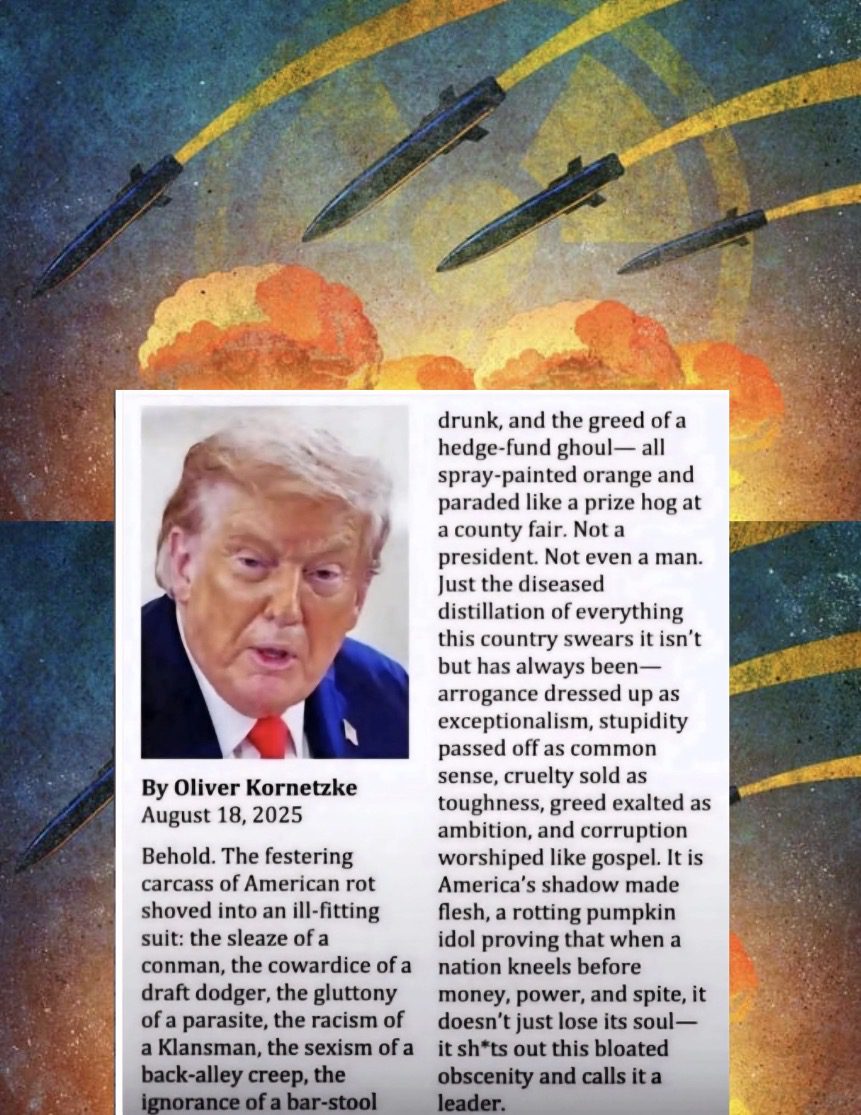
The imagery surrounding this moment feels almost apocalyptic: missiles arcing across a darkened sky, fire blooming beneath them, the sense that civilisation itself is once again being wagered on the ego and impulses of powerful men. The political fury reflected in public commentary is rooted in a deeper fear — that arrogance, spite and exceptionalism can still drive nations towards catastrophe.
Nuclear war rarely begins because one leader openly declares a wish for it.
It begins through escalation.
A strike on Cuban infrastructure.
A Russian naval response in the Atlantic.
American military deployments near Florida.
Missile systems repositioned.
One aircraft shot down.
One commander misreading an order.
One retaliatory launch.
From there, events move faster than diplomacy can catch them.
Cuba’s geographic position makes it uniquely dangerous. Barely ninety miles from the United States, any military confrontation there would carry immense symbolic and strategic weight. For Washington, it is a historic adversary. For Moscow, it is a perfect opportunity to project power into America’s immediate sphere.
That makes Cuba not merely an island, but a tripwire.
The world should be terrified by how casually the language of confrontation is being used. Because once missiles begin moving towards Havana, the issue is no longer regime change, ideology, or diplomacy.
It becomes survival.
If any modern crisis holds the potential to ignite a chain reaction leading towards nuclear confrontation, Cuba remains the most chillingly plausible.
The lesson of history is brutally simple: when pride, power and paranoia collide around Cuba, the whole world pays attention.
Because last time, we nearly paid with everything.







