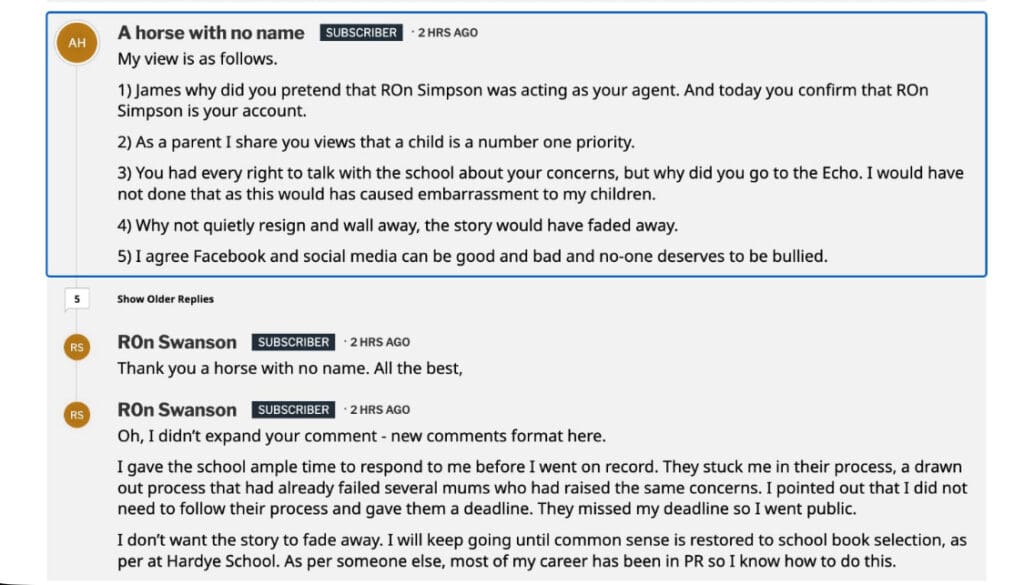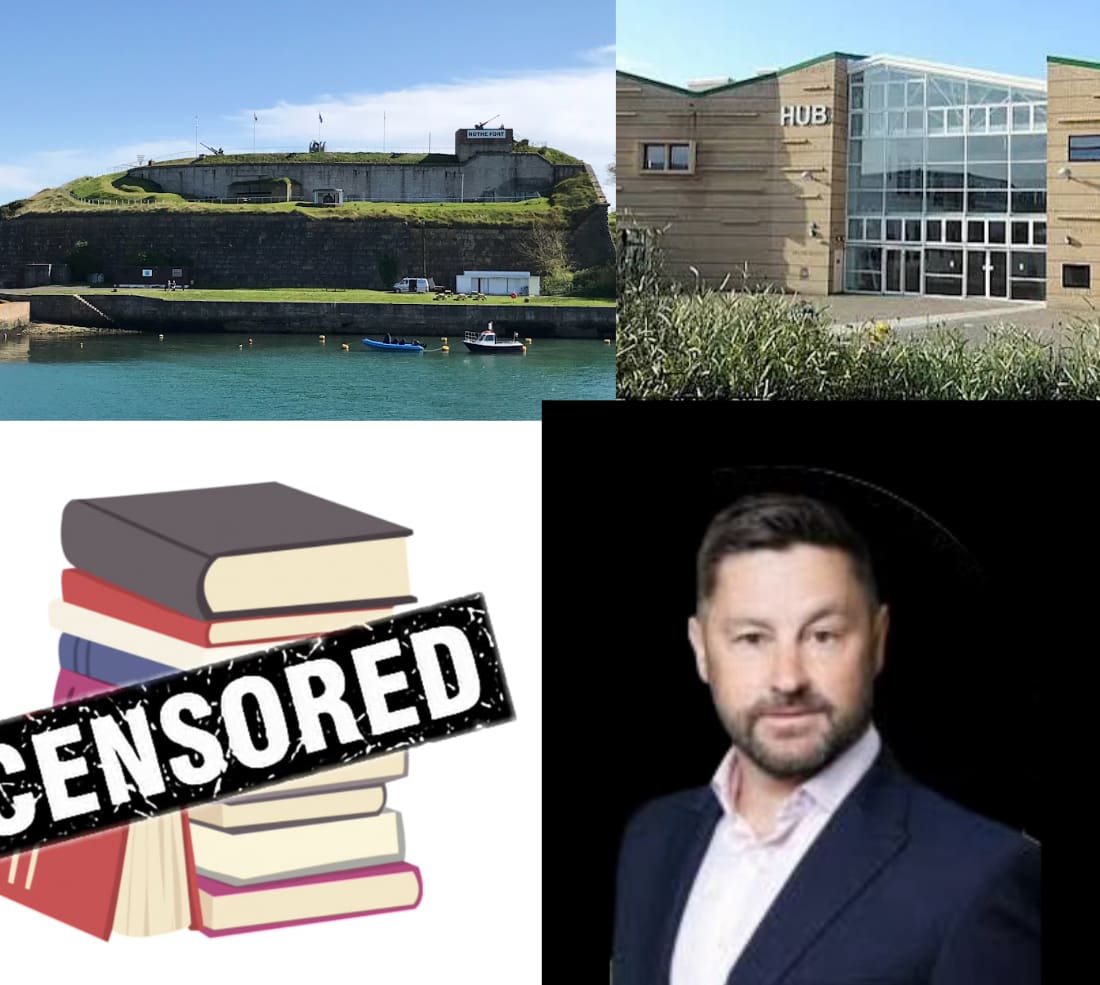
It started at a school meeting. It then moved online. Then it escalated to the local and national media. Finally, it ended with a victory for those who do not believe in censorship and are committed to authentic free speech.
Literally hundreds of children and parents locally made their feelings clear. ‘We can decide for ourselves,’ they exclaimed. ‘We do not need someone who admits that he hasn’t even read much of a specific book to tell us what is acceptable about it and what isn’t.’ ‘We do not need a self-proclaimed right-wing ex-politician to dictate our children’s experiences.’ ‘We do not need a book banner in our community.’ And so it came to pass that the voices of those parents and children won through.
Instead of holding his hands up and admitting he could have put his children first and kept this as a matter with just the school, he decided to shoot from the hip, with no public reflexivity.
Mr Farquharson’s statement:
‘I have resigned from my voluntary role as chairman of Nothe Fort, effective immediately. Protecting my children is my most important duty. I can’t accept their school conducting potentially unlawful political indoctrination (Education Act 1996), as well as normalising illegal sex acts (e.g. teacher on student rape), foul language and bad grammar.
I have raised this matter to national attention over the last few weeks. Lacking the ability to argue against me effectively, the progressive Left has chosen to attack me in other ways. A group has decided to attack Nothe Fort, the heritage arm of a local charity I help to lead. Protecting Nothe Fort is also important to me so I can’t expose it to potential harm. Resigning also reduces by one the personal attack vectors available for the Left to use in its campaign of intimidation.
Over the last nearly six years, I’m proud to have helped form a Nothe Fort team that has increased annual visitor numbers from around 60,000 to 100,000, as well as be named ‘England’s Best Small Visitor Attraction’ two times by Visit England. I nudged, the team delivered, so I’m sure the attraction will continue going from strength to strength.’
Now let us take a closer look.
Farquharson claims he has resigned from his role as Chairman of Nothe Fort to protect his children. These are the same children that he showed little consideration for when he drove this issue onto social media? The same children that could have been spared all of this if he had kept this all in-house and not appeared on GB News or in the Daily Mail? Please forgive my cynicism but the level of sincerity by Farquharson appears to be less than that contained by the tip of a rusty pin.
Now let us assess the so-called ‘unlawful indoctrinations’ and the citing of the Education Act 1996. The following requires your patience, kind reader.
The 1996 Education Act does NOT use the specific term “unlawful indoctrination.” Instead, the legal principle is established through a combination of key duties imposed on schools and the case law that has interpreted them.
The core legal requirements that prevent indoctrination are found in Section 406 and Section 407 of the Education Act 1996, which themselves are re-enactments of similar clauses from the Education Act 1944.
Here’s a breakdown of what the Act says and how it has been interpreted:
1. The Core Legal Provisions in the 1996 Act
Section 406: Prohibition of Political Indoctrination
- This section states that the local curriculum (i.e., the curriculum determined by the local authority) must be “balanced and broadly based.”
- It specifically forbids the promotion of “partisan political views” in the teaching of any subject.
- It requires that when political issues are brought to the attention of pupils, they are offered a balanced presentation of opposing views.
Section 407: Duty to Secure Balanced Treatment of Political Issues
- This section places a parallel duty on governing bodies and headteachers to ensure that:
- Where political issues are taught, pupils are encouraged to form their own opinions.
- The teaching avoids bias towards any particular partisan view.
2. The Spirit of the Law: The 1988 Education Reform Act
While the 1996 Act contains the specific clauses, the broader context is set by the Education Reform Act 1988, which is crucial for understanding the modern interpretation. This Act introduced the National Curriculum and, most importantly, Section 1, which states that the curriculum for a maintained school must:
- “Promote the spiritual, moral, cultural, mental and physical development of pupils at the school and of society.”
- “Prepare such pupils for the opportunities, responsibilities and experiences of adult life.”
A curriculum that indoctrinates, rather than educates, would fundamentally fail in these aims.
3. Key Case Law: Interpreting “Indoctrination”
The courts have clarified what constitutes unlawful indoctrination. The most significant case is:
- R v Secretary of State for Education and Science, ex parte Talmud Torah Machzikei Hadass School Trust (1985) – This case pre-dates the 1996 Act but is the foundational legal precedent. Mr. Justice Woolf (as he then was) provided a classic definition of what constitutes “efficient and suitable” education, the absence of which could be seen as indoctrination. He stated that education is not suitable if it “does not offer the child an opportunity to develop so that he (sic) is able when he leaves school to take his place as an adult in a pluralistic, multi-cultural society, and if it does not teach him to tolerate other views than his own.”
This judgment establishes that suitable education must equip a child for life in modern Britain, which requires the ability to think critically and tolerate differing viewpoints—the very antithesis of indoctrination.
Summary: What It Means in Practice
In essence, the 1996 Education Act, supported by the 1988 Act and key legal judgments, creates a legal framework that makes unlawful indoctrination any systematic attempt by a school to:
- Promote a single, partisan political view without presenting opposing arguments.
- Fail to encourage pupils to think for themselves on political or controversial issues.
- Provide an education that is so narrow that it prevents a child from integrating into and tolerating a pluralistic, democratic society.
Important Nuances:
- It does not prevent schools from having a religious character. Faith schools are permitted under the law, but they must still teach a broad and balanced curriculum and respect other faiths and beliefs.
- It does not mean teachers must be neutral on fundamental British values. Schools have a duty to actively promote values such as democracy, the rule of law, individual liberty, and mutual respect and tolerance for those with different faiths and beliefs. This is seen as a foundation for a cohesive society, not as partisan indoctrination.
- The focus is on “partisan” views. This means views associated with a particular political party or a specific, one-sided agenda.
Thus, in conclusion, while the term “unlawful indoctrination” isn’t in the text of the 1996 Education Act, the Act, in conjunction with other legislation and case law, establishes a powerful legal requirement for balance, objectivity, and the promotion of critical thinking in schools, which effectively prohibits it.
Outcome: Mr Farquharson really should have spent more time reading the Act and the legal precedents before commenting. He has made himself look very foolish to those who do the research.
Farquharson then claims the school has ‘normalised illegal sex acts’, foul language and bad grammar. I shall leave this to the legal department at Budmouth Academy and consider staying quiet at this time as more sensible and virtuous.
Farquharson then goes on to state, ‘I have raised this matter to national attention over the last few weeks. Lacking the ability to argue against me effectively, the progressive Left has chosen to attack me in other ways.‘
Lacking the ability to argue against me. Really?
I myself did just that when Mr Farquharson went public:
I am told that this article was very well received by many in the community, including Mr Farquharson. Thus, this comment appears disingenuous at best.
I would also like to question his use of the term ‘progressive left’. What does that mean? If it is a term in which he seeks to criticise it is a strange term to use. Similar to the authoritarianism of Trump and Farage, it is just a phrase that has absolutely no intelligent application. Who does he hope will see this phrase and start frothing? Not people I would want living next door to me, that’s for sure.
Then Mr Farquharson continues by stating that this so-called ‘progressive left’ has decided to attack Noth Fort because of his chairmanship. I was expecting to find hundreds or thousands of members of this ‘attack’ group. The group has 14 members. Really? He resigned because of 14 members? Again, he looks disingenuous and foolish if he seriously believes that most people will believe him.
I can only surmise from all of this that Mr Farquharson is appealing to those who do not do the research. Those who are trapped in an echo chamber where facts are deprived from them.
All of this could have been avoided with contrition. Now I suspect it is going to get much messier and we know who gains the most when things get messy, don’t we?
And the community will help.
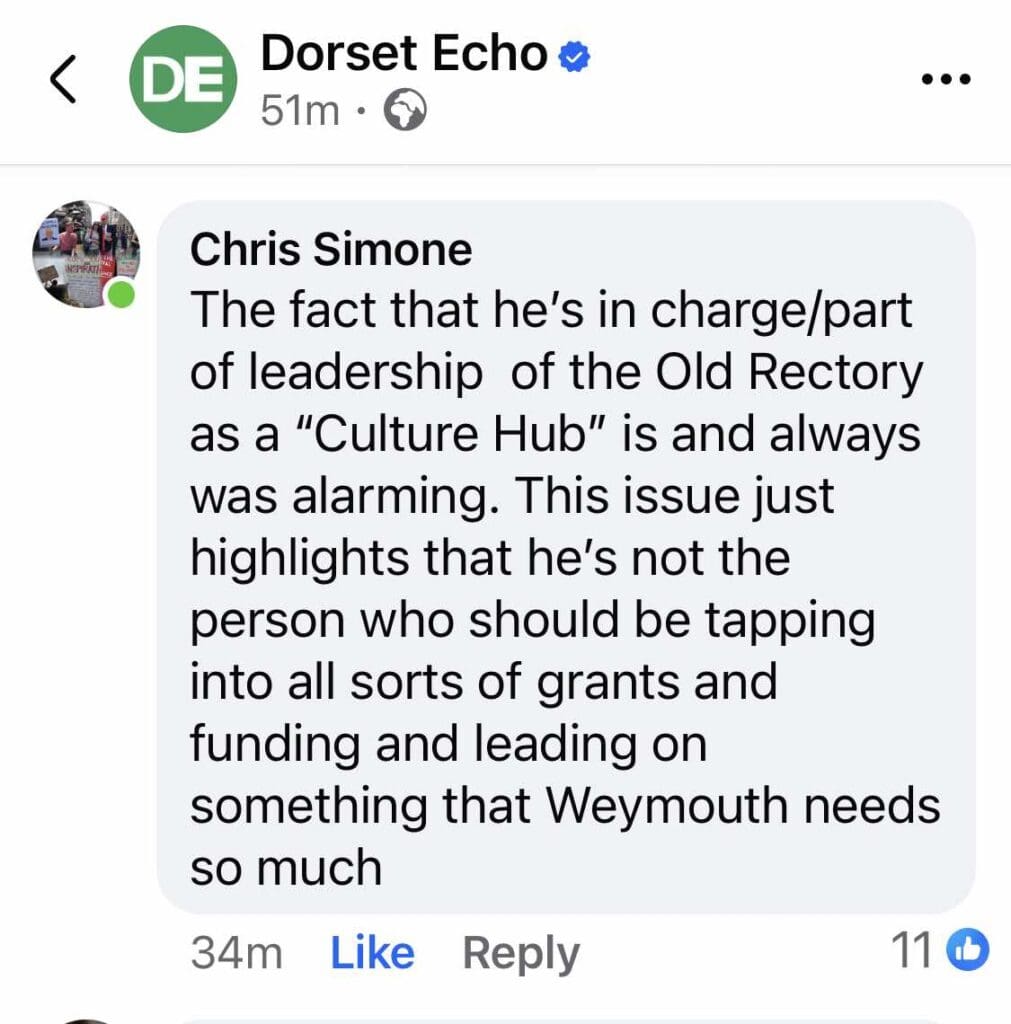
And if anyone is confused as to who Ron Swanson is: