

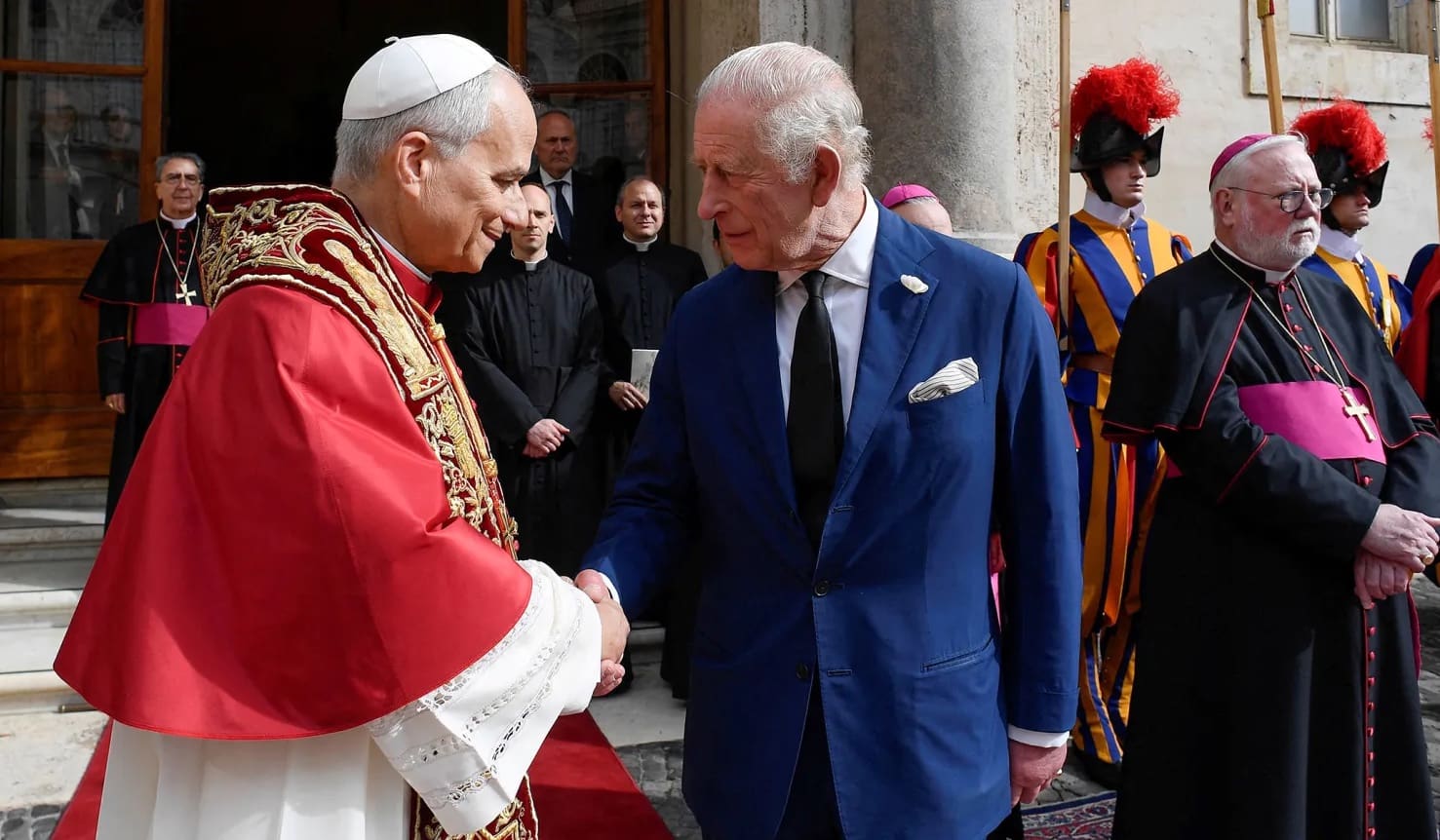
In a move rich with historical symbolism and geopolitical significance, King Charles III has stepped into the Vatican, becoming the first British monarch to make a formal visit in nearly 500 years, a period defined by the schism between the Church of England and Roman Catholicism. While framed publicly as a gesture of ecumenical goodwill, the visit is being analysed by political analysts and scholars as a profound act of faith-based diplomacy, signalling a strategic pivot by the British Crown to reclaim its influence within the complex and resurgent arena of religious soft power.
The historical weight of the moment is inescapable. To understand the profound significance of this diplomatic gesture, one must revisit the roots of the centuries-long divide. King Henry VIII has long been subject to a reductive and false narrative, cultivated in part within Roman Catholicism, that confines his role in the English Reformation to the annulment of his marriage to Catherine of Aragon (Haigh, 1993). For generations, the public has been told, inaccurately, that the Church of England’s break from Rome was driven solely by the king’s marital dispute. Yet this popular account obscures the far more complex and protracted nature of the schism.
While the annulment controversy served as the immediate catalyst, the rift was neither sudden nor merely personal, but deeper and longer in the making (Duffy, 1994). For centuries, England’s monarchy and clergy wrestled with an ecclesiastical structure dominated by Italian popes and Italian interests, a monopoly that reinforced Rome’s political and cultural control over European Christendom. English-language prayers were systematically discouraged in liturgical practice; Latin remained the exclusive medium of worship; and prayers for England were conspicuously absent, while prayers for Rome were central (MacCulloch, 1996), a liturgical and political hierarchy that underscored the extent of Roman control over English spiritual life. Thus, the break from Rome was as much about national sovereignty and autonomy from Roman authority as it was about royal matrimony. A further, seldom-acknowledged grievance was the long-standing convention, informal yet effectively binding, that barred non-Italian cardinals from ascending to the papacy – an unwritten rule that remained unbroken until the election of Pope John Paul II in 1978.
Against this historical backdrop, King Charles III’s visit is far more than a symbolic gesture or diplomatic formality. It represents a carefully calibrated effort to heal a half-millennium of estrangement and to reposition England within the wider Catholic world, a return, as one junior royal aide described it, to England’s “rightful place in the Catholic world.”
The Machinery of Faith-Based Diplomacy
This reconciliation effort is a textbook example of what scholars’ term “faith-based diplomacy.” This form of multi-track diplomacy, as defined by Brian Cox and Daniel Philpott (2003), seeks to integrate the dynamics of religious institutions and spiritual symbolism into the practice of statecraft. It moves beyond traditional state-to-state relations, engaging religious institutions as critical actors on the global stage. For King Charles, a known proponent of interfaith dialogue, this visit is a strategic application of this principle. By leveraging his unique position as the Supreme Governor of the Church of England, he is employing religious soft power, the ability to attract and co-opt rather than coerce (Nye, 2004), to rebuild a bridge of immense symbolic and political value. In essence, King Charles’s Vatican visit signals a soft but strategic reshaping of Britain’s religious and diplomatic identity. On the one hand, it may serve as a gesture of ecumenical reconciliation, England symbolically returning to a spiritual home it once abandoned. On the other hand, it is a subtle assertion of Britain’s relevance in global Christianity, positioning the monarchy and the Anglican Church as stakeholders in the future of Catholic leadership.
The ultimate goal of this diplomatic offensive may be more ambitious than simple reconciliation. Analysts suggest that a long-term aim is to reshape the future of the papacy itself. For centuries, a narrative has persisted in Rome: “The English departed from us, creating their own church with the monarch as its head.” King Charles’s historic overture begins to dismantle this narrative, potentially paving the way for a future where an English cardinal is no longer an unthinkable candidate for Pope.
The Geopolitical Timing
In geopolitics, timing is never accidental. King Charles III’s visit comes amid a shifting international order, particularly the war between Russia and Ukraine. As political scientist Peter Mandaville notes in The Religious Turn in Great Power Politics (Mandaville, 2025), global powers increasingly deploy religion as an instrument of influence. In an era of renewed great power competition, religion has re-emerged as a potent vehicle for legitimacy and identity construction. This is not a new phenomenon; during the Cold War, the United States partnered closely with the Catholic Church to counter Soviet ideology across Latin America, Eastern Europe, and the Global South.
What has changed, however, is the scale and explicitness with which major powers now integrate religious symbolism into foreign policy. This pattern is evident across the globe. In Russia, President Vladimir Putin has cultivated a symbiotic relationship with the Russian Orthodox Church, leveraging its symbolism to project Russia as a defender of traditional Christian values and a civilizational counterweight to a secular West (Agadjanian, 2017). Similarly, Prime Minister Narendra Modi’s government in India has infused Hindu nationalist narratives into its foreign policy, advancing a vision of India as a uniquely spiritual nation (Cox & Philpott, 2003). Within this broader geopolitical landscape, King Charles III’s visit is not an anomaly but part of a widening trend in which states seek legitimacy, identity, and influence through religious diplomacy.
Understanding this move requires turning to soft power theory. Soft power, the ability to influence through attraction rather than force (Nye, 2004), has long been a Vatican specialty. The Holy See is a global spiritual authority, a sovereign state, and a cultural symbol with diplomatic ties spanning continents. For centuries, England stood outside that circle of influence. Charles’s visit signals a re-opening of that symbolic gate. For the Vatican, the gesture softens a wound stretching back to the Reformation. For Britain, it offers a path back into Catholic geopolitical networks—a realm where spiritual authority and politics quietly intertwine.
Conclusion
King Charles III’s pilgrimage to the Vatican, therefore, is far more than a ceremonial closure of a historical rift. It is a calculated diplomatic manoeuvre that operates on multiple levels: as an act of ecclesiastical reconciliation, a bid for future influence within the Catholic world, and a strategic play in the new geopolitics of religion. By engaging in faith-based diplomacy, the King is acknowledging that in the 21st century, power is not derived solely from military or economic might, but also from moral authority and spiritual legitimacy. While the ultimate success of this gambit, whether it truly can culminate in an English pope or significantly amplify British soft power, remains to be seen, its immediate success lies in its execution. The journey to close a 500-year-old diplomatic deadlock may well be the first step in a long game to reposition both the British monarchy and the Anglican Communion at the centre of a world where faith, once again, is a decisive force in shaping global order.
…
References
Agadjanian, A. (2017). Religion, patriotism, and civic education in post-Soviet Russia. Routledge.
Cox, B., & Philpott, D. (2003). Faith-based diplomacy: An ancient idea newly emergent. The Brandywine Review of Faith & International Affairs, 1(2), 31–40. https://doi.org/10.1080/15435725.2003.9523161
Duffy, E. (1994). Traditional religion in England, 1400–1580. Yale University Press.
Haigh, C. (1993). English Reformations: Religion, Politics, and Society under the Tudors. Oxford University Press.
MacCulloch, D. (1996). Thomas Cranmer: A Life. Yale University Press.
Mandaville, P. (2025). (in press). The religious turn in great power politics. Oxford University Press.
Nye, J. S. (2004). Soft power: The means to success in world politics. PublicAffairs.







