For those who believe in fairies at the bottom of the garden, that snow is God’s dandruff and that Nigel Farage will not receive over three times the UK national average income from the EU when he is 63, look away now.
It never ceases to amaze me how political parties of all colours tell us so many brazen lies. From Labour to Conservatives to Reform UK… we are all choking on fake news and misinformed opinions. Labour does it to shut down the left. Conservatives do it to shut down the centre and Reform UK does it for their billionaire paymasters. It is no wonder social media is drowning in ignorance. Who or what to believe now is akin to cracking the Enigma code. The corporate media are run by the wealthy and only support those who will not attack the richest. All the while those who will be hit the hardest often vote for those who will hit them harder. Stockholm Syndrome barely touches the sides.
Thus, when I was made aware that local Weymouth and Portland Conservatives were sending out stickers to local pubs with the intention of attempting to ban Labour MPs, I did not know whether to cough up my own lungs or sew up my abdomen. If they were innocent bystanders pointing out how society was collapsing, I would have understood, but when we all know that they are the equivalent of fluoroantimonic acid, it becomes about as trustworthy as an electric fire in your bath.
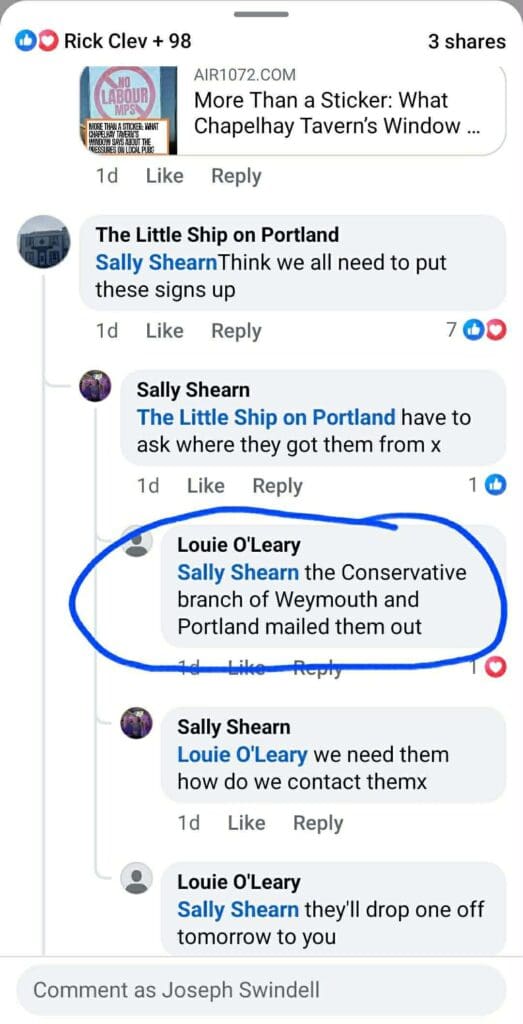
And along with the sticker, you get some ready-cooked ‘Tory Facts’.
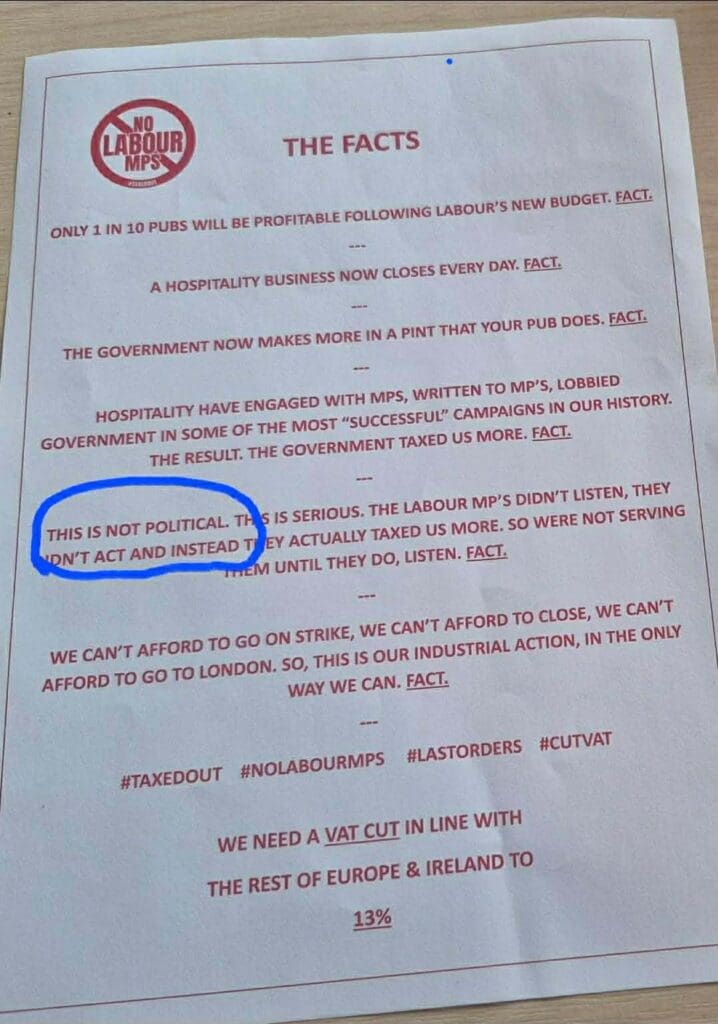
No sources, however. We are merely expected to swallow their very high-fat creation that appears to lack any protein.
I therefore decided to use a fact checker and look what I found:
| Claim on Flyer | Accuracy |
|---|---|
| Only 1 in 10 pubs profitable | ❌ Not verified |
| A hospitality business closes every day | ⚠️ Roughly true but simplified |
| Government takes more per pint | ❌ Not supported as fact |
| Industry engaged with MPs & got taxed | ⚠️ Lobbying true; causation oversimplified |
| Not political / Labour didn’t listen | ❌ Political messaging |
| VAT should be cut to 13% | ⚠️ VAT is high and lower abroad, but this is a policy position |
However, the really interesting fact that I found is that the Conservatives were largely responsible for the impact upon pubs and that the Labour Party inherited most of it.
Then I thought, “Well, it’s only fair to investigate what the Conservatives did to Dorset generally since 2010,” and again what I found was unsurprisingly devastating.
How the Tories Decimated Dorset 2010-2024
For fourteen years, Dorset lived through the consequences of Conservative austerity. While ministers in Westminster spoke of “efficiency savings” and “doing more with less”, the reality for people in Dorset has been a steady erosion of public services, rising costs pushed on to residents, and a growing sense that the social contract was peppered with gasoline.
Dorset’s experience mirrors national trends, but its older population, rural geography and low-wage economy have made the impact particularly acute. From children and young people to working-age adults and pensioners, Tory austerity touched every stage of life.
Early Years and Children (0–11): Fewer Safety Nets, Rising Need
Children in Dorset have grown up in a landscape where early intervention services have been steadily hollowed out.
- Sure Start and children’s centres, once central to early years support, were scaled back or repurposed after 2010 as ring-fenced funding disappeared.
- Health visitors and family support services became thinner on the ground, particularly in rural areas such as West Dorset villages, the Purbecks and North Dorset market towns.
- Schools increasingly absorbed responsibilities once shared with councils, charities and youth services, despite facing their own funding pressures.
The result was a shift away from prevention. Problems that might once have been addressed early—speech and language delay, family stress, mild behavioural issues—now often escalate until statutory intervention is required. This not only harms children but also drives higher long-term costs.
In towns like Weymouth, Bridport and Blandford Forum, schools reported rising levels of need without equivalent growth in support staff, educational psychologists or pastoral services.
Teenagers and Young People (12–25): Lost Spaces and Limited Futures
Few groups illustrate austerity more starkly than Dorset’s young people.
- Youth services have been among the hardest hit since 2010, as they are largely discretionary. Youth clubs, outreach work and drop-in centres have disappeared or survived only through volunteers.
- Public transport cuts have isolated young people in rural villages, making it harder to reach colleges, apprenticeships or social activities—particularly in areas such as Shaftesbury, Sherborne hinterlands and coastal villages.
- Mental health support struggled to keep pace with demand, with long waits for CAMHS and limited crisis provision.
For many young people, austerity has meant fewer safe places to go, fewer trusted adults to turn to, and fewer visible routes into stable employment. This has contributed to rising anxiety, disengagement and out-migration, with many feeling they must leave Dorset to find opportunity.
Working-Age Adults (26–64): Paying More, Getting Less
For working-age adults, austerity in Dorset has taken the form of rising personal costs combined with shrinking public provision.
- Council tax has increased steadily as central government support has fallen, meaning residents now fund the majority of local services directly.
- Adult social care pressures have crowded out spending on libraries, community centres, leisure services and local grants.
- Housing pressures have intensified, with councils less able to invest in social housing while private rents rise faster than wages.
In places like Dorchester, Wareham and Wimborne, people increasingly rely on voluntary groups for help once provided by councils—food banks, advice centres and community transport schemes.
Rural workers face particular hardship. Limited buses, higher fuel costs and the decline of local services mean daily life is more expensive and less convenient, while wages in Dorset remain below the national average.
Older People (65+): Care Consumes the System, but Gaps Remain
Dorset’s ageing population has been at the centre of austerity’s contradictions.
- Spending on adult social care has risen sharply, now consuming the largest share of the council’s budget.
- Yet despite this, many older residents experience reduced support: tighter eligibility thresholds, fewer preventative services, and increased charges.
Day centres, community lunches and social activities—crucial for combating loneliness—have been cut back or transferred to charities and volunteers. In villages and smaller towns, this has left older people more isolated, particularly those without cars.
In coastal communities such as Weymouth and Swanage, where older populations are concentrated, pressure on NHS services and social care has grown alongside cuts to transport and local amenities.
The paradox is stark: more money is being spent on care than ever before, yet many older people feel less supported.
Families and Intergenerational Impact
Austerity has not affected age groups in isolation. Its most damaging effects are intergenerational.
- Parents absorb the loss of youth services by providing informal supervision and support.
- Grandparents step in to fill childcare gaps created by cuts to early years provision.
- Adult children shoulder caring responsibilities for elderly relatives as formal support becomes harder to access.
This hidden, unpaid labour props up a system weakened by long-term funding cuts—and disproportionately affects women.
Dorset’s Towns and Villages: Geography Makes Austerity Bite Harder
Dorset’s rural nature amplifies austerity’s effects.
- When a library reduces hours in a city, alternatives exist; when it happens in a rural village or small market town, the loss can be total.
- Cuts to bus services hit hardest where distances are long and car ownership is essential.
- Centralised “efficiencies” often mean services moving further away from the people who need them most.
The cumulative effect is a quiet shrinking of civic life, especially outside the main towns.
A County Reshaped by Austerity
Fourteen years of austerity reshaped Dorset not through one dramatic collapse, but through a thousand incremental withdrawals. Services have narrowed to the statutory minimum, costs have shifted onto residents, and communities have been asked to fill gaps left by the state.
Children have grown up with fewer supports, young people with fewer opportunities, working-age adults with higher costs and older people with thinner safety nets. Dorset remains a beautiful county—but for many who live here, life is now more precarious, more expensive and less supported than it was in 2010.
The legacy of austerity is not just financial. It is social, emotional and generational—and its effects will be felt in Dorset for years to come.
And now for the real crusher: all the while the richest got richer and the poorest poorer. And those in the middle squeezed even more into debt. Would you Adam and Eve it?
It becomes particularly interesting then that working-class pubs in working-class areas were not asked by political parties not to serve Tory politicians. However, following fourteen years of economic depravity, we are suddenly being asked to ban Labour MPs.

We need the word ‘HYPOCRISY’ emblazoned across the hills outside Weymouth, perhaps with a Louis O’Leary cheesy grin between the ‘O’.
If these pubs are going to politicise and brazenly ignore the devastation Dorset has experienced since 2010, perhaps those of us who don’t eat sand should boycott them and take our custom to those who aren’t propagandising our pints….
Look out for the stickers, folks, and keep walking right on by.