Many people will not be aware that in addition to being a local political “loud mouth” I am also an archaeology graduate. Throughout my studies for my Batchelor’s and Master’s degrees I spent huge amounts of time studying the origins of what we might call “The British”.
My studies showed me that since “year dot” the lives of Brtain’s people have been inextricably linked with our neighbours on mainland Europe. The first metal workers in the British Isles seem to have arrived from the Iberian Peninsula. Our earliest hunters walked here from Northern Europe across plains and forests that once stood where the North Sea and the English Channel now lie.
Pottery and farming reached us courtesy of brave explorers who ventured out on those seas, travelling sometimes vast distances in boats made from wood and hides. Our most ancient British languages have been born out of the various tongues spoken by those early settlers while modern English grew from seeds planted by those who have come and gone over the last two thousand years.
Since the days of stone axes, goods and people have flowed backwards and forwards. Tools from the Lake District turn up in central Europe, Copper and Tin from Wales and Cornwall reaches the Mediterranean and shale bangles and beads from Dorset were sought after by the well-to-do in the great classical kingdoms and empires. In return we find amber from the Baltic, evidence of daggers from Mycenae (at Stonehenge) and, later on, ceramics and luxury goods from all parts of the Roman Empire and beyond.
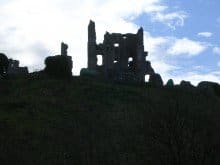
One thing that struck me in my studies is that, from time to time, people have built boundaries or walls. Here in Dorset we have numerous Bronze Age field systems and boundaries. Later in time there’s Bokerly Dyke as an example of what was probably some form of Anglo-Saxon defence system. Wareham, Christchurch and (probably) Bridport were all fortified around this period. From earlier times we find the great Iron-Age fortresses of Maiden Castle, Hod Hill and Eggardon Hill. Last but not least in Dorset is the mighty medieval castle at Corfe.
Looking further afield there’s Offa’s Dyke, Hadrian’s wall and the Antonine Wall, (to name just a few). Taken as a whole they all have two things in common. Firstly they must have been built at a time of mistrust and strife, standing today as lasting testament to some sort of breakdown in human relationships. They are manifestations of power and control being exercised at a range of scales, from farmers protecting livestock, to emperors controlling access to their realm.
The second thing they have in common is that not a single one of them remains intact. Each and every one of them was either abandoned or destroyed. Ultimately, each represents defeat and failure. At the local scale it is, perhaps, the failure of one neighbour to deal fairly with another. At the national scale, it is the failure to keep “the other” out or, maybe, preserve a system within.
When I look at those who talk today of building walls, I think of those walls, boundaries and fortresses of the past. Hadrian’s Wall, the Great Wall of China, Germany’s Atlantic Wall, the Berlin Wall, the wall surrounding Gaza or the wall proposed for the Mexico/USA border. Ultimately none of them worked and none of them can work.
Walls are generally built through fear and I can think of no wall ever built that made the object of that fear go away. I can think of no such wall in our nation’s past that actually worked as it was intended to do.
I believe the greatest advances in early British civilisations show that we are at our best when we have no walls; when people and ideas are able to move freely, one enriching the culture and technologies of the other.
Maybe it’s time we all stopped thinking about walls.
Phil Dunn