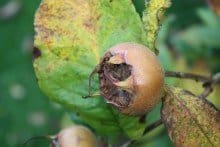
The Medlar Tree
It is thought the Medlar tree Mespelus germanica was introduced to England by the Romans and was an important fruit throughout the medieval period. More recently in Victorian times bletted (ripe) Medlars were often served with sweet sherry at the end of a big meal. I read somewhere that these unusual fruits could be described as resembling a rosehip crossed with a pear. Having tasted one today for the first time, I can assure you that’s where any resemblance ends! Unripe the fruit whitish in colour has the texture of dry sandpaper. The combination of acids and tannins give a tangy astringent shock to the tongue. Definitely not morish!
From Yuk to Yum…
It is recommended that the Medlar is harvested after a hard frost in late October, and stored for several weeks for bletting to occur. Wikipedia explains that this process both softens and increases the sugar content of the fruit. The fruit is ready to eat when it looks ready to be thrown in the bin, when the flesh has turned brown and mushy. The fruit can then be eaten off a spoon and has the sweetness of a date. Unusual in texture it is probably an acquired taste.
Medlars make deliciously fragrant jellies and fruit cheese and hold their own as both sweet or savoury partners to toasted crumpets, cold meats or soft cheeses. The medlar makes an attractive red jelly and sets well as it is naturally high pectin. Well worth the meddle with these jellies make unique ideal Christmas gifts. If you see some of these fruits at a farmers market in the next few weeks do give them a try.
Cultivation
Belonging to the Rosacea family, the Medlar is a smallish tree with an open sprawling habit. It makes a charming statement offering yearlong interest. The tree bears beautiful white loose open blossoms in May with distinctive long sepals which remain visible on the fruit. Once pollinated they are self-fertile, and the squat brown skinned characteristic fruit develops during the summer months. The large leaves turn a rich buttery yellow with warm rich browns as they fall in the autumn. During winter the tangle of lichen clad branches provide structural interest and are lovely to look at.
The trees are very easy to grow, and are a worthy inclusion in any orchard or small garden. A variety called Nottingham is quite widely available. Once formative pruning is done let them grow with abandon, and please please resist the urge to ‘tidy’ them by pruning.
Marie McLeish is a gardening coach based in west Dorset. She gives talks to gardening clubs, WI’s and groups. To get in touch please email; [email protected] Twitter @MyGardenCoachUK