

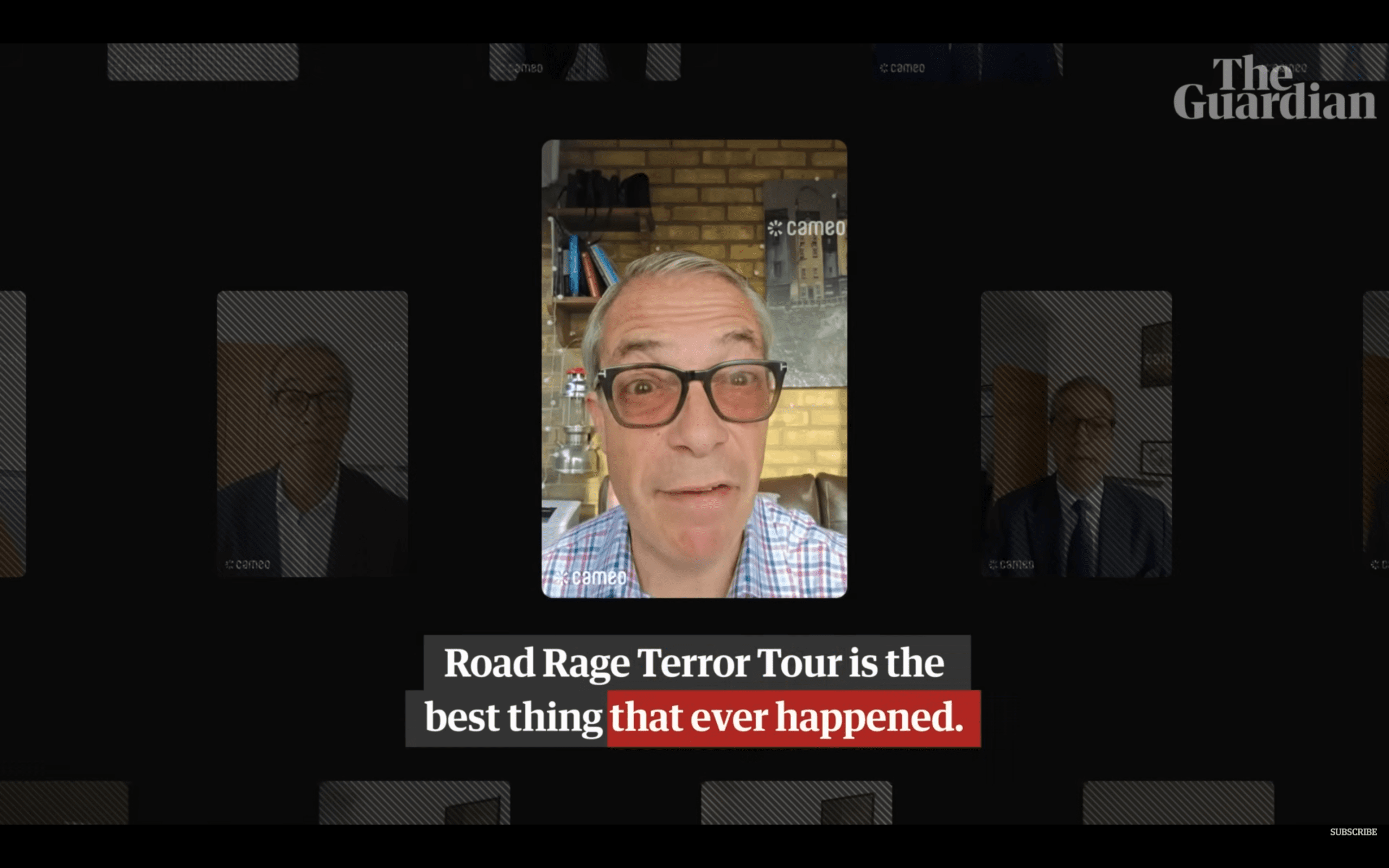
There is something almost too perfectly emblematic of our degraded media ecology in the spectacle of Nigel Farage, that perennial pub-orator of ressentiment, reconstituted as a sort of digitised rent-a-voice on Cameo. A platform, lest we forget, whose entire business model consists of slicing celebrity into thin, saleable wafers of ersatz intimacy. One does not so much engage with Farage here as purchase a fleeting simulation of his attention: a few seconds of tailored bonhomie, delivered with all the performative chumminess that has long been his stock-in-trade.
Yet what elevates this from the merely absurd to the faintly grotesque is not the existence of such a marketplace—late capitalism has accustomed us to far worse—but the uses to which these commodified utterances are put. For, as the video painstakingly details, Farage has reportedly made some £370,000 from these personalised clips, a not inconsiderable sum accrued through the steady drip-feed of greetings, congratulations, and knowing winks to an unseen clientele. And among that clientele, it appears, are individuals and networks whose ideological commitments stray well beyond the bounds of what might politely be termed democratic discourse.
Here, the transaction becomes something more than a harmless exchange of cash for content. For these videos, innocuous in isolation, their tone one of genial vacuity, do not remain hermetically sealed within the private sphere for which they are ostensibly intended. Instead, they are extracted, reframed, and redeployed within the digital ecosystems of the far right: appended to propaganda, circulated in forums, and leveraged as a form of borrowed legitimacy. In such contexts, Farage’s affable patter takes on a distinctly more sinister valence.
We are told, of course, that these messages are not endorsements. That they are, in essence, content-free: the political equivalent of signing a birthday card for a stranger. This is the defence advanced by those orbiting Farage’s current political vehicle, Reform UK, that a Cameo is “just” a Cameo, stripped of ideological significance by virtue of its transactional nature. But this is to indulge in a peculiarly anachronistic understanding of communication, one that assumes meaning resides solely in intention rather than in reception.
In the contemporary mediascape, such distinctions collapse almost immediately. An utterance, once released, is no longer the property of its speaker but of its interpreters, its editors, and its amplifiers. It is clipped, memed, recontextualised, made to serve purposes far removed from its original framing. To participate in this system while disavowing responsibility for its outputs is rather like pouring dye into a river and insisting one bears no relation to the colour of the sea.
The figure of Farage is, in many respects, uniquely suited to this ambiguity. His career has been characterised by a deft navigation of the porous boundary between the respectable and the reprehensible: a continual oscillation between dog whistle and denial, provocation and retreat. He speaks in a register that is sufficiently elastic to accommodate multiple readings: robust common sense for some, something altogether darker for others. It is precisely this pliability that renders his Cameo performances so susceptible to appropriation.
And appropriation there is. The video documents instances in which these paid-for messages have been utilised to promote individuals and events steeped in neo-Nazism and anti-Semitism, ideologies that, one might have assumed, required no further oxygen. That Farage’s image and voice should find their way into such contexts may not be the result of deliberate alignment, but neither can it be dismissed as a trivial accident. When one’s likeness becomes a kind of floating signifier, detached from its moorings and available for purchase, one forfeits a measure of control over its eventual destination.
The £370,000 figure looms large here, not merely as a testament to the lucrative nature of this sideline but as an index of scale. This is not the odd ill-judged video slipping through the net; it is an industrial process, a conveyor belt of content in which due diligence, if it exists at all, is necessarily cursory. The sheer volume militates against scrutiny. And so the question arises: at what point does ignorance cease to be a defence and become, instead, a form of complicity?
There is, too, a broader cultural pathology at work. Platforms like Cameo do not simply monetise fame; they erode the very distinction between public and private speech. A politician’s words, once subject to the constraints of office and the expectations of accountability, are here repackaged as bespoke commodities: detachable, contextless, and infinitely reproducible. In such a milieu, the notion that one can speak “off the record” or “just for fun” becomes increasingly untenable.
What we are witnessing, then, is not merely a lapse in judgement on the part of a single individual, but the logical endpoint of a system that incentivises visibility above all else. Farage, ever the adept self-publicist, has simply extended his brand into a new medium, one that rewards volume, accessibility, and the appearance of intimacy. That this extension should intersect with the murkier reaches of online extremism is perhaps less surprising than it ought to be.
The defence will persist, no doubt: that no endorsement was intended, that the messages were generic, and that the platform bears its share of responsibility. All of which may be true, in a narrow, technical sense. But politics does not operate in such narrow registers. It is a realm of symbols, associations, and perceptions of what is said and where it ends up.
And where these messages have ended up is in spaces where neo-Nazism and anti-Semitism are not aberrations but organising principles. To appear there, even inadvertently, is to contribute, however obliquely, to their normalisation.
In the end, the question is not whether Nigel Farage intended to promote such ideologies. It is whether, having made a small fortune in a system that allows his words to be so readily co-opted, he can plausibly claim that intention is all that matters. In an age where meaning is endlessly mutable and context perpetually unstable, that claim rings increasingly hollow, another hollow note in the ceaseless chatter of the marketplace.







