
Britain is not drifting gently into the future. It is pulling itself apart along generational lines, with the force of a country that no longer agrees on what it is, who it is for, or how power should be exercised. The most striking divide is not simply class or region, but age.
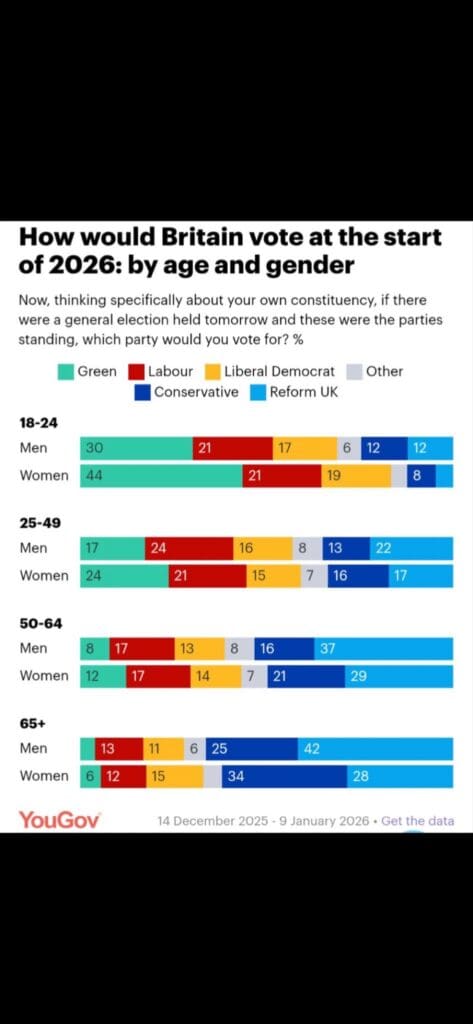
Recent polling crosstabs underline what many already sense anecdotally: many older voters are moving sharply to the right, while many younger voters—taken as a whole—are moving left, often decisively so. Parties like Reform UK perform disproportionately well among over-50s, while younger voters lean towards Labour’s left, the Greens, or explicitly socialist positions. Even where right-wing support exists among some young white men, it is often volatile, protest-driven, and fuelled by online grievance rather than settled ideology.
This is not healthy pluralism. It is fracture.
Two Britains, Facing Opposite Directions
For many older voters, especially white men who came of age during the post-war settlement, politics has become a rearguard action. Immigration, multiculturalism, feminism, environmentalism are framed not as debates but as existential threats to a world they believe is being taken from them. The language is apocalyptic: “invasion”, “replacement”, “traitors”, “enemies within”.
This is fertile ground for the far right. Reform UK and similar movements thrive on a sense of loss of status, certainty, and dominance. They offer a simple emotional bargain: you didn’t fail; the country betrayed you. A denial of political free will. Fascinatingly, this derives from Marxist theory. The very theory that the far right constantly attempts to ridicule.
Younger Britain, by contrast, has grown up amid permanent crisis: climate breakdown, housing unaffordability, precarious work, and collapsing public services. For many under-35s, the promises that structured older lives—home ownership, stable employment, pensions—feel mythical. Their politics is less about restoring a past than salvaging a future.
This is why younger voters skew left. Not out of naïveté, but necessity.
Culture War as a Substitute for Material Politics
The danger lies in how these two Britains now talk about each other.
Older right-wing voters increasingly see the young as entitled, ungrateful, or “brainwashed”. Younger voters, in turn, see older generations as selfish custodians of a rigged system—people who pulled the ladder up and now sneer from above.
The political system has failed to mediate this conflict. Instead, it monetises it. Culture wars substitute for serious economic reform. Rage replaces policy. Algorithms reward outrage, not understanding.
When politics becomes a zero-sum game between generations, democracy starts to feel like a hostile occupation rather than a shared project.
The “Civil War” Narrative—and Why It’s Dangerous
Talk of “civil war” is increasingly common, particularly on the right. It is almost always rhetorical, but rhetoric matters. It normalises the idea that political opponents are enemies, not neighbours. That violence is not tragic but cleansing. That democracy is optional if the “wrong people” keep winning.
Britain is not on the brink of armed conflict—but it is flirting with the emotional and moral preconditions that make democratic breakdown possible: dehumanisation, fatalism, and contempt.
That is why it is crucial to reject any framing that implies progress comes through the disappearance, literal or metaphorical, of older people. Social change happens through political struggle, generational turnover, and persuasion, not through death or collapse. Anything else is not radical; it is nihilistic.
Waiting Is Not Enough
It is true that demographics favour the young over time. Values do change. Electorates renew themselves. But history shows that entrenched power rarely dissolves politely. Without organisation, clarity, and solidarity, youthful progressive instincts can be outmanoeuvred, demobilised, or co-opted.
The far right understands this. That is why it is moving aggressively now, hardening borders, attacking institutions, delegitimising courts and media, while it still holds disproportionate influence.
The left cannot afford to simply wait.
A Choice Still Exists
Britain’s generational divide does not have to end in rupture. But healing will not come from pretending the conflict isn’t real, nor from indulging fantasies of collapse or “inevitable” victory.
The choice is stark:
- A politics of resentment, nostalgia, and scapegoating
- Or a politics that rebuilds material security, dignity, and shared purpose across generations
The young may yet bring better values into power, but only if they refuse both despair and dehumanisation. The future is not guaranteed. It has to be fought for.