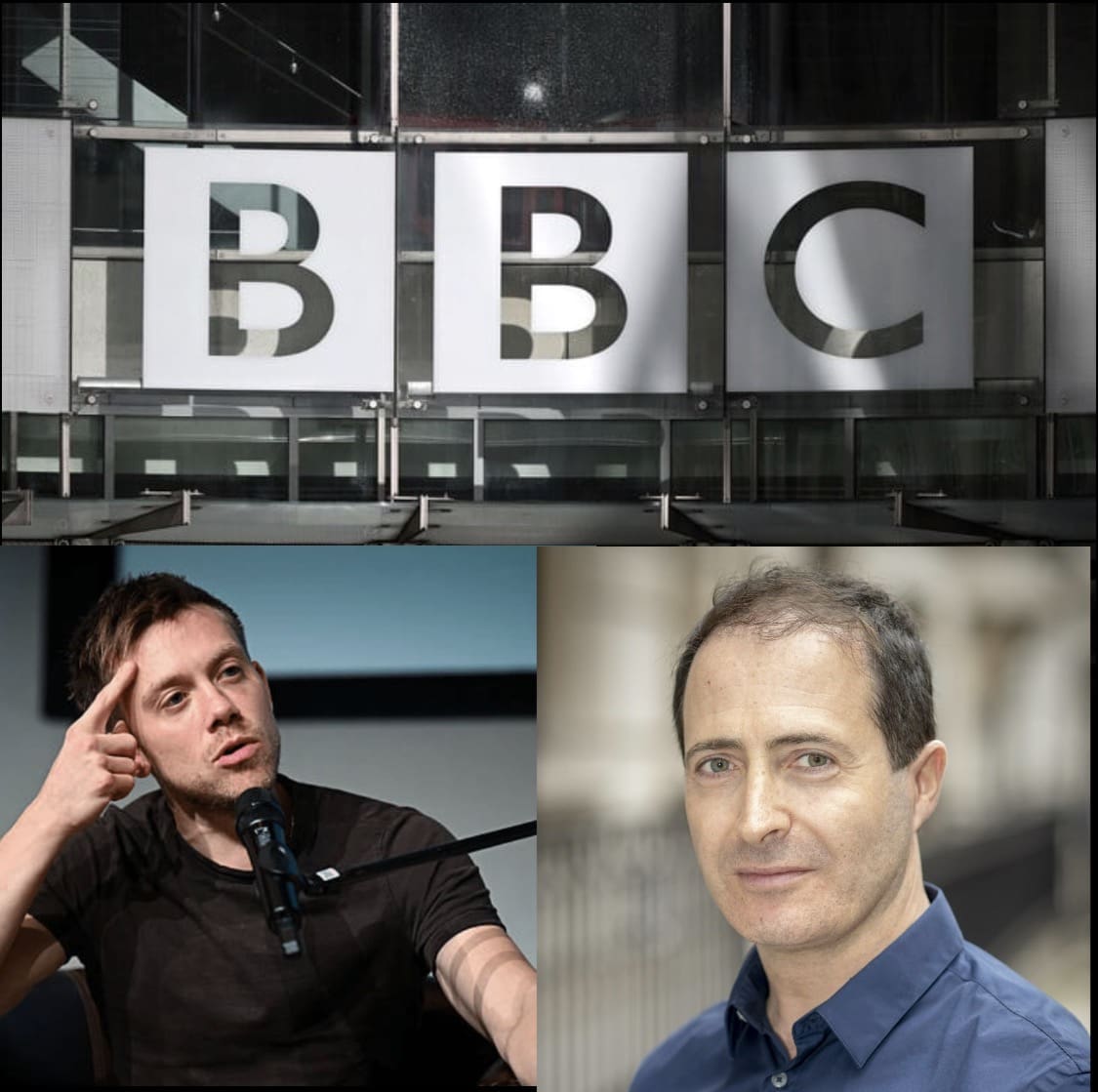
The long-running and often bitter arguments about how the war in Gaza is reported in the British media have now spilled into the High Court, producing a ruling that is as revealing about Britain’s libel laws as it is about the dispute itself. Journalist and commentator Owen Jones has claimed a significant early victory in a libel case brought against him by Raffi Berg after a judge ruled that the central allegations in Jones’s article should be understood as an expression of opinion rather than statements of fact.
The case stems from an article Jones wrote last December titled The BBC’s Civil War Over Gaza. In it he reported claims from BBC insiders who alleged that Berg, the corporation’s Middle East editor since 2013, played a central role in shaping coverage of the Israel–Palestine conflict in a way that favoured the Israeli narrative. The article quoted staff who said Berg “reshapes everything from headlines, to story text, to images” and that BBC reporting under his editorial influence tended to foreground the Israeli military perspective while stripping away the human experience of Palestinians. Other sources cited in the piece claimed that the culture within parts of the BBC’s coverage amounted to what they described as “systematic Israeli propaganda”.
For Berg, those claims crossed a line. Through his lawyers he argued that the article did not merely express a controversial opinion about the BBC’s editorial balance but instead made serious factual accusations about his conduct as a journalist. His legal team told the High Court that the piece effectively alleged he knowingly manipulated coverage to promote Israel’s interests and breached the BBC’s editorial standards. Berg also argued that the article had real consequences for him personally, claiming that it damaged his professional reputation and that he had received death threats following its publication.
The case was brought as a libel claim in the High Court in London. Berg is seeking damages, an injunction preventing Jones from republishing the article and orders requiring websites hosting it to remove the piece. Yet before the case could progress to a full trial, the court was asked to rule on a series of preliminary questions, the most important of which concerned how the article should be interpreted. The central issue was whether Jones had made factual allegations that could potentially be proven true or false or whether he was expressing a critical opinion based on evidence and testimony.
This distinction matters enormously under British defamation law. In England and Wales libel occurs when someone publishes a statement that seriously harms another person’s reputation. If the statement is presented as fact, the person who made it must be able to prove that it is substantially true or rely on other defences such as public interest reporting. However, if the statement is clearly an opinion rather than a factual assertion, the law provides a powerful defence known as “honest opinion”.
That defence, introduced in its modern form by the Defamation Act 2013, protects commentators who express views that others may strongly disagree with, provided certain conditions are met. The opinion must be recognisable as opinion rather than fact, it must be based on facts that are either stated in the article or generally known; and it must be an opinion that an honest person could reasonably hold on the basis of those facts. In effect, the law acknowledges that public debate, particularly on political or journalistic matters, often involves sharp and uncomfortable criticism.
The High Court judge, Mrs Justice Steyn, concluded that the article written by Jones fell squarely within that territory. In her written ruling she found that the “central allegation”, that Berg’s work on the Israel–Palestine conflict was biased and failed to meet the BBC’s editorial standards of impartiality, would strike the reasonable reader as a statement of opinion. While the article accused Berg of taking an active role in shaping the BBC’s coverage in a way that favoured Israel, the judge said it would not be read as alleging that he knowingly falsified news reporting or deliberately breached the corporation’s rules.
Justice Steyn also emphasised that many of the claims cited in the article were inherently subjective. Assessments about whether reporting gives too much prominence to Israeli military statements or whether Palestinian victims are sufficiently humanised in coverage are questions of judgement rather than simple matters of fact. Different journalists, editors and readers might reach very different conclusions when examining the same broadcast or news report. For that reason, the judge concluded that the criticisms contained in the article would be understood by ordinary readers as Jones’s interpretation of the BBC’s editorial approach rather than a provable factual accusation.
Another important factor in the ruling was that Jones set out the material on which his opinion was based. His article referred to discussions with BBC staff and pointed to examples of coverage that critics argued reflected an imbalance. Under the honest opinion defence, readers must be able to see the basis on which the author has formed their view. By including that material, the judge found, Jones had allowed readers to understand the reasoning behind his criticism, even if they ultimately disagreed with it.
The ruling therefore represents a significant moment in the case. If the article is interpreted primarily as opinion, Jones has access to one of the strongest protections available in British defamation law. Yet it is important to stress that this was not the final verdict. The decision addressed preliminary questions about meaning and interpretation rather than determining the entire claim. Berg’s legal team has already indicated that they intend to continue the case through the courts.
His solicitor, the well-known media lawyer Mark Lewis, stressed that the judgment was only an interim finding rather than a full determination of the dispute. Further legal arguments and evidence may still be presented if the case proceeds to trial. Berg’s lawyers maintain that the article damaged his reputation and that its implications went far beyond legitimate commentary on BBC editorial policy.
The BBC itself has sought to keep its distance from the legal fight. A spokesperson for the corporation said it had no role in bringing the libel action, which is being pursued by Berg in a personal capacity rather than by the broadcaster.
Nevertheless, the case inevitably touches on the BBC’s handling of one of the most politically charged conflicts in the world. For decades the corporation has faced criticism from all sides over its coverage of the Israel–Palestine conflict, with some accusing it of bias towards Israel while others claim its reporting is overly sympathetic to Palestinians. Such disputes have become even more intense during the current war in Gaza, where emotions and political stakes are exceptionally high.
In that sense the legal battle reflects a broader struggle over how journalists interpret and frame events in a conflict that remains deeply polarising. It also illustrates the delicate balance that libel law must strike between protecting individuals from damaging accusations and safeguarding the right to robust public debate.
British courts have long recognised that criticism of powerful institutions, including the media itself, must be allowed a wide margin. Without that protection, commentators could face crippling legal risks simply for expressing controversial views about how news is reported. At the same time, the law exists to prevent individuals from being falsely accused of serious misconduct.
The High Court’s ruling suggests that, at least in this instance, the criticisms made by Owen Jones fall within the realm of opinion that the law is designed to protect. Whether that conclusion ultimately holds as the case progresses remains to be seen. But for now, in the opening rounds of a dispute that blends journalism, politics and law, the early advantage appears to lie with the man who wrote the article rather than the editor who says it defamed him.