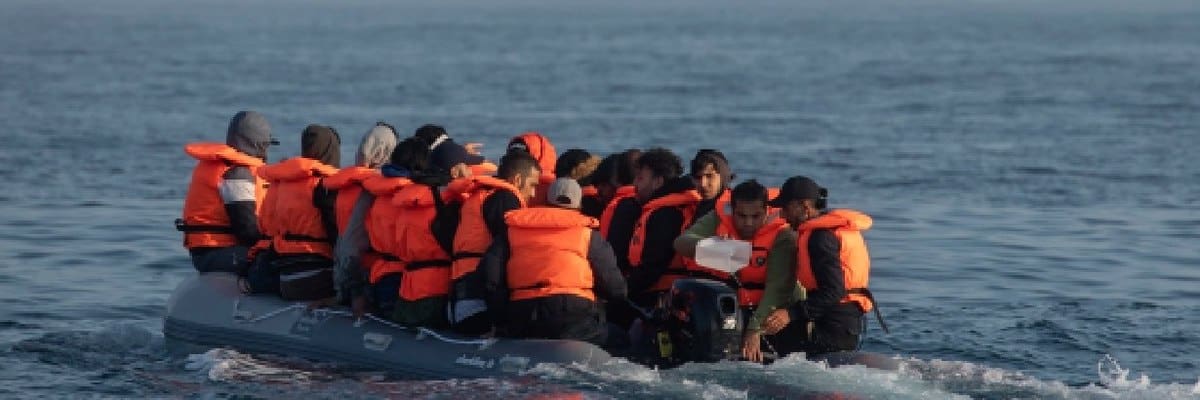
Let’s start with some perspective:
“It’s a blessing,” Elara Finch tells me, standing next to a thriving peace lily. The 78-year-old retired librarian says she “doesn’t have time” for the likes of Nigel Farage, whose divisive image she once saw on a newspaper lining a recycling bin.
“Everybody talks about migration, but our country is being enriched,” Elara adds. “They are reminding us of our humanity.”
The “they” in her mind? People who have sought safety in the UK after perilous journeys.
She was, like many of the volunteers we met, initially cautious about speaking to a journalist, wary of how the corporate media often distorts the narrative.
Elara says she “is careful with mainstream news” because of “media lies” that stoke division.
Instead, she says she gets her information from a variety of independent and international sources.
It was on a local community forum that Elara learned about a welcome picnic being organised outside a hotel in Wakefield, which has housed asylum seekers for several years.
It was the first such event she had ever attended.
“We’ve been so insulated for so long, and I think ordinary people now, they’ve decided it’s no good sitting, doing nothing while our neighbours are dehumanised,” Elara says.
After reading about the overwhelming backlog in the asylum system and the tragic drownings in the Channel, she says she is “heartbroken” for the families seeking safety.
“They’re our future neighbours,” she says, referring to those who have arrived in the UK. “We have so much to learn from them. We don’t know their stories yet, but we can offer a warm welcome. It’s only right, isn’t?”
She’s also angry about the profiteering of private companies housing asylum seekers in hotels instead of building an efficient, humane system.
I ask Elara what she thinks about those who plan to close asylum hotels, stop the crossings through deterrence, and deport people.
“It’s all fear, all fear”, she says. “I don’t believe it will work.”
“I would be happy if the Navy went into the Channel, we’re an island for God’s sake, and started performing search and rescue missions.
“That would make me over the moon.”
Elara tells us people used to be “afraid” of saying what they really thought about showing kindness to migrants.
No more, she says.
The ‘community welcome’ group
On the other side of Wakefield, we meet 47-year-old Ben Carter.
He’s also been to the local asylum hotel.
An army veteran and former aid worker, Ben says he believes asylum seekers deserve dignity and safety, not to be greeted by racists and haters.
“I’ve served in Kosovo and in Iraq, within the British Army and with charities,” he says. “And if I learned one thing, it’s that nobody chooses to flee their home unless the alternative is death. They deserve a proper roof over their heads, just as we all do.”
The prime minister has pledged to end the “costly use of hotels to house asylum seekers” – a plan Ben fears will lead to even more inhumanity but welcomes it all the same.
Ben has, by his own admission, become somewhat known in his local area for trying to set up what he’s called a “community welcome”.
He says the police are “overstretched” but believes “community cohesion is the best way to prevent any social tensions”.
Called “5 Town Community Welcome” and advertised by him on social media, Ben says the volunteer group will support the new arrivals and act as a “friendly presence” in public areas to foster “integration and mutual understanding”.
It will focus on helping everyone feel they belong, a mission Ben describes as “the best of British culture.”
“They come from cultures with rich histories that we can learn from,” he says. “The idea that any culture accepts sexual assault is a vile racist myth peddled by the likes of Farage to dehumanise people. We must see them as individuals, not stereotypes.”
I say to Ben that some people are fearful of cultural differences, a point he says he “understands but must challenge with facts.”
He points out that by international law, people have a right to seek asylum, and their method of arrival is not a crime.
Ben’s group has attracted hundreds of supporters online, but also criticism from people who believe the group – and Ben himself – is naive.
Ben admits he has previously been arrested for a peaceful protest against arms dealers, not related to the community welcome, but stresses this group “is about building bridges, not walls.”
“It’s a peaceful movement,” he says. “We stand our ground against hatred, but we do it with conversation and cups of tea. That’s how you change minds.”
‘People are compassionate’
A few days later, we meet Elara again outside the Cedar Court Hotel in Wakefield.
Volunteers line the road, waving Welcome banners and flags of many nations. Some are offering homemade cakes and packets of biscuits. They chant “say it loud, say it clear, refugees are welcome here.”
A small group of counter-protesters are there too, chanting “invasion” from behind a police barricade.
I ask Elara how that feels.
“I think it’s deeply sad,” she says. “They’ve been poisoned by the xenophobia of the far-right and the media they consume. I pity them, but I won’t let their hatred silence our compassion.”
But standing next to Elara, also holding a welcome sign, is Maureen.
She says she’s “a little bit nervous being here” and feels it’s unfair that ordinary people have to stand against such vitriol just “to get the government to show some basic human decency”.
She added: “I’m a 60-year-old mum. I work 40 hours a week. And my life is built on kindness and community. You just want everyone to have a fair chance.”
In the crowd, we find Ben.
I ask him what he thinks about the government’s continued use of hotels.
“Of course they were going to stick with a failed policy,” he tells me. “The real smiles here and the good attitude and the positivity is masking the deep anger we feel about what’s being done in our name.
“People are angry. People know that once they’re out of here,” he says, gesturing at the hotel behind us, “they need to be properly integrated into the community, not left in limbo.”
“What happens then is up to us to make it a success.”
Elara and Ben are among thousands of volunteers who share a sense of being ignored by the government – leaving an overwhelming sense of determination and certainty that community solidarity is the only way forward.