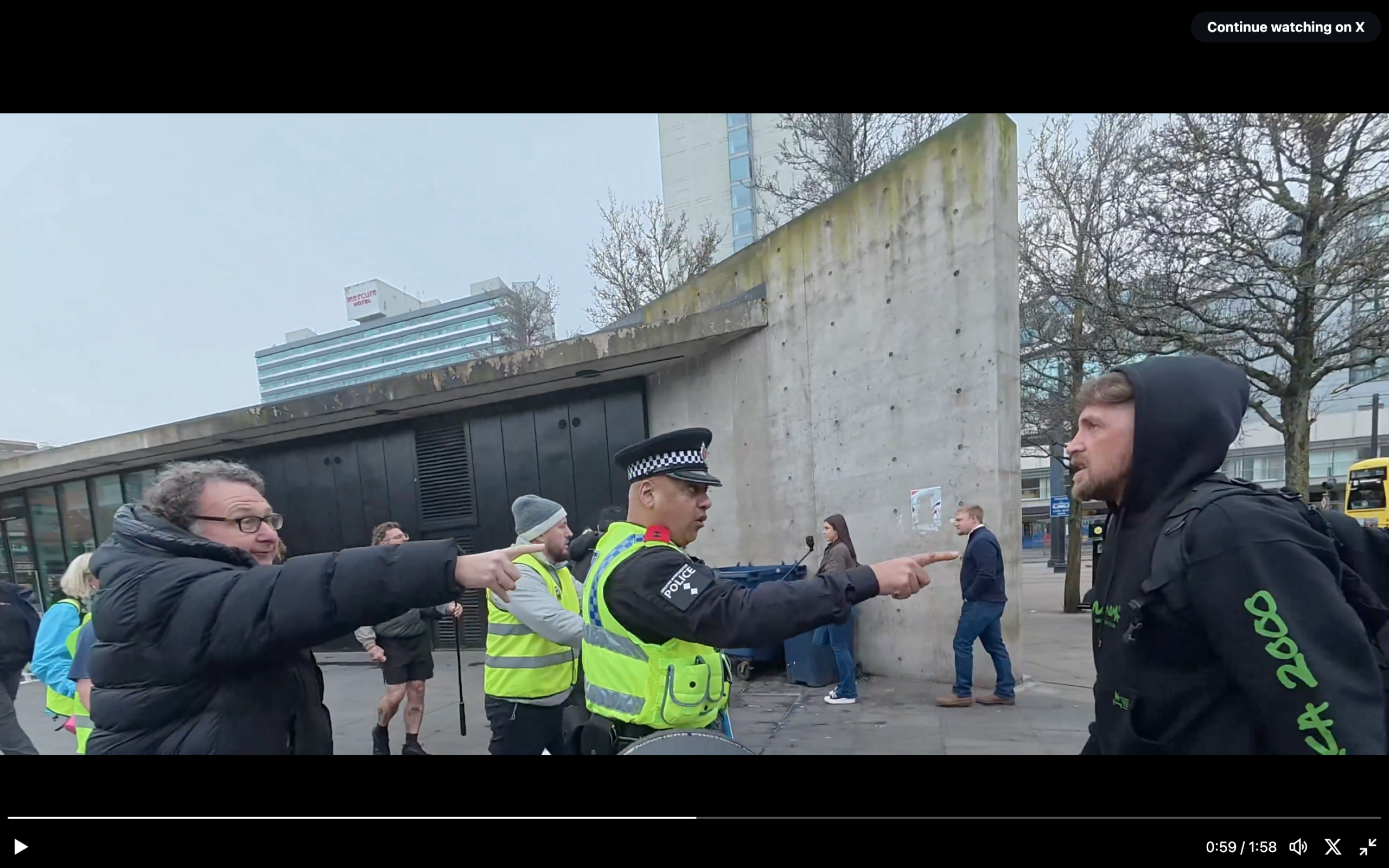
What should have been a day of solidarity and reflection was instead marred by hostility when anti-trans protesters attempted to intimidate speakers at a rally marking International Women’s Day in Manchester. The gathering in Piccadilly Gardens had been organised as an anti-far-right event, intended to promote unity and resistance to hatred. Yet the behaviour of a small group of anti-trans activists revealed precisely the sort of intolerance the rally had been convened to oppose.
During the event, a speaker addressed the crowd about the need for communities to stand together against division and extremism. The tone was one of solidarity and mutual support. But the atmosphere shifted abruptly when a man holding an anti-transgender placard pushed forward and confronted her directly. Witnesses described the encounter as aggressive and deliberately provocative, an attempt to disrupt a peaceful gathering and intimidate a woman speaking about equality.
Nearby, tensions escalated further as scuffles broke out between different groups present at the rally. Stewards moved quickly to separate people, while others attempted to calm the situation. Within minutes, police officers formed a cordon to prevent the confrontation from spreading through the crowd. Although the disorder was brief and no serious injuries were reported, the incident left a sour impression on what had been intended as a positive public demonstration.
Make it Make Sense???
— James Goddard (@JamesPGoddard90) March 8, 2026
Hannah Spencer gets given a police escort out of Piccadilly Gardens because one of her Muslim fanboys PUNCHED a woman
pic.twitter.com/FIanm4aXtB
The actions of the anti-trans protesters illustrated a troubling pattern increasingly seen at public events across Britain: organised disruption framed as “free speech” but carried out in a way designed to provoke fear and hostility. Holding a sign expressing disagreement is one thing. Moving aggressively toward a speaker, attempting to shout them down, and creating the conditions for confrontation is quite another.
In response, the Green Party of England and Wales condemned what it described as “anti-trans bigotry” displayed by a handful of angry men at the rally. Party representatives argued that targeting women speakers on International Women’s Day with hostile messaging was a stark example of how anti-trans activism often overlaps with broader patterns of harassment and intimidation.
Online reactions quickly became polarised. Supporters of the speaker condemned the disruption, describing it as a deliberate attempt to silence voices advocating inclusion and equality. Many pointed out the irony of anti-trans protesters choosing a day dedicated to women’s rights to aggressively challenge a female MP speaking about community unity.
Critics, however, attempted to flip the narrative, accusing pro-trans counter-protesters of escalating tensions. Social media commentary, often detached from what actually happened on the ground, turned the brief confrontation into yet another culture-war battleground. As is frequently the case, the facts were quickly buried beneath partisan interpretations.
Yet the essential truth remains difficult to ignore. A peaceful rally calling for unity against extremism was interrupted by individuals carrying explicitly anti-trans messaging who chose confrontation rather than dialogue. Their behaviour demonstrated not principled disagreement but an eagerness to provoke conflict in a public setting.
Crucially, the situation did not spiral into serious violence. Police intervention and the quick actions of stewards prevented the scuffles from spreading. No arrests were made, and no major injuries were reported. But the absence of serious harm does not erase the underlying issue: the willingness of some activists to use intimidation tactics in order to dominate public spaces.
International Women’s Day should be about advancing equality, celebrating progress, and building solidarity among those who face discrimination. Instead, in Manchester, a small but vocal group attempted to turn the occasion into a stage for hostility toward transgender people and those who support them.
Their actions served as a reminder that prejudice rarely arrives quietly. It appears loudly, disruptively, and often under the banner of “debate”. But when disagreement becomes harassment and protest becomes intimidation, it reveals something deeper than political difference: a refusal to accept that dignity and safety should belong to everyone.