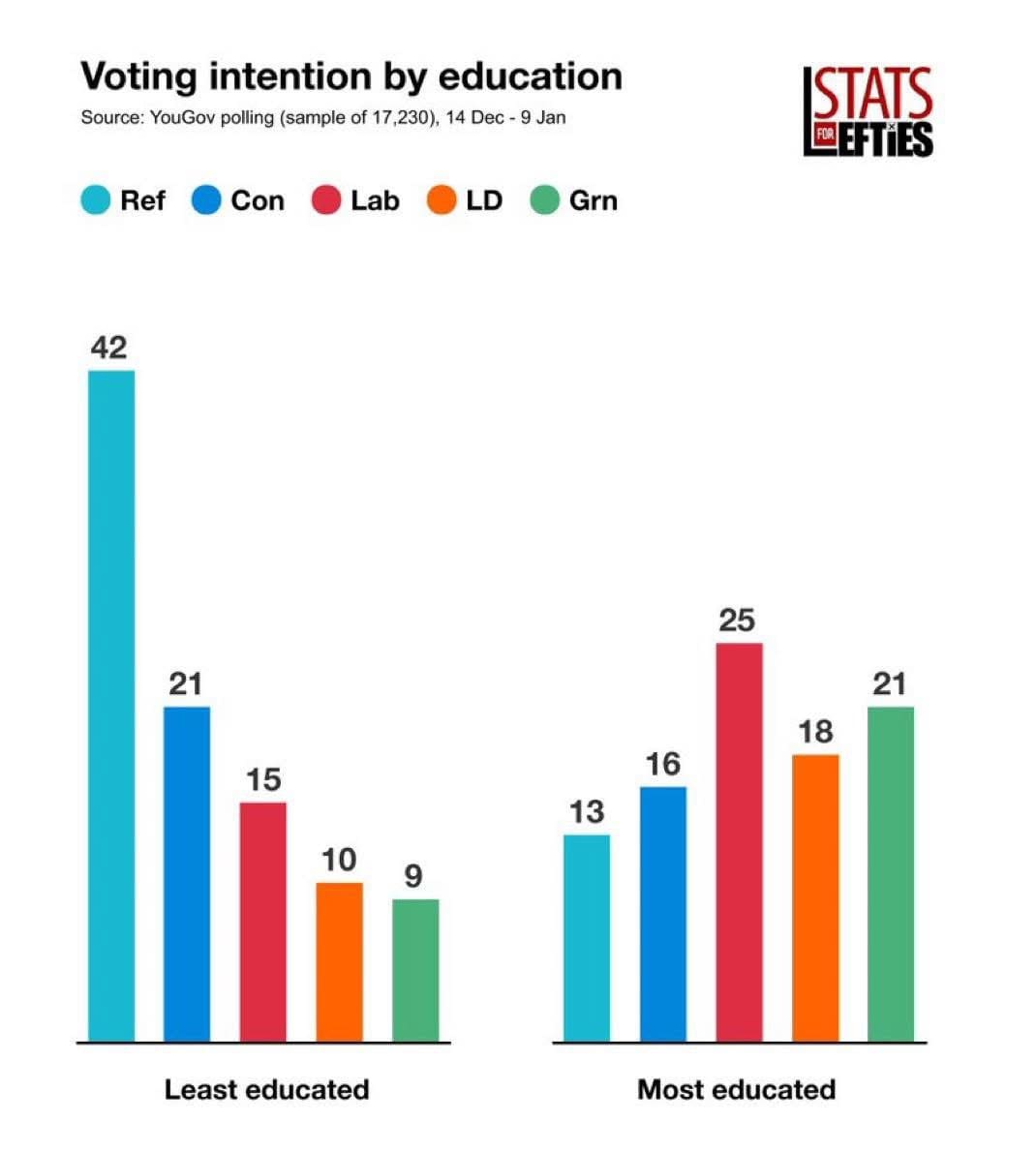
Following on from a damning report earlier this month that exposes the weakness in right-wing voters
Daniel Lismore reveals how polling research now exposes how Reform UK’s support collapses when voters have the skills to understand what their policies actually mean in reality.
Polling consistently shows that Reform UK draws its strongest support from voters with lower levels of formal educational attainment. That fact matters. Not as a slur, but because it helps explain a pattern that keeps repeating.
Reform supporters are being told, clearly and repeatedly, what the party’s policies would mean in practice. They are being told that Reform supports weaker worker protections, a rollback of human rights safeguards, cuts to public spending, and a shift away from universal healthcare toward systems where individuals pay more themselves. They are being told that council taxes are rising under Reform-run councils despite explicit promises that they would not. They are being told that the party is dominated by former Conservative figures whose last period in power left the country poorer and public services weaker.
And yet many supporters refuse to engage with these facts.
Instead, warnings are dismissed as “establishment lies” while the same political figures are trusted again, even when the consequences are spelled out in advance. This is not confidence. It is avoidance.
There is a psychological pattern at work. When people are under sustained economic pressure, anxious about the future, and angry at a system that has failed them, simple narratives become comforting. Blame is redirected outward. Immigrants. Protesters. Cultural enemies. The promise offered is emotional relief rather than material improvement.
This is why Reform’s messaging prioritises grievance over detail. The party does not need supporters to understand policy. It needs them to remain angry long enough not to look too closely.
The uncomfortable reality is that Reform’s policies would hit its own voter base hardest. People on lower incomes rely most on public healthcare. They are least able to absorb higher costs when services are privatised or withdrawn. They are most exposed to cuts in legal protections, benefit changes, council tax rises, and the erosion of local services.
Reform’s politics depends on keeping that contradiction unresolved.
As long as supporters stay locked in outrage, they are spared the moment of reckoning where they have to confront what is actually being offered to them: less security, fewer protections, higher costs, and a thinner safety net, all repackaged as freedom.
That is not empowerment. It is control.
Anger is being used as a distraction from policies that would leave people poorer, sicker, and more exposed. And the more uncomfortable that truth becomes, the louder the shouting gets.
This is not about intelligence. It is about manipulation.
And the people being manipulated will be the first to pay the price.
Reform’s model depends on confusion. Fear is the glue. Outrage is the shield. Because once voters understand what Reform actually proposes, the support does not harden. It collapses.

The Reality of Reform UK:
1. Tax cuts that don’t reach the low-paid
Reform’s flagship offer is tax cuts, but these are overwhelmingly tilted towards income tax thresholds and business taxes. Millions of low-paid workers don’t earn enough to benefit meaningfully. Meanwhile, cuts to public spending to “pay for it” land directly on the services they rely on.
2. Erosion of workers’ rights
Reform regularly attacks “red tape” and employment regulation. In practice, this means weaker protections against unfair dismissal, fewer rights for agency and gig-economy workers, and less leverage for people already stuck in insecure work.
3. No serious plan to raise wages
There is no credible strategy to lift pay at the bottom. No enthusiasm for stronger collective bargaining, no commitment to a genuinely enforced real living wage and no challenge to employers who keep wages low while profits rise.
4. A bonfire of public services
Reform’s small-state ideology means cuts to local government, social care, libraries, transport subsidies, and youth services. Low-paid people use these services most because they have no private alternatives.
5. Hostility to welfare as a safety net
Reform rhetoric consistently frames welfare as a problem of “dependency”. That means tougher sanctions, harsher conditionality, and less support for people in unstable or low-paid work, even though in-work poverty is now widespread.
6. Housing policy that favours landlords
There is no serious commitment to mass social housing. Reform opposes stronger regulation of landlords and tenant protections, leaving low-paid renters exposed to rising rents, insecurity, and poor conditions.
7. Privatisation by stealth
Reform’s enthusiasm for market solutions opens the door to further privatisation in health, transport, and utilities. When services are run for profit, costs rise and quality drops, a double hit for low-income households.
8. Blaming migrants instead of employers
Low pay is blamed on immigration rather than on weak labour enforcement and exploitative employers. This lets bad bosses off the hook while dividing low-paid workers against each other instead of improving pay and conditions for all.
9. Cuts disguised as “efficiency”
Reform talks constantly about “waste”, but in practice this usually means fewer staff, lower quality services, and higher user costs. Efficiency for them means doing less, not doing better.
10. Culture-war politics as economic distraction
Reform offers anger, grievance and scapegoats instead of redistribution, investment, or structural reform. For the low-paid, this is fatal: you can’t pay rent or heat a home with slogans about flags, migrants, or “wokeness”.
Bottom line
Reform UK is not a party of the low-paid, it is a party of low expectations. Its economic model assumes cheap labour, weak protections, and a shrinking state, while offering cultural theatre in place of material improvement.
For people on low wages, Reform UK PLC doesn’t represent rebellion against the system, it represents being locked even more tightly into it.