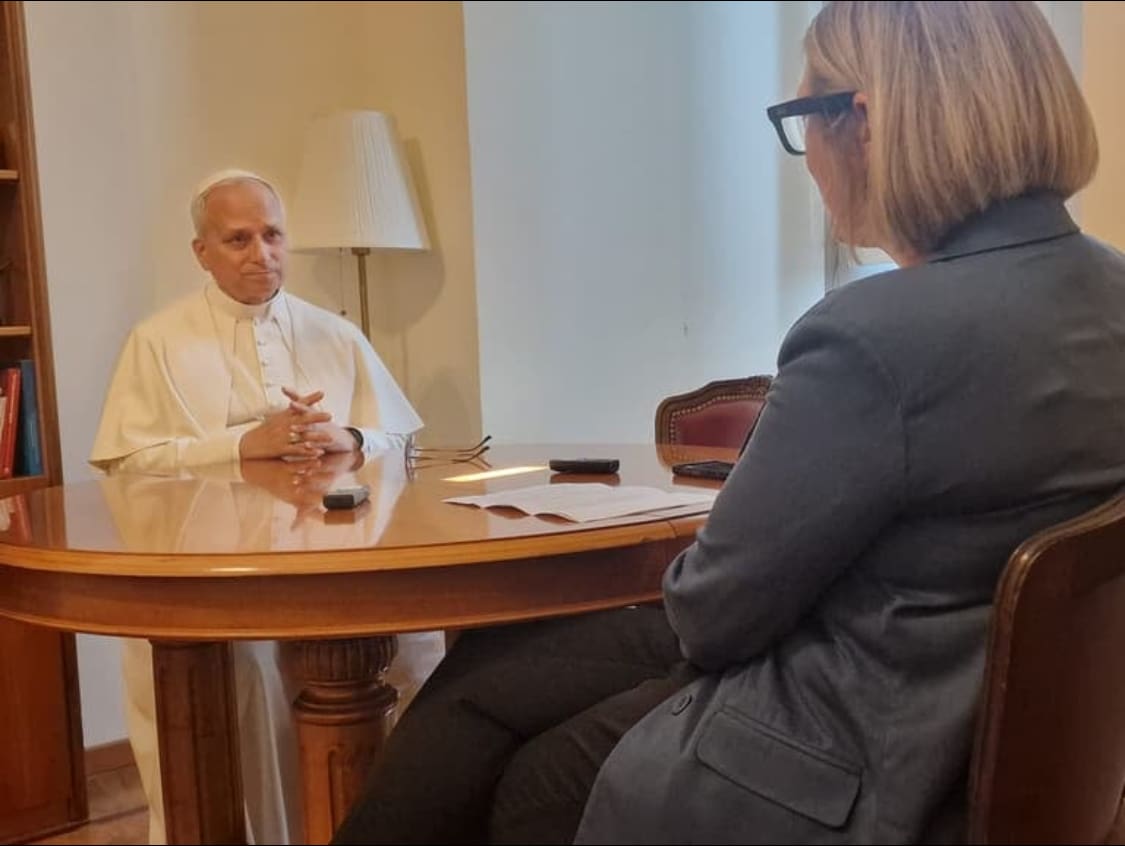
In a landmark interview that has sent ripples through both the theological and financial worlds, Pope Leo XIV offered a stark, historically-grounded critique of modern economic inequality, invoking the spectre of Karl Marx and the tangible example of Elon Musk to warn that extreme wealth concentration places the world “in big trouble.”
The pontiff’s conversation with Elise Ann Allen, a senior correspondent with the Catholic newspaper Crux, marked his first sit-down media interview as the leader of the world’s 1.3 billion Catholics. While covering a breadth of topics, his comments on the “driving force in polarization” were particularly striking. Applying a Critical Discourse Analysis (CDA) lens, which examines how language use is shaped by and shapes power structures, history, and ideology reveals a deliberate framing of global inequality not just as an economic issue, but as the central class struggle theorized by Marx.
Language, History, and the “Widening Gap”
From the outset, the Pope’s terminology was carefully chosen and historically loaded. When he spoke of the “world” being polarized, he explicitly anchored his meaning in Marx’s theory of social class. He identified the root of this division as the “continuously wider gap between the income levels of the working class and the money that the wealthiest receive.”
This language is a direct conduit to the 19th century. By defining the problem through this specific lens, Pope Leo XIV resurrected Marx’s core dichotomy: the bourgeoisie (the capitalist class who own the means of production) and the proletariat (the working class who must sell their labour for wages). His historical comparison of CEO pay from being “four to six times more than what the workers are receiving” sixty years ago to “600 times more [now]” was not a mere statistic. In Marxist terms, this exponential multiplier is a potent symbol of the extraction of “surplus value,” the economic concept describing the value created by workers’ labour that is kept as profit by the owners of capital.
The Pope’s choice of example, Elon Musk, is equally significant. Musk embodies the modern, hyper-globalized bourgeoisie. His potential to become the world’s first trillionaire is not presented as a celebratory milestone of human innovation but as a dire warning. “What does that mean and what’s that about?” the Pope questioned rhetorically. “If that is the only thing that has value anymore, then we are in big trouble.”
Likewise, for Catholics, Pope Leo XIV’s remarks resonate with a long tradition of papal social teaching, notably Rerum Novarum (1891) , Pope Leo XIII’s encyclical on capital and labour, which condemned worker exploitation. Yet by singling out Elon Musk, Pope Leo XIV situates the discussion firmly within contemporary debates on billionaires and the concentration of wealth.
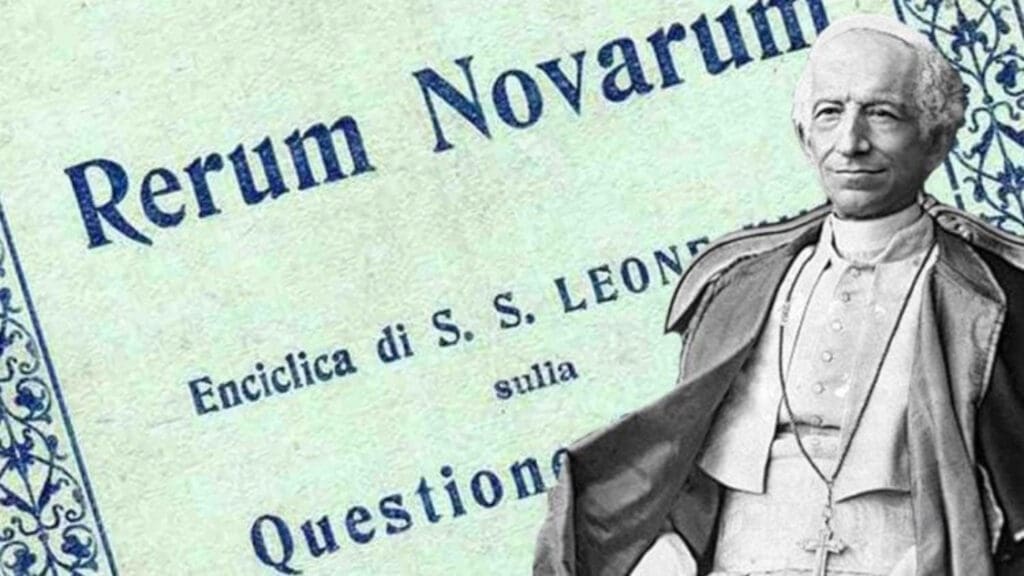
Pictured: Rerum Novarum (1891), Pope Leo XIII’s encyclical on capital and labour, which condemned worker exploitation
“We Are in Big Trouble”: A Discourse of Alarm and Ideology
The phrase “we are in big trouble” is the interview’s discursive climax. Its alarming, colloquial tone breaks from more traditional, measured papal language, designed to shock a global audience into attention. A CDA examines such phrases not as isolated comments but as manifestations of deeper ideological beliefs.
In this context, the Pope’s alarm can be interpreted through two key Marxist ideologies. First, it is a stark acknowledgment of intensifying “class struggle” and “exploitation.” The statement underscores the belief that the bourgeoisie’s power, exemplified by Musk’s ascent, derives entirely from their ownership of capital, which allows for the systemic exploitation of the proletariat. The trillion-dollar figure is the ultimate symbol of accumulated surplus value on a global scale.
Second, and more profoundly, the warning of “big trouble” echoes Marx’s historical materialism, which posits that class struggle is the engine of history and that capitalism contains the seeds of its own destruction. Marx believed the inherent contradictions and exploitative nature of capitalism would inevitably lead to a revolutionary moment and its eventual overthrow, paving the way for a classless society.
The Pope is not calling for revolution. However, by using this Marxist framework, he is issuing a prophetic warning to the current economic order: a system that allows for such grotesque inequality is fundamentally unstable and morally bankrupt. It is a plea for reform rooted in the fear that without it, the natural and violent consequence predicted by Marx could become a reality. He frames extreme wealth not as a reward for success but as a harbinger of societal collapse.
The Power of the Papal Platform
The power dynamics at play are crucial to this discourse. The speaker is not a socialist academic but the Supreme Pontiff of the Catholic Church, a global institution with immense moral authority. By adopting this critical framework, he legitimizes Marxist economic critique as a valid tool for diagnosing societal ills, separating it from the atheistic ideology that often accompanies it.
This creates a powerful fusion of theological and socioeconomic discourse. The Pope is essentially arguing that the accumulation of vast wealth is not only an economic failure but a profound spiritual and moral one. His warning is thus twofold: we are in trouble socioeconomically because the system is unsustainable, and we are in trouble spiritually because the system corrupts the human soul and community.
The interview represents a significant moment in the modern papacy’s social teaching. By implicitly using Marx’s class theory and the contemporary example of Elon Musk, Pope Leo has moved the Vatican’s critique of capitalism from general principles of solidarity and preference for the poor into a specific, sharp, and structurally focused analysis. He has framed the ever-widening pay gap not as an unfortunate side effect of a free market, but as the central polarizing force of our time, an active engine of social division that, left unchecked, will lead the world into grave, and perhaps revolutionary, trouble.