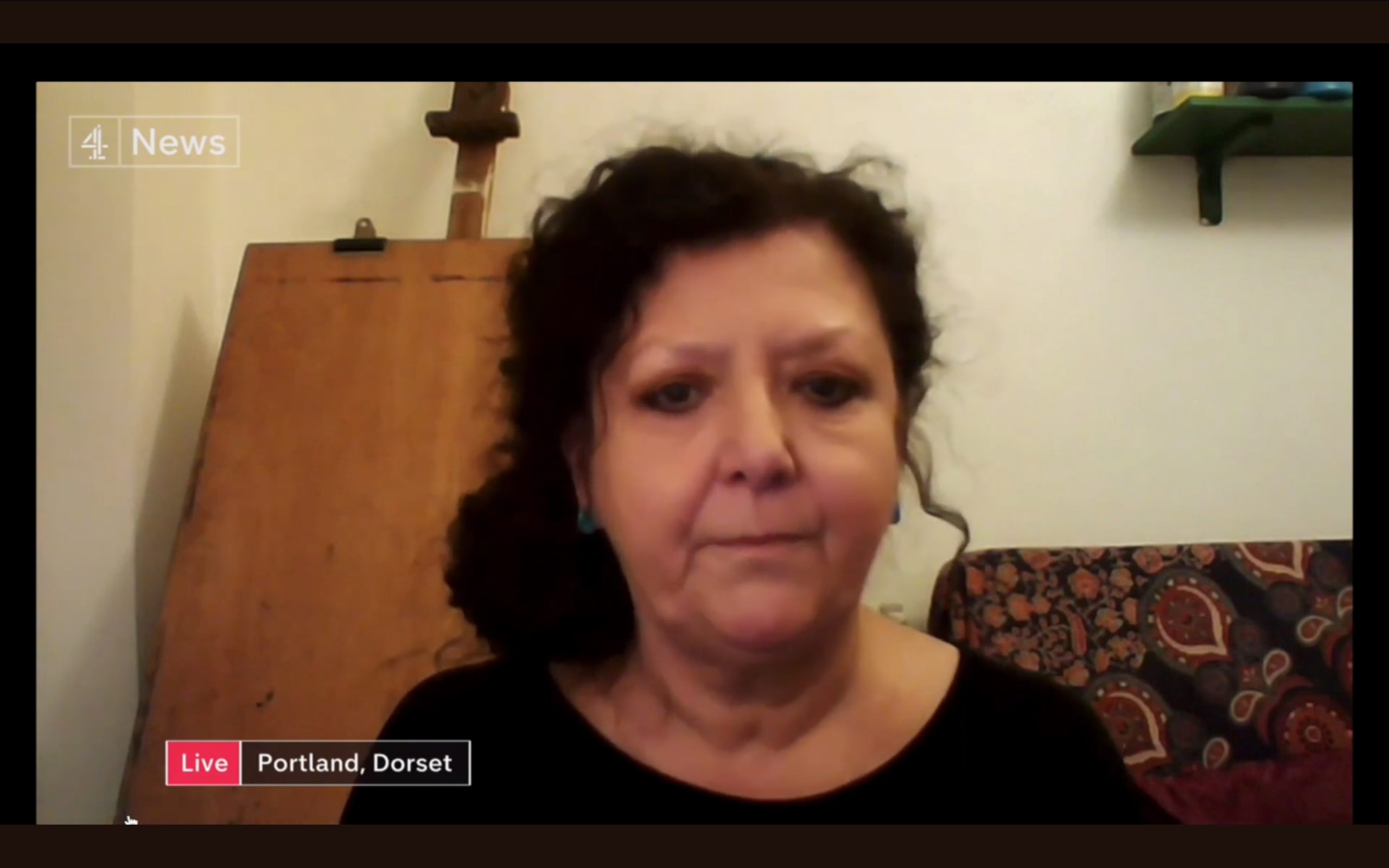
Here is Carolyn’s profile for the selection process.
ABOUT CARRALYN: I’m an artist, art historian, and former lecturer. I’ve lived in the South-West for thirty years, but I originally come from Liverpool (the greatest city on Earth!). I’m a Unite the Union member, and I left the Labour Party over the Iraq war and rejoined when Corbyn came to power. I was South Dorset Labour candidate in the 2019 General Election and was a Portland councillor, council chair, and Labour group leader. As mayor of Portland, I took the Home Secretary and Dorset Council to the High Court over the inhumane and barbaric Bibby Stockholm asylum seeker accommodation barge. I can’t remember a time when the Labour movement hasn’t been part of my life. One of my earliest memories was as a little kid sitting on my bus driver dad’s shoulders during the 1968 Liverpool Bus Strike. We were marching to a rally at the Pier Head, and I was in the middle of a sea of people with red flags as far as the eye could see. Truly inspiring! The strike lasted twelve weeks, and what echoes down the years from that time, apart from the comradeship of striking families, is as a child, being hungry. I’ve never forgotten it and have spent fifty years of my adult life supporting workers in struggle, fighting poverty, hunger, racism, oppression, and for a socialist transformation of society. I’m proud of my involvement in Liverpool City Council’s fight against the Thatcher government. Whilst other councils made redundancies and cut services, Liverpool built houses and created jobs. We were (and still are) vilified by the Labour elite for standing up to Thatcher’s rampant capitalism, and while Neil Kinnock’s ‘dented shield’ lies rusting in the dustbin of history, the beautiful houses that we built continue to be decent homes for Liverpool’s people. I’m not on a slate- I’ve been saddened to see the divisions that have arisen. I’m standing as an independent because I think that the only way to heal is to be laser focussed on you, the members. I believe that the skills I’ve have gained as a council leader and through life experiences have given me the abilities to bury our differences, build bridges, and bring all members of the CEC together. This isn’t the Labour Party- there is no right and left, we are ALL the left. What unites us is bigger than what divides us, I will work to make your voice heard and conference decisions become a reality. Your Party is a moment in history where we can bring hope and a brighter future for all working class, oppressed, and marginalised people. Let’s move forward in unity.
CARRALYN ANSWERS YOUR QUESTIONS….
YOUR MEMBERSHIPS & AFFILIATIONS
- Please list any past and present memberships of political parties, trade unions and other political organisations, please detail any previous political offices you have held, explain the work you undertook there and what experience you feel you’ve gained as a result.
Political Parties: Militant, the Labour Party (I left over the Iraq War), and RESPECT. I rejoined the Labour Party when Jeremy Corbyn came to power and left just before the formation of Your Party in August 2025, and finally, Your Party.
Unions: NALGO, TGWU, NUS, NATFE, Unite the Union
Political Offices: Labour Party: I’ve been a councillor, council chair, Labour Group leader, deputy mayor, and mayor of Portland. I was South Dorset’s Labour candidate in the 2019 General Election. I resigned from the Labour Party as stated, because I couldn’t bear the party’s rightward drift. I also resigned my council positions. People had elected me as a Labour councillor, and I felt that as I was no longer a Labour member, to stay in post as an independent/other party was cheating people of the representation that they had selected at the ballot box. I’ve also served as ward secretary, constituency secretary, constituency vice-chair, and constituency chair.
Unions: NALGO secretary, TGWU youth officer, NUS Art Faculty rep, NATFE Faculty of Art and Design rep.
I think the over-arching experience that I would take away from this activism is the ability to work collectively and in a comradely fashion with others, to identify problems and to provide solutions through policy formation and negotiation..
YOUR POLITICAL ACTIVISM
- Please breakdown any previous political actions and campaigns you have been involved with – either through helping to organise, taking part in, or instigating – and explain what role you played in each.
During my term as mayor of Portland, the highest profile campaign that I have ever been involved in was the fight to stop the cruel and barbaric Bibby Stockholm asylum seeker’s accommodation barge being used as what I can only describe as a floating prison in Portland Port. The Bibby Stockholm was Rishi Sunak’s ‘flagship’ in his ‘stop the boats’ policy. He intended to put barges across the country in ports and waterways, and it was meant to be so degrading and intimidating that it would frighten people away from claiming asylum in the UK. With Deighton, Pierce, and Glynn Law, I took the Home Secretary, Suella Braverman, and Dorset Council to the High Court on the grounds that planning permission should have been applied for, and if it had, planning would never have been granted as Portland Port was wholly unsuitable to house human beings. This despicable means of housing asylum seekers was ruthlessly exploited by the far-right, whipping up a frenzy of fear and hate in our community. This rhetoric was ultimately defeated by my pro-refugee legal action, the kindness of local activists in the Portland Global Friendship Group with their care packages and companionship for the men, and the support of Stand up to Racism Dorset. Although we didn’t win the court case, we stopped Sunak and Braverman’s plans for other barges. I suppose you could say we lost the battle but won the war.
The most important and long running campaign I have been involved in is the campaign to ‘Stop Portland Waste Incinerator’, because of the generational health, environmental, and heritage problems it will bring. Powerfuel and Portland Port announced in November 2019 that they were going to build a waste incinerator backing into a cliff in the Port. At the top of this cliff is a housing estate and a prison. The chimney stack would discharge its fume-plume over the estate, prison, areas of special scientific interest, and be carried by prevailing wind across Portland and Weymouth. The negatives of this project, the pollution, transporting waste through unsuitable roads, the blight on the landscape far outweigh any benefits claimed by the Port and Powerfuel. I first campaigned against this as an Underhill ward councillor (where the incinerator is to be built) and 2019 Parliamentary Candidate. As chair of council, I supported the financing of a forensic examination of Powerfuel’s planning application by Freeth’s solicitors. I’ve contributed to planning committees, enquiries, spoken as mayor of Portland and a local councillor at meetings and public rallies/demonstrations, and continued my support in demonstrations after resigning my council positions in August 2025.
I set up a Portland Council initiative that provides the parents/carers of Portland school children in receipt of free school meals, a supermarket voucher to pay for breakfast in the school holidays. It began in 2021, helps approximately 400-500 children every school holiday, and has delivered thousands of meals.
In fifty years, I’ve been involved in many campaigns. I’ve campaigned against animal experiments and bloodsports. I picketed the Waterloo Cup (an annual barbaric hare-coursing event, now banned). I used to go to the annual national picket of the South African Embassy for the release of Nelson Mandela- my friends and I made a nuisance of ourselves by linking arms and sitting in the road (as you do!). As art students, we made a fabulous banner for the Poll Tax march in London saying ‘Pollocks to the Poll Tax’ only to arrive and see that every other art student had the same idea! I’ve also demonstrated locally and nationally against the Iraq War, and I’ve long opposed the oppression of Palestine.
As a Trades Unionist, I’ve continuously supported striking workers and workers in struggle. The ones that really stick out are the Miners Strike and Wapping because of the massive level of state brutality. I’ve opposed local authority and education cuts, tuition fees, and have been on strike for improvements in education funding, pay, terms and conditions as a lecturer. I’ve also painted banners, an example being for Dorset Unison’s Centenary.
As a community member, I fought against the closure of our local library, schools, hospital, and minor injuries unit.
YOUR HOPES FOR YOUR PARTY
- What does Your Party mean to you, what do you want to see Your Party members doing more, and how would you support that work from within the CEC?
- What processes and safeguards would you want to see implemented to curb factionalism in the party and ensure that members remain sovereign when it comes to important decisions.
1. I’ve been fighting all my life for a socialist society, most of it in the Labour Party, and I’ve seen chance after chance for a brighter future for all working class and oppressed people squandered. Your Party is a once in a generation opportunity to make socialism a force for good in mainstream politics, a real chance to transform our communities locally, nationally, and internationally. I would work to ensure that the voices of all members are heard loud and clear, and that the decisions made in conference are applied to the letter and in the spirit in which they were moved.
2. It’s been a bit of a mess, hasn’t it? We must bury our differences and move forward together. Ultimately, Your Party doesn’t belong to any MP or faction, it belongs to its members. Again, it’s about making sure that conference is sacrosanct and negotiating within the CEC, always keeping that principle at the top of the agenda. A system of local, district, and regional assemblies as a means of members communicating to the CEC and for the CEC to feed back to members would help keep things member focused.
LET’S TALK POLICIES
On Disability
- A disabled person’s care needs don’t end when a parent or carer reaches retirement age but the carer’s allowance does. What do you think the CEC and Your Party could do to address this injustice?
- Are you committed to the social model of disability?
- How do we ensure the rights of disabled people are taken seriously?
- How will you ensure accessibility and inclusivity for disabled people in Your Party?
1. Of course, the allowance should continue. This is work that is currently massively underpaid, saves the state a fortune, and the poverty and suffering it causes is hidden in silent misery behind closed doors. A proper socialist review of the benefits system is long overdue, a review with the need of recipients at its heart, not cost cutting or punishment.
2. Yes. Disability exists within how a society and its structures function to exclude differently abled people.
3. By making sure that disabled people are at the heart of any decision making or structures that influence their lives. People need to directly own and control these processes- it must be from the ground up, not top-down.
4. Again, it’s all about putting the power to shape these policies to ensure accessibility and inclusion in the hands of disabled members. We need a disabled members section with representation on the CEC with the capacity to make policy regarding disability.
On Benefits
- What is your vision for sickness, disability, carer, child and unemployment benefits?
- Do you support a Universal basic income / Universal basic services?
- Currently, Amnesty International calls the social security system in the UK ‘Consciously cruel’. What do you think needs to be done to tackle this?
1. As previously stated in Disability Q1, a proper socialist review of the benefits system is long overdue with the need of recipients at its heart, not cost cutting or punishment. I would dearly love to see the cruel insecurity of Universal Credit thrown into the dustbin of history. We are a rich country, and the richest people and corporations can well afford to shoulder their social responsibilities- to paraphrase a wise man, “From each according to their abilities to each according to their needs”.
2. Universal Basic Income: Yes, absolutely. The Welsh Government has a system for care-leavers, and I’d heard of a two-year trial to be conducted in Finchley and Jarrow (supposedly starting in 2023). Basic income trials across the world have been encouraging- trials in India showed that the education rate of children rose by 25%. Universal Basic Services: Again, yes. I think of health, housing, education, food, transport, water, legal services, and digital, as human rights.
3. I think they are right, it is cruel. It’s all about kicking those of us who are unfortunate enough to be at the bottom of the heap, it’s designed to punish and humiliate recipients, to make life hard. I repeat what I said in previous questions: a proper socialist review of the benefits system is long overdue with the need of recipients at its heart, not cost cutting or punishment.
On Jobs
- How do we generate more well paid jobs in this country?
- Do you believe the wealth gap between employers and employees needs to be addressed and, if so, where would you cap it?
- Do you think the real living wage should continue to be voluntary or obligatory?
- Do you think we should introduce a ‘back-to-work’ scheme in this country where people are given an annual allowance, instead of fortnightly benefits (for a period of time), so that they can become self-employed instead?
- Do you think think the Employment Rights Act is adequate and, if not, why not, and how would you want to improve it?
1. A good socialist programme of taking back into public ownership, utilities, transport, and key infrastructure, reinvesting profits into jobs and services. Seeing sewage spilt into our waterways whilst the shareholders laugh all the way to the bank makes my blood boil. We need to repeal anti-trades union law, giving power back to workers to be able to properly defend terms and conditions and negotiate pay. Also, education for life, abolish tuition fees and reinstate grants- a better educated society is a prosperous society. Investment in skills, green manufacturing and green energy creating the well-paid jobs that people are crying out for.
2. Yes, most workers are paid much less than their work is worth. If we think back to the pandemic, it was the health, transport, and food production workers to name but a few that were essential, not the hedge fund manager. I’ve heard in the past of people putting the differential at 1:10. It would certainly increase the pay of Sainsbury’s workers (other supermarkets apply!).
3. Although higher than the minimum wage, I don’t think it’s high enough. Whilst I respect the Joseph Rowntree Trust and the work that they do, workers need to be able to do more than cover the bills, so perhaps there needs to be some enhancement on how the cost of living is calculated. To make the real living wage obligatory would be replace the minimum wage. As it has advantages over the minimum wage for workers as it starts at 18 and includes London weighting, it may be a better system to adopt to price minimum wage.
4. This works for some and not for others. If someone feels capable of starting a business, that’s a fabulous opportunity to make your skills work for you and provide a living. However, there can be no compulsion, and there needs to be a safety net for those whose businesses fail so that no-one becomes destitute.
5. I remember starting work in the late1970’s when unemployment was rising, there was a six-month unfair dismissal law. What happened, particularly with young workers in low skilled jobs, was that an employer would sack them just before the six-months was up and employ someone else off the lengthening dole queues. Employment protection should begin from day one. The fire and rehire ban and Statutory Sick Pay introduced from day one is a step in the right direction. A bit of a curate’s egg, really.
On Housing
- How do you think we can improve housing in deprived areas, so as to tackle the urgent issues of rising rents, unaffordable housing, shortage of social housing and, in some areas, Airbnb or developers taking over all free properties that could become homes for people? This issue is badly affecting young people who can’t afford the rent on their low wages and also older people 50+ who also can’t find enough work
- When we win an election, and if it’s within your remit to do so, what measures would you implement to address the homelessness crisis.
1. We need a massive programme of good old fashioned council house building, decent, well-built homes in properly planned communities with all the amenities that make life secure and happy. Liverpool Labour Council did this in the 1980’s and I’m proud of the role that I played in our city’s struggle to improve life for people and fight the Thatcher government’s cuts in jobs and services. Scrapping the right to buy, rent freezes, beefing up tenancy rights, stopping social housing providers from selling properties on the open market, and the compulsory purchase and management by councils of slum landlord and abandoned properties at a fraction of market rate would also help. Airbnb and second homes are the bane of my life in Portland as they are across most areas in the South-West. Council tax of 1000 times band value on Airbnb and second/holiday homes would damage this as a business model. Additionally, Stamp Duty of 100% on second homes would start at the first one pound of property value, and getting rid of buy-to-let mortgages would put off people encouraged into landlordism by property development TV shows.
2. In my part of Dorset (and across the South-West), house building is not geared up to the needs of the local community. Developers are building accommodation for rich people wanting a sea view for a few weeks a year, whilst people are on social housing waiting lists for decades. I hope that the measures that I outlined in this Q1, reclaiming Airbnb, second/holiday homes would make these properties available and go a long way to solving our housing problems. And again, building council houses. Street homelessness can be complicated and there may need to be lots of support (mental health, social services, etc) to help people move from rough sleeping to the permanence of a proper home. We need the political will to ensure that this is properly resourced.
On Inequality
- Where do you stand on Trans rights and do you believe a woman’s place on the CEC should also be open to Trans women?
- What is your stance on a youth/student wing, Disabilities group, BAME group, Women’s group or a LGBTQIA+ group within the party?
- If it were within your remit, what measures would you want to see put in place to combat Transphobia, gender stereotypes, racism, religious intolerance and the general ‘fear of the other’ within our communities, for example in education, in health, in the work place and in negative media portrayals.
- How do you think we can tackle the centuries-old culture of blaming poor people, and address the real causes of poverty?
1. Yes. I think it’s a shame that the election was framed in a gendered way, creating an unnecessary division. However, although a move forward, I don’t think that opening a women’s seat to Trans women candidates is enough. We have enshrined Trans rights in our founding documents and really should have dedicated Trans seats in the CEC.
2. I think that we are all stronger when everyone’s voice is heard. We need sections for self-organised groups so that they have a safe space to discuss in. Again, it’s not enough just to provide a safe space. Groups need a seat at the CEC, fully empowered to advance policy decisions.
3. I think that it is important to give the power for combatting prejudice into the hands of those who experience it. I would be looking to consultations, the parameters of which would be organised by groups- too often have enquiries and reports been conducted by well-intentioned individuals who by not living these lives, have created new sets of problems.
4. Capitalism has always sought to divide and conquer us by manipulating difference. The language of the ‘deserving poor’ and ‘undeserving poor’ has been used for centuries to kick those of us at the bottom of the heap, who are victims of a system that creates poverty and inequality. The words that we use to describe people are important and have consequences. A two-pronged attack, first on capitalism in re-distributing resources to eradicate poverty, and secondly reconfiguring discriminatory language (attacking the use of words such as scrounger) would be a start.
The Environment + Green & Renewable Energy
- Consider the challenges of building renewable energy. What is your view on how we should handle the trade‑offs between industrial growth, renewable construction, environmental impact, and the concerns of local people, for example, in the proposed Morgan & Morecambe Wind Farm?
- What do you think should be done to tackle global warming and environmental degradation?
- How do we achieve a just transition from the fossil fuel extraction industry to carbon neutral occupations?
- How do you think we can tackle the lobbying power of the fossil fuel and animal agriculture industries?
1. As I said in the question on political activism, I have been fighting Powerfuel and Portland Port’s plans to build a waste incinerator on Portland. It’s been dressed up as green energy, but in reality, it is one of the dirtiest ways of generating power. In our location, Navitus Bay Wind Park was refused planning permission due to its visual impact on the Jurassic coastline. I’m a supporter of renewables, but every form of construction has an impact, and part of the problem with companies is that they want to maximise profits by having enormous developments that are environmentally insensitive. Developers need to bring communities into proper consultation and think smaller and more sensitively.
2. The biggest polluters are corporations. Taxing corporations heavily for dirty practices will force them to rethink environmental policies. Insulate Britain has some good ideas on solar panels for every suitable property and insulating homes to save fuel consumption.
3. Unions should be a key partner in negotiating the transformation of the fossil fuel industry into manufacturing and developing carbon neutral alternatives. Communities dependent for jobs on these industries don’t have to be negatively impacted on the transition to carbon neutral.
4. Clean up politics and make all forms of lobbying and second jobs for MP’s (apart from jobs related to necessary continual practice) illegal.
The Economy
- Imagine Your Party has just won the General Election. How do you think Your Party could best manage the hostile economic reaction of the capitalist markets and hostile hyper capitalist countries?
- What is your view of economic growth versus de-growth, and what do you think the key economic policies of Your Party should be?
- Do you support the Wealth Tax?
1. Emergency legislation to stop the flight of capital by nationalising banks, taking control of and nationalising key manufacturing and infrastructure such as utilities, telecommunications, transport. Importantly, not worrying about whether this upsets Donald Trump and going about the business of a good socialist transformation of society.
2. Endless growth in the current economic model is environmentally unsustainable. We should be moving to a more circular economy. A green industrial strategy with the nationalisations outlined in Q1 would be a reasonable place to start.
3. Yes, the rich can afford to pay back into society a fair share of what they’ve taken out.
Foreign and Defence policy
- Do you commit to a complete arms embargo on Israel and ending all military cooperation, and what do you think about the global militarisation of foreign policy generally, including the planned defence of Ukraine.
- Do you believe the UK government is complicit in the Palestinian Genocide (named as such by the UN 9/25).
- If it were in your remit, would you reverse the proscription of Palestine Action?
- What are your thoughts on defence expenditure in general, but also in light of the fact that we’re going through a cost of living crisis in this country and our taxes could instead be used to ease the financial burden on households and support our public services?
- What does a ‘free Palestine’ look like to you?
1. Yes, a complete arms embargo and ending military cooperation is something we can do with immediate effect. I’m against the militarisation of foreign policy, as the only people it benefits are arms traders and manufacturers, and the corrupt and despotic regimes profiting from the deaths and maiming of innocent civilians.
2. Absolutely, truly a crime against humanity.
3. The High Court today (13/02/2026) has just done exactly that, but as the Home Secretary is appealing, the proscription stands. The legislation used to stop and criminalise peaceful protest needs to be scrapped, and if that was in my power I would repeal these laws and reverse the proscription. Our media rightly highlights the criminalisation of human rights protesters overseas, but glosses over the abuses of our government. It speaks volumes for the state of our democracy when you can be jailed for stopping traffic as part of a peaceful protest, or arrested and detained by police for holding a blank sheet of paper.
4. It never ceases to amaze me that we can’t find the money to pay public sector workers properly, or fund schools, hospitals, and welfare, but we’ve always got the money to bomb countries back to the stone age. The decision to cut overseas aid to pay for increased defence funding was shameful. This money needs to be spent on living, not death.
5. I think that is a decision that needs to be made by the Palestinian people, it should look how they want it to look. I’d feel like I was committing a form of continued colonialism if I were to say what that should be.
General Questions on policy
- What are the key policies that you would like to see in the Your Party manifesto for the next general election?
- Imagine Your Party has just won a general election, what’s the first action or policy you would work to implement?
- What do you think our taxes should be spent on?
- What should, or should not, pension funds be invested in?
- What are your thoughts on mass surveillance? Mandatory ID might be on ice but what about future attempts to reintroduce it, and what do you think about live facial recognition?
- What are your thoughts on full public ownership of vital public services?
1. Taking control of and nationalising key manufacturing and infrastructure such as utilities, telecommunications, transport, a massive programme of council house building, properly resourcing health and education, a green industrial policy, and a truly ethical international policy embargoing ALL rogue states.
2. As I said before, stopping the flight of capital so that proper taxes can be levied on corporations and the super-rich, so emergency legislation to stop the flight of capital by nationalising banks.
3. Health, housing, education, environment, and all the good socialist stuff that makes life worth living.
4. They shouldn’t be invested in fossil fuels, the arms trade, intensive farming, or companies involved in animal experiments. It’s difficult to talk about investments as it’s such a murky world, but the Co-operative Bank’s ethical investment and lending policy is a good place to look for kinder financing under capitalism.
5. I’m no supporter of any ‘Big Brother’ ID or surveillance methods. There are already too many restrictions on our freedom to protest, and the use of these methods to identify, catalogue, and potentially incarcerate those involved in civil disobedience are very real.
6. Yes, as stated in previous questions I fully support this.
YOUR PARTY RULES & MANAGEMENT
- In your opinion, what would be the most effective and fair way for Your Party to decide on and write policy (i.e. proposed and written the by CEC, by branches, by individual members, or by Sortition Assembly, for example)?
- What are your thoughts on how the CEC, and other Your Party structures, could be made to function more effectively and in the interests of its members?
- Do you support dual membership and, if so, which other parties would you approve?
- Will you ensure that ‘one member, one vote’ is enshrined into the party’s constitution?
- Voters do not want to see discord in Your Party. What processes would you want to see put in place to allow members to raise grievances, have them addressed fairly and expediently, and for lessons to be learnt?
- Would you ensure the CEC provides members with a contact number and email so that members can contact you with suggestions and questions?
- Taking cybersecurity concerns and obligations into consideration, at a time when there is serious concern that member’s data could be hacked, leaving members exposed to harassment and other risks, what protections, other than those provided by cybersecurity tools, would you want to see put in place when sharing membership information with local branch executives?
- How do you see Your Party operating in areas where people are fundamentally right wing and any kind of public street stalls can be very dangerous for those involved, and how should Your Party CEC and the party centrally support comrades in those areas?
- Do you support the party investing, on a targeted and financially sustainable basis, in permanent and visible local spaces to enable branches to hold meetings, run public-facing events, and engage with citizens outside of election cycles? Please also explain why you support, or don’t support, this initiative.
- Given the fact that politics is rife with self-serving careerists who priorities their own interests and the interests of their donors, over the interests of party members, and British voters, to the extent that they are prepared to lie their way into office and then break every promise they ever made, would you support a simple mechanism that allows party members to call an immediate vote of confidence in any Your Party elected official, including MPs, councillors and staff on the CEC (or other party structures)? Also, in the event that they lose that vote of confidence, that they are immediately removed from that office (ideally triggering a by-election in the case of MPs and Cllrs)
1. Conference decides policy and the CEC enacts it. To ensure that the collective leadership is grounded in the membership, there should be a system of assemblies, local, district, and regional with clear lines of communication to and from the CEC. Self-organised groups (eg, women, youth, disability, LGBTQIA+) should have sections to discuss dedicated policy and reserved seats to this feed into the party structure.
2. See Q1 regarding assemblies and sections.
3. Yes, conference made the decision to support dual membership and if elected I will make sure that this happens. Any party that wishes to be considered would have to comply with the socialist principles enshrined in our founding conference, so approval would be given to those that are compliant.
4. Yes!
5. Having had experiences in the Labour Party of their procedures, I’d say that any process needs to be quick, transparent, and based in natural justice. Discipline and grievance need to be based in fair, democratically agreed, clearly understood rules applied on the basis that there is a breach, not as a punishment for being politically opposed.
6. Yes!
7. I’m not an expert on cyber security and would seek the advice on this from someone qualified to put in protections. Personal experience of using data in branches and constituencies has led me to see the importance of using emailing and data storage systems provided by the party and limiting the number of people with access to it, most commonly the membership secretary and the secretary.
8. I live in a right-wing area and have experience of attacks at street stalls and public events during the 2029 General Election. Visible stewards are useful- having someone who is watching and can intervene to de-escalate a situation is essential. Making sure that people are not doing these things alone and therefore vulnerable is also important. Training in public engagement and de-escalation tactics for comrades taking our message to the streets is something that the CEC can implement.
9. Yes. A visible hub can be really useful in the community, so that people can come to us for help and support, and provide a secure gathering space.
10. Yes. When I left the Labour Party I also resigned as a councillor. I felt it was dishonourable to the people who elected me as a Labour councillor to become independent or join another party. Losing a Recall vote would remove someone from office in Your Party and stop someone from standing for council or parliament on a YP ticket in future. However, it can’t remove them from the office of MP or councillor as the publicly elected position belongs to them for the elected term. You’d have to hope that they’d be honourable, respect members wishes, and resign.
GENERAL QUESTIONS
- How would you distinguish democratic socialism from social democracy, do you identify with either, and, if so, why?
- Should there be an electoral alliance with the Green Party?
- Please sketch how you would fight an election campaign paying particular attention to the voting base you would attempt to mobilise, the messages you would try to get across, and the means you would employ to promote such messages.
- Do you think we should keep the Monarchy?
- Do you think it’s important for Your Party to have strong animal rights policies? If so, can you provide examples?
1. I’m a democratic socialist, I believe the working class and oppressed people should own and control society. I’ve always seen social democracy as capitalism throwing a few more crumbs at us from the capitalist bread wrapper!
2. As a very new party, I think our priority is to be building an electoral identity of our own based on our socialist principles.
3. It depends on the election. Whilst there are different priorities for council or parliamentary elections, most elections have some national element to them, so national figures and policy should feature in materials. Identifying what needs are provided by council/parliament in a local area and what a socialist platform should address should come from the community and YP membership. Different groups within a community will have differing needs and expectations, for example, there may be cuts at a local school effecting parents, carers, and school staff. Working with unions representing staff, leafleting at the school gate, talking to parent/carer groups, press/media releases, social media are all means of getting out an anti-cuts socialist message. Most importantly, we need to continuously work within the campaigns in our communities all year round. We don’t want to be accused by voters of only turning up when there’s an election.
4. No. Some of those palaces would make fabulous social housing. I’m sure they wouldn’t mind sharing them with us.
5. Yes. I’m a lifelong supporter of animal rights. I first went veggie when I was 14 and became vegan in 2017. Although the ban on hunting live animals with dogs was passed by the Blair government, enforcement of the ban is weak. We need to resource the policing and prosecution of hunters with meaningful custodial sentences. I fought hard to support the abolition of animal testing and although it’s banned in cosmetics, the useless and cruel testing of animals in pharma/labs continues. Although new legislation has been passed, the government’s roadmap is still too long. Cruelty in farming animals is rife, for example, chickens are horribly abused. Although battery cages were banned in 2012, so called ‘enhanced colony’ cages where up to 90 hens are crammed with insanitary conditions and no room to move.
To report this post you need to login first.