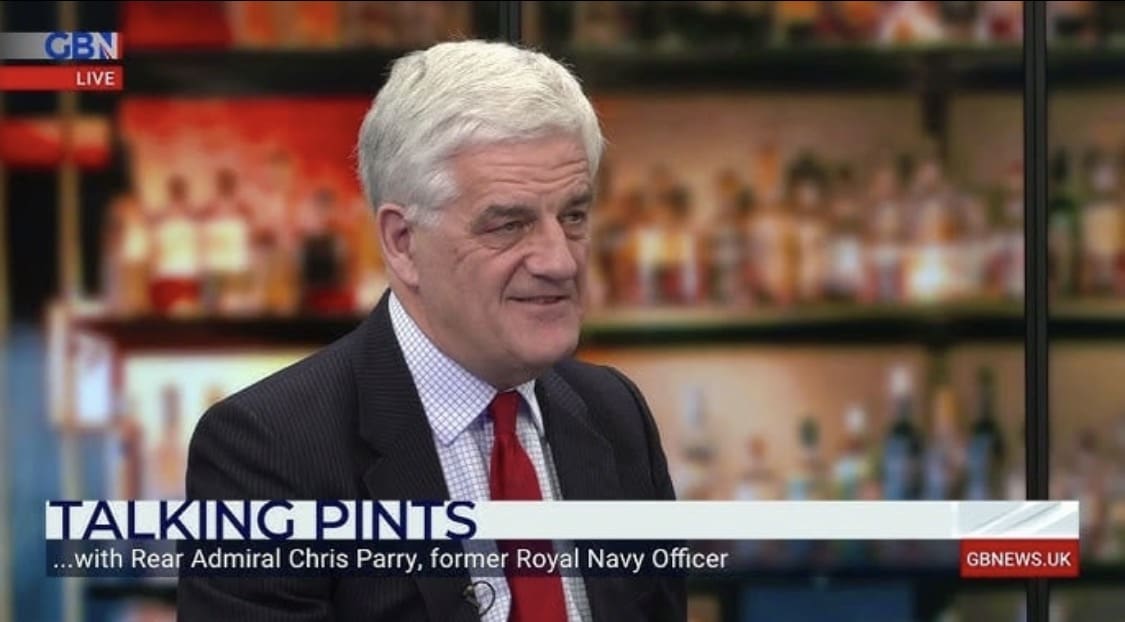
Update:
Reform UK has now suspended Chris Parry.
Following on from The Guardian expose, I want to give my take on this loathsome candidate who seeks to become Mayor of Hampshire and the Solent Combined Authority.
The language of power often reveals itself not in grand speeches but in the careless, unguarded moments, those flickers of contempt that betray a deeper truth. What Chris Parry has offered the public is not merely a “clumsy” social media post, as he now claims, but a window into a worldview that is as corrosive as it is dangerous.
Hours after ambulances belonging to Hatzola were set ablaze in what police deemed serious enough to involve counter-terrorism officers, Parry chose his moment. Rather than condemn the attack unequivocally or express solidarity with a targeted community, he amplified a sneer. Sharing a post from Catherine Blaiklock, he dismissed members of Shomrim, volunteers who work closely with emergency services, as “cosplayers” and likened them to “Islamists on horseback.”
This is not merely offensive; it is revelatory. In one breath, Parry collapses distinctions between community self-help and extremism, between citizens trying to protect their neighbours and the spectre of terror that haunts modern political discourse. It is a tactic as old as propaganda itself: blur the lines, sow suspicion, and let fear do the rest.
But there is something more insidious here. The timing is not incidental. In the aftermath of an attack on Jewish infrastructure, when communities are on edge and vigilance is heightened, such language does not exist in a vacuum. It feeds a narrative, subtle perhaps to some, but unmistakable to those who have seen it before, that minorities organising for their own safety are somehow illegitimate, even threatening.
When challenged, Parry doubled down, invoking legality as though it were a moral shield. “They are a community organisation, not a legal entity,” he insisted, before repeating the grotesque comparison. This bureaucratic reductionism, stripping human effort of its context and compassion, serves only to dehumanise. It ignores the reality that groups like Shomrim exist precisely because communities, time and again, have found themselves underserved, misunderstood, or targeted.
The response from Herschel Gluck was measured but telling. He described the remarks as “ignorant,” highlighting both the close cooperation between Shomrim and the police and the organisation’s role in protecting all citizens, not just Jewish families. It is a reminder that reality, unlike rhetoric, is grounded in lived experience.
Yet Parry’s comments cannot be dismissed as a singular lapse. They form part of a pattern, one that stretches back to his earlier assertion that David Lammy should “go home to the Caribbean,” despite being born in Britain. The same logic applies: question belonging, cast doubt on loyalty, and reduce identity to something conditional and suspect. Others such as Sadiq Khan, Shabana Mahmood, Humza Yousaf, Zarah Sultana, and Anas Sarwar have all been subjected to similar insinuations.
This is not politics as service; it is politics as division.
And what of Nigel Farage, the figurehead under whose banner Parry stands? Silence, or at best hesitation, speaks volumes. Leadership is not merely about electoral strategy; it is about moral clarity. To tolerate such rhetoric is to legitimise it, to allow the boundaries of acceptable discourse to shift ever further into the shadows.
There is a broader lesson here, one that echoes through history. When those seeking power begin to normalise the language of exclusion, when they mock the vulnerable and question the belonging of their fellow citizens, they are not merely courting controversy. They are eroding the fragile fabric of trust upon which any society depends.
Parry’s words, stripped of their defensive justifications, reveal a stark truth: this is a politics that sees communities not as partners but as problems, not as citizens but as categories. It is a politics that thrives on division, that feeds on fear, and that ultimately diminishes us all.
In the end, the question is not whether Chris Parry misspoke. It is whether we are prepared to recognise what his words represent and to decide, collectively, that such a vision has no place in public life.