The Farage Link: How a Donor’s Crypto Empire is Entangled in a Web of Crime and Russian War Funding
A Friday night line of cocaine in a British club. The cash handed over for a smuggled firearm. The fee paid to an immigration gang. These seemingly local crimes are, according to the National Crime Agency (NCA), feeding a billion-pound money laundering network with a direct line to the battlefields of Ukraine, funding the very Russian war machine that the UK government has vowed to counter.
At the heart of this shadowy financial web is a cryptocurrency called Tether. And a significant stakeholder in that company is Christopher Harborne, one of Britain’s most generous political donors and a key financial backer of Nigel Farage.
The Laundering Machine: From UK Streets to the Kremlin’s War
For four years, the NCA has been running Operation Destabilise, a major investigation that has peeled back the layers on a sophisticated money-laundering operation spanning 28 UK towns and cities. The scheme is brazen in its simplicity: couriers, often paid a pittance for the risk, collect “dirty” cash from the proceeds of drugs, firearms, and people smuggling. This physical cash is then converted into cryptocurrency, effectively washing it through the digital realm.
But this is not just about domestic crime. The NCA states unequivocally that these illicit transactions are directly linked to “geopolitical events causing suffering around the world.” The enterprise became so audacious that it allegedly purchased its own bank to facilitate payments that supported Russia’s military efforts and sidestepped international sanctions.
Sal Melki, the NCA’s deputy director for economic crime, has drawn a clear line, stating: “A line can be drawn from this money-laundering scheme to support for companies involved in the Russian military-industrial base.” The network is accused of facilitating the export of sanctioned electronic components to Russia, components that end up in the drones and missiles devastating Ukrainian cities.
The scale is staggering. To date, the operation has led to 128 arrests and the seizure of over £25m in cash and digital assets. A global spin-off investigation smashed two networks, Smart and TGR, which detectives described as the invisible link between “Russian elites, crypto-rich cybercriminals and drug gangs in the UK”.
Tether: The Crypto of Choice for Criminals and a Donor’s Fortune
So, which cryptocurrency is fuelling this system? The NCA reveals that the “vast majority” of the $24m (£18.3m) in crypto seized so far was issued by Tether.
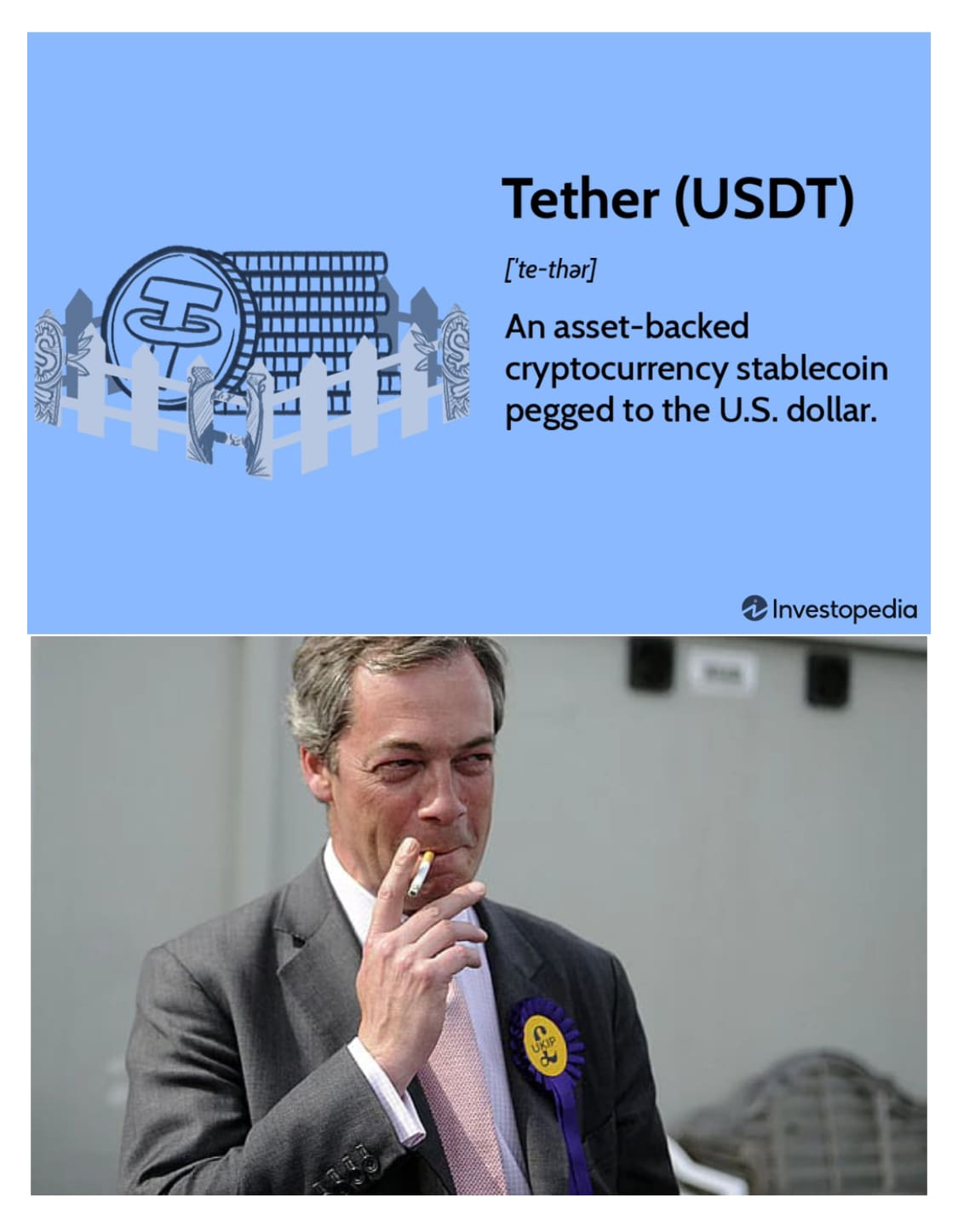
Tether is a “stablecoin,” a type of cryptocurrency pegged to the US dollar, making it a stable and easy vehicle for exchanging real-world currency. With 184 billion Tether tokens (USDT) in circulation, the company has become a behemoth, declaring profits of $13 billion for 2024.
And this is where the story enters the British political sphere. Tether’s shares are owned by a small, private group. Court papers show that around 2016, a 12% stake was taken by Christopher Harborne, a Thai-British businessman and one of the UK’s largest political donors.
While there is no suggestion that Mr Harborne is personally implicated in the money laundering, his fortune is intrinsically linked to a company whose product is in high demand from the very criminal and sanctions-evasion networks the British state is fighting.
The Farage Connection: Donations and Inaugurations
Mr Harborne’s wealth has flowed directly into British politics, most notably to the parties of Nigel Farage. In 2019-20, as the UK was finalising its departure from the EU, Harborne gave £10m to Farage’s Brexit Party (since renamed Reform UK). More recently, in January, Farage accepted another £28,000 from Harborne to attend Donald Trump’s inauguration – a trip that took place just one month after the US sanctioned the Russian bosses of the very laundering networks now known to be using Tether.
Reform UK, which was the first British party to accept donations in crypto, did not respond to requests for comment on the matter.
When approached, Harborne’s lawyers defended his investment, arguing that accusing a Tether investor of complicity in crimes by its users would be “akin to claiming the US Treasury is an accomplice in money laundering because it prints the US dollar”.
A System “Turbocharged” and a Regulatory Black Hole
The NCA’s assessment is stark: cryptocurrency has “turbocharged” money laundering. The Russian scheme switched to Tether shortly before 2020, exploiting its stability and global reach. The network’s services were even sought by Russian intelligence agents attempting to fund a spy ring in the UK, which was hunting a journalist linked to the investigation into the poisoning of Alexei Navalny.
The problem for British authorities is their limited hold over Tether. The company is headquartered in El Salvador and operates in a largely unregulated space. While Tether claims to “unequivocally condemn the illegal use of stablecoins” and boasts of having frozen $3.4bn in collaboration with global law enforcement, experts point out that all demand—including illicit demand—drives up the company’s profits by increasing the cash reserves it holds.
The Security Minister, Dan Jarvis, has emphasised the government’s stance: “This complex operation has exposed the corrupt tactics Russia used to avoid sanctions and fund its illegal war in Ukraine… It will never be tolerated on our streets.”
Yet, as Operation Destabilise continues its work, the uncomfortable truth remains: profits from a cryptocurrency, part-owned by a chief bankroller of Nigel Farage, are being generated by a system that British investigators say helps fund the Russian war effort—a war that the UK has committed billions to help Ukraine fight. The line from a British Friday night to the front lines in Ukraine, it seems, is shorter than anyone could have imagined.