

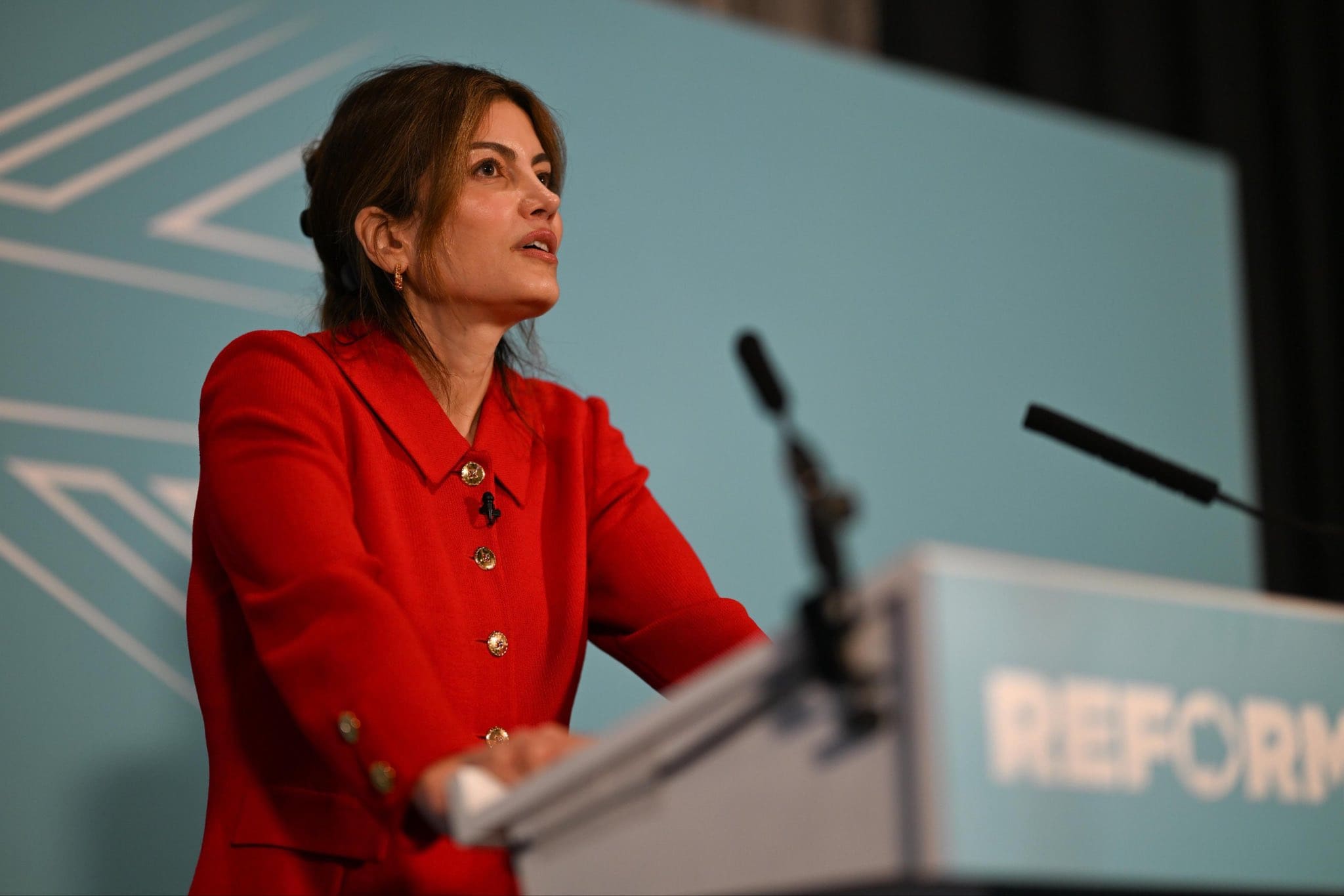
Nigel Farage’s carefully cultivated image as the comfort blanket of Britain’s angriest culture warriors hit an unexpected snag this week after Reform UK unveiled its prospective candidate for the 2028 London mayoral election: a 47-year-old Westminster councillor, former Crown prosecutor, born in Paddington, and a proud British Muslim. Within hours, Reform’s online ecosystem descended into open panic, exposing an uncomfortable truth about a movement that insists it is “not racist, just concerned”.
The candidate, who defected from the Conservatives in 2025, has been positioned by Farage as the party’s most serious electoral gamble yet. She pledges an uncompromising “war on crime”, more visible policing, the deportation of foreign criminals, and the scrapping of London’s Ultra Low Emission Zone. In short, a law-and-order platform lifted straight from the Reform playbook, wrapped in the language of toughness and national resolve. Farage himself declared her “the only candidate capable of defeating Sadiq Khan”, whose prospective third term is already under scrutiny amid ongoing debates over public safety and mixed crime statistics.
🚨 Farage is challenged on the truth about London.
— Best for Britain (@BestForBritain) January 7, 2026
"London's murder rate is the lowest in decades."
"Knife crime has fallen sharply over the past 10 years."
"The proportion of adults who have been victims of personal crime has fallen to the lowest level since 2002." pic.twitter.com/61pq5jyTSe
Yet if Farage expected his base to applaud the move as shrewd political strategy, he badly misjudged the mood. Across social media, comment sections, and Reform-friendly forums, the response was swift and revealing. For a party that claims to stand for “British values”, a significant chunk of its supporters appeared less concerned with policy than with identity. The problem, it seemed, was not what the candidate believes or proposes to do, but who she is.
The meltdown followed a familiar pattern. Some Reform voters accused Farage of “selling out”, others demanded to know why the party had not selected a “proper Reform candidate”, while a louder faction descended into barely disguised Islamophobia. That this woman’s record includes years as a Crown prosecutor, a background in local government, and a hard-line stance on crime appeared irrelevant to those who have been told for years that Britain’s problems can be traced to Muslims, migrants, and multiculturalism.
The irony is glaring. Reform UK has built its appeal on the promise of meritocracy and straight talking, judging people on what they do, not who they are. Yet the moment Farage applies that logic to a Muslim candidate who echoes many of his own positions, the party’s base fractures. The episode exposes a tension that has long simmered beneath Reform’s surface: is it really about policies, or is it about preserving a narrow idea of Britishness?
Farage, ever the political showman, attempted to frame the selection as a masterstroke. London, he argued, is a diverse city that cannot be won by culture-war theatrics alone. A candidate who can appeal to voters tired of crime, sceptical of ULEZ, and unconvinced by Khan’s record might just break Labour’s grip on City Hall. From a purely electoral standpoint, the logic is sound. The candidate’s background allows Reform to claim toughness on crime while disarming accusations that the party is hostile to minorities.
But that logic runs headlong into the preferences of Reform’s most vocal supporters, many of whom had pinned their hopes on a celebrity outsider, most notably former SAS soldier and television personality Ant Middleton. For them, politics is less about governance than symbolism, and the idea of a Muslim woman representing Reform in London was never going to fit the fantasy.
What makes the backlash particularly damaging is how neatly it undermines Reform’s claims of inclusivity. The party frequently insists it welcomes anyone who subscribes to its values. Yet the online fury suggests those values come with unspoken conditions. When supporters recoil at a “proud British Muslim” despite her hawkish stance on crime and deportations, it becomes difficult to maintain the fiction that Reform’s grievances are purely civic rather than cultural.
The candidate herself has responded calmly, emphasising her British roots, her career in public service, and her belief that crime and disorder disproportionately harm working-class communities. In doing so, she has inadvertently highlighted another contradiction: Reform voters often claim to speak for the working class, yet here they are rejecting a candidate whose rhetoric focuses squarely on law, order, and social cohesion.
For Farage, the episode is a gamble within a gamble. If he retreats, he confirms that Reform is hostage to its most intolerant voices. If he stands firm, he risks alienating a significant segment of his base that prefers grievance to governance. Either way, the mask has slipped. The selection has forced Reform UK and its supporters to confront an awkward question: can a party built on resentment cope with a candidate who refuses to fit its stereotypes?
As London looks ahead to 2028, one thing is already clear. Long before a single vote is cast, Farage’s choice has exposed the fault lines within his own movement. The meltdown is not about strategy or electability. It is about identity and the uncomfortable reality that for many Reform voters, the problem was never Sadiq Khan’s policies alone, but who they believe is allowed to represent Britain.







